| Description | Images | VII ZW 466VII Zw 466 is an empty ring galaxy about 650 million light-years away in the tail of Draco. It is 4.6 minutes north of NGC 4613, another type of ring galaxy. VII Zw 466 is what is called an "empty ring galaxy" since it consists only of a ring with no core. These are thought to be due to a direct hit by a high speed small but massive galaxy. Could it be one of the three galaxies also named VII Zw 467 to its east? Two are known to be at about the same redshift and likely distance. The third has no redshift data that I could find. There is a reddish object in the "empty" core of VII Zw 466 at the northwest edge. Could this be the core of the galaxy or is it the colliding galaxy? Its position is the one NED uses for VII Zw 466 itself rather than the center of the ring. This could indicate NED considers it at least part of the galaxy. For now, I'll say it is most likely the remains of the galaxy's core. Related Designations for VII ZW 466UGC 07683 NOTES01, VV 788, CGCG 315-043, CGCG 1229.8+6640, CGPG 1229.8+6640, SDSS J123204.38+662416.2, IRAS F12297+6641, WBL 412-002, SDSSCGB 02199.01, [RC2] A1229+66B, NSA 141588, PGC 041524, LEDA 5098209, SSTSL2 J123204.41+662416.2, [BFW2006] J188.01821+66.40458 , Mr19:[BFW2006] 02786 NED03, VII Zw 466:[MNP2009] RN, NGC 4515, UGC 07701, VCC 1475, CGCG 099-086, CGCG 1230.5+1632, MCG +03-32-065, 2MASX J12330494+1615557, 2MASXi J1233049+161555, 2MASS J12330495+1615558, SDSS J123304.96+161555.9, SDSS J123304.97+161555.9, GALEXASC J123305.02+161555.0 , GALEXMSC J123305.00+161554.6 , LDCE 0904 NED174, HDCE 0720 NED146, USGC U490 NED134, ACSVCS 045, ASK 651184.0, MAPS-NGP O_436_0184490, NSA 117864, PGC 041652, SSTSL2 J123304.97+161555.8, UZC J123305.0+161556, EVCC 0855, LGG 292:[G93] 038, [M98j] 174 NED152, [FCJ2006] 045, [PJC2008] 045, VII ZW 466, NGC4515, |
| VII Zw 770VII Zw 770 is a strange galaxy northeast of the head of Draco about 420 million light-years away by its redshift. NED classifies it as N galaxy? Those are defined as: "A galaxy with a small, bright, blue nucleus superposed on a much fainter red background. In terms of form, color, spectrum, redshift, and optical and radio variability, N galaxies are intermediate between quasars and Seyfert galaxies. The "N" designation comes from the Morgan classification." Related Designations for VII Zw 770CGCG 301-015, CGCG 1809.0+5822, CGPG 1809.0+5822, MCG +10-26-017, KAZ 188, 2MASX J18095033+5822435, 2MASS J18095037+5822437, GALEXASC J180950.73+582245.2 , PGC 061476, VII Zw 770, |
| VII Zw 941VII Zw 941 is another one Arp missed. It would fit with his category for spirals with high surface brightness companions on the arm except that arm is mostly missing. So it might also fit his one-armed spiral category. It is located in Cepheus 1.6 degrees west of NGC 188. Both are very red as are the other galaxies in the image. There is some blue extinction at this galactic latitude but not enough to account for all these red galaxies. Apparently, they just are red. The CGPG catalog note on this galaxy pair says: "...red pair of Sc (galaxies) with compact core and spherical compact." NED doesn't attempt to classify either. The main one does appear Sc with a compact core but I'm not sure about the companion. Hard to tell if that's its fuzz around it or remains of the missing spiral arm of the brighter galaxy. In any case, the pair is listed at a redshift that puts them about a half billion light years distant. NED has no redshift data for any other galaxy in the field, not even the companion. NED shows a correct position for the main galaxy and for the companion but it also lists a third entry with nothing at that position. Since the only note they have is identical in all three I assume it is referring to this pair. But I can't make any sense out of the third entry. Related Designations for VII Zw 941CGPG 2328.0+8518, IRAS 23272+8518, IRAS F23271+8519, AKARI J2327469+853533, PGC 071497, WN B2327.1+8518, VII Zw 941, |
| WBL071This field is in Andromeda less than a degree southeast of the far more famous NGC 891. CGCG 538-059/PGC 9101 is one Arp missed for his category spiral galaxies with a low surface brightness galaxy on an arm. Like many Arp put in this category the companion has no redshift data. In this case, the field is very poorly cataloged so it isn't even listed. While it appears likely it is a true companion I can't verify it. It is a very blue galaxy that could indicate interaction. The main galaxy has one cut off arm and one long one apparently drawn out by the companion. I moved it to the upper right of the image to pick up as much of the WBL 071 galaxy cluster as possible. Related Designations for WBL071WBL 071, HDCE 0137, NGC 0897, ESO 355- G 007, ESO 021858-3357.0, AM 0218-335, MCG -06-06-003, 2MASX J02210637-3343144, 2MASXi J0221061-334316, 2MASS J02210638-3343144, SGC 021858-3357.0, ESO-LV 3550070, 2dFGRS S516Z064, 6dF J0221064-334314, APMBGC 355+057-062, APMUKS(BJ) B021859.16-335645.4, GSC 7007 01137, PGC 008944, NGC 0906, UGC 01868, CGCG 539-014, CGCG 0222.1+4152, MCG +07-06-012, 2MASX J02251625+4205234, 2MASXi J0225162+420523, 2MASS J02251627+4205236, WBL 071-005, LDCE 0224 NED017, HDCE 0137 NED014, USGC U120 NED07, HFLLZOA F199, HFLLZOA G140.97-17.47, PGC 009188, UZC J022516.2+420523, NVSS J022516+420515, [MO2001] J022516.3+420521.7, NGC 0891:[S2014] 65, NGC 0909, UGC 01872, CGCG 539-016, CGCG 0222.2+4149, MCG +07-06-013, 2MASX J02252279+4202074, 2MASXi J0225227+420207, 2MASS J02252279+4202078, GALEXMSC J022522.36+420206.9 , WBL 071-007, LDCE 0224 NED018, HDCE 0137 NED015, USGC U120 NED05, HFLLZOA F204, HFLLZOA G141.01-17.52, NPM1G +41.0066, PGC 009197, UZC J022522.8+420208, [SLH97] B08, NGC 0891:[S2014] 69, NGC 0911, UGC 01878, CGCG 539-021, CGCG 0222.6+4145, MCG +07-06-016, 2MASX J02254239+4157225, 2MASXi J0225423+415722, 2MASS J02254238+4157226, WBL 071-011, LDCE 0224 NED021, HDCE 0137 NED018, USGC U120 NED08, HFLLZOA F207, HFLLZOA G141.10-17.57, PGC 009221, UZC J022542.4+415722, [SLH97] B10, NGC 0914, UGC 01887, CGCG 539-023, CGCG 0222.9+4155, MCG +07-06-017, 2MASX J02260519+4208386, 2MASXi J0226051+420838, 2MASS J02260515+4208385, IRAS 02229+4155, AKARI J0226050+420841, WBL 071-012, LDCE 0224 NED024, HDCE 0137 NED021, USGC U120 NED14, HFLLZOA F202, HFLLZOA G141.09-17.37, PGC 009253, UZC J022605.1+420838, NVSS J022605+420837, [MO2001] J022605.1+420837.1, WBL071, NGC897, NGC906, NGC909, NGC911, NGC914, |
| WBL073WBL 073 is a 5 galaxy group in Aries the ram. NED puts the group's distance at 430 million light-years. The 5 are PGC 009220, NGC 0915, PGC 009233, NGC 0916 and NGC 0919. Note that NGC 0915 is much closer than the other 4 by redshift. Other galaxies in the image are at the right distance and likely members of the same group as the 4 but don't make the WBL 73 group criteria. Apparently, distance isn't important. I couldn't find any criteria but that the galaxy is magnitude 15.7 or brighter and has an overdensity of 10^(4/3). The catalog is known as the Catalog of Nearby Poor Clusters of Galaxies. The authors are, White, Bliton, Bhavsar, Bornmann, Burns, Ledlow and Loken. Apparently, WBBBBLL was shortened to WBL. The catalog has 732 entries. I only have a few on my to-do list. Since the southern cutoff is 2 degrees south all are within my range. Related Designations for WBL073WBL 073, CGCG 483-038, CGCG 0222.7+2705, MCG +04-06-032, LCSB S0387O, 2MASX J02253953+2717429, 2MASXi J0225395+271743, 2MASS J02253954+2717433, 2MASS J02253958+2717437, GALEXASC J022539.56+271743.9 , IRAS F02227+2704, WBL 073-001, AGC 120234, NSA 170212, PGC 009220, NVSS J022538+271741, ALFALFA 2-233, HI J022538.8+271709, NGC 0915, KUG 0222+269, CGCG 483-041, CGCG 0222.8+2700, MCG +04-06-033, 2MASX J02254561+2713160, 2MASXi J0225455+271316, 2MASS J02254560+2713159, GALEXASC J022545.66+271316.3 , WBL 073-002, LDCE 0163 NED013, HDCE 0139 NED001, NPM1G +26.0063, NSA 131789, UZC J022545.5+271315, NVSS J022545+271323, ESO 409- G 028, ESO 001127-3059.3, MCG -05-01-044, 2MASS J00135896-3042346, GALEXASC J001358.92-304234.6 , ESO-LV 4090280, APMBGC 409-131+048, GSC 6990 00481, MRSS 409-009189, PGC 000923, NGC 0916, KUG 0222+270, CGCG 483-043, CGCG 0222.9+2701, MCG +04-06-034, 2MASX J02254763+2714330, 2MASXi J0225476+271433, 2MASS J02254764+2714335, GALEXASC J022547.78+271434.5 , WBL 073-004, LDCE 0163 NED014, HDCE 0139 NED002, USGC U119 NED04, NPM1G +27.0095, NSA 131791, PGC 009232, SSTSL2 J022547.65+271434.0, UZC J022547.7+271432, NGC 0919, UGC 01894, CGCG 483-049, CGCG 0223.4+2659, MCG +04-06-039, 2MFGC 01892, 2MASX J02261667+2712433, 2MASXi J0226166+271243, 2MASS J02261666+2712436, GALEXASC J022616.75+271240.2 , WBL 073-005, LDCE 0163 NED018, USGC U119 NED07, NSA 131823, PGC 009267, SSTSL2 J022616.66+271243.8, UZC J022616.7+271243, HI J022620.2+271315, WBL073, PGC009220, NGC0915, PGC00923, NGC0916, NGC0919, UVQS J022539.56+271743.4, |
| WBL130WBL 130 is a three galaxy group in the southeast corner of Lynx. NED lists it as being about 270 million light-years away and consisting of three galaxies. But what three? It would seem easy, the three obvious ones in my image. Problem is one of the three is a background galaxy. Redshift shows the lower left one, UGC 03679, to be an Sa galaxy that is 270 million light-years away. So far so good. The middle galaxy is CGCG 205-017, an Sb spiral at 267 million light-years. So that fits. But the upper right galaxy, UGC 03673, a SABcd spiral, is listed with a redshift that puts it 687 million light-years away. It is 2.5 times more distant yet only slightly smaller in angular size so must be about 2 times larger. So where is the third member of the group? Maybe this is it. The WBL catalog is labeled as being a catalog of nearby, poor, galaxy groups. It doesn't record distance so that was provided by NED from some other source. Nor does it list a diameter for the group. So it may be that it just records apparent groups whether they are all members of the same local group or not. But then we come to the flat galaxy at the bottom of my image. It is FGC 598, an Sd spiral that has a redshift that puts it 272 million light-years away. So it certainly is related to the lower two galaxies above. Also, NED lists a note about it under those two galaxies as well as under FGC 598. So that points to it being the third member. Are any of the other galaxies in the image also at about 270 million light-years? Darned if I know. These are the only 4 galaxies in the image on which NED has any redshift data. The few others it lists are all from the 2MASS survey and don't even include magnitude estimates since the survey isn't at visual light frequencies but those sort of between IR and radio. Related Designations for WBL130WBL 130, UGC 03679, CGCG 205-018, CGCG 0703.8+4452, MCG +07-15-007, 2MASX J07072811+4447236, 2MASXi J0707281+444723, 2MASS J07072809+4447241, 2MASS J07072824+4447219, GALEXASC J070728.06+444724.4 , IRAS 07038+4452, IRAS F07038+4452, AKARI J0707280+444728, KTG 13C, WBL 130-003, LDCE 0479 NED015, HDCE 0422 NED003, PGC 020190, UZC J070728.2+444725, NVSS J070728+444723, [MGD2014] 0703.8+4452, UGC 03673, CGCG 205-016, CGCG 0703.3+4455, MCG +07-15-005, 2MASX J07070077+4450588, 2MASXi J0707007+445058, 2MASS J07070077+4450589, KTG 13A, WBL 130-001, PGC 020172, WBL130, UGC03679, UGC03673, |
| WBL179WBL 179 is in a field jam-packed with galaxies. The 7 brightest make up the WBL 179 group. 5 of which are about 400 million light-years distant and 2 are half that distance. This appears to be part of a much larger cluster, ZwCl 0820.6+0436 which is just over a degree in diameter and contains 163 galaxies. While NED puts it at about 400 million light-years distant the vast majority of the galaxies in my image and out to a larger area cover a wide range of distances. Many out to 1.2 billion light-years. NED lists a couple clusters at that distance, WHL J082258.9+041756 with 29 members and SDSS-C4-DR3 1283 with 23. Their positions differ by only 2" of arc so are likely referring to the same group, just defined slightly differently. Many other lesser groups are listed at NED that likely are subgroups of these. As usual, I picked up a few very distant galaxies but most fall within 1.3 billion light-years. The result is one of the densest annotated images I've made as I included all NED had a redshift value for and were bright enough to survive JPG compression. Related Designations for WBL179WBL 179, IC 0504, UGC 04372, CGCG 032-008, CGCG 0820.0+0425, MCG +01-22-005, 2MASX J08224116+0415443, 2MASS J08224119+0415449, SDSS J082241.19+041544.7, WBL 179-001, LDCE 0567 NED004, HDCE 0481 NED004, USGC U176 NED04, NFP J082241.2+041545, NSA 135037, PGC 023495, UZC J082241.2+041544, NVSS J082241+041544, [DZ2015] 564-01, IC 0505, UGC 04382, CGCG 032-015, CGCG 0820.7+0432, MCG +01-22-008, 2MASX J08232169+0422207, 2MASS J08232166+0422209, SDSS J082321.66+042220.8, SDSS J082321.66+042220.9, SDSS J082321.67+042220.9, WBL 179-006, USGC U175 NED03, LQAC 125+004 006, ASK 258496.0, NFP J082321.7+042221, NSA 046723, PGC 023528, SSTSL2 J082321.67+042221.1, UZC J082321.7+042221, UZC-CG 072 NED03, NVSS J082321+042221, RX J0823.3+0422, 1RXS J082321.4+042231, RX J0823.3+0422:[BEV98] 002, ZwCl 0820.6+0436:[CAE99], [BFW2006] J125.84028+04.37247 , Mr18:[BFW2006] 07320 NED07, Mr19:[BFW2006] 14839 NED04, Mr20:[BFW2006] 24347 NED04, [TTL2012] 447193, IC 0506, CGCG 032-016, CGCG 0820.8+0428, MCG +01-22-009, 2MASX J08233072+0417587, 2MASS J08233072+0417580, SDSS J082330.72+041758.2, GALEXASC J082330.67+041800.3 , WBL 179-007, LDCE 0570 NED003, HDCE 0483 NED003, USGC U175 NED02, ASK 258494.0, NFP J082330.7+041758, NPM1G +04.0158, NSA 046722, PGC 023536, UZC J082330.7+041757, [BFW2006] J125.87803+04.29950 , Mr18:[BFW2006] 07320 NED11, Mr19:[BFW2006] 14838 NED04, Mr20:[BFW2006] 24342 NED03, [TTL2012] 447191, [DZ2015] 568-01, WBL179, IC0504, IC0505, IC0506, |
| WBL360WBL 360 is a group of galaxies about 390 million light-years from us in the southwest corner of Virgo. There's a second group at 600 million light-years. One in this second group seems made up of two likely interacting galaxies. NED's position points to the gap between the two. These are below the main galaxies. The label NSA 140313 has two lines, one to each galaxy. They appear to be dwarf galaxies. Related Designations for WBL360WBL 360, WP 17, MKW 03, PCC N56-392, Mr18:[BFW2006] 00818, Mr19:[BFW2006] 01540, WBL360, |
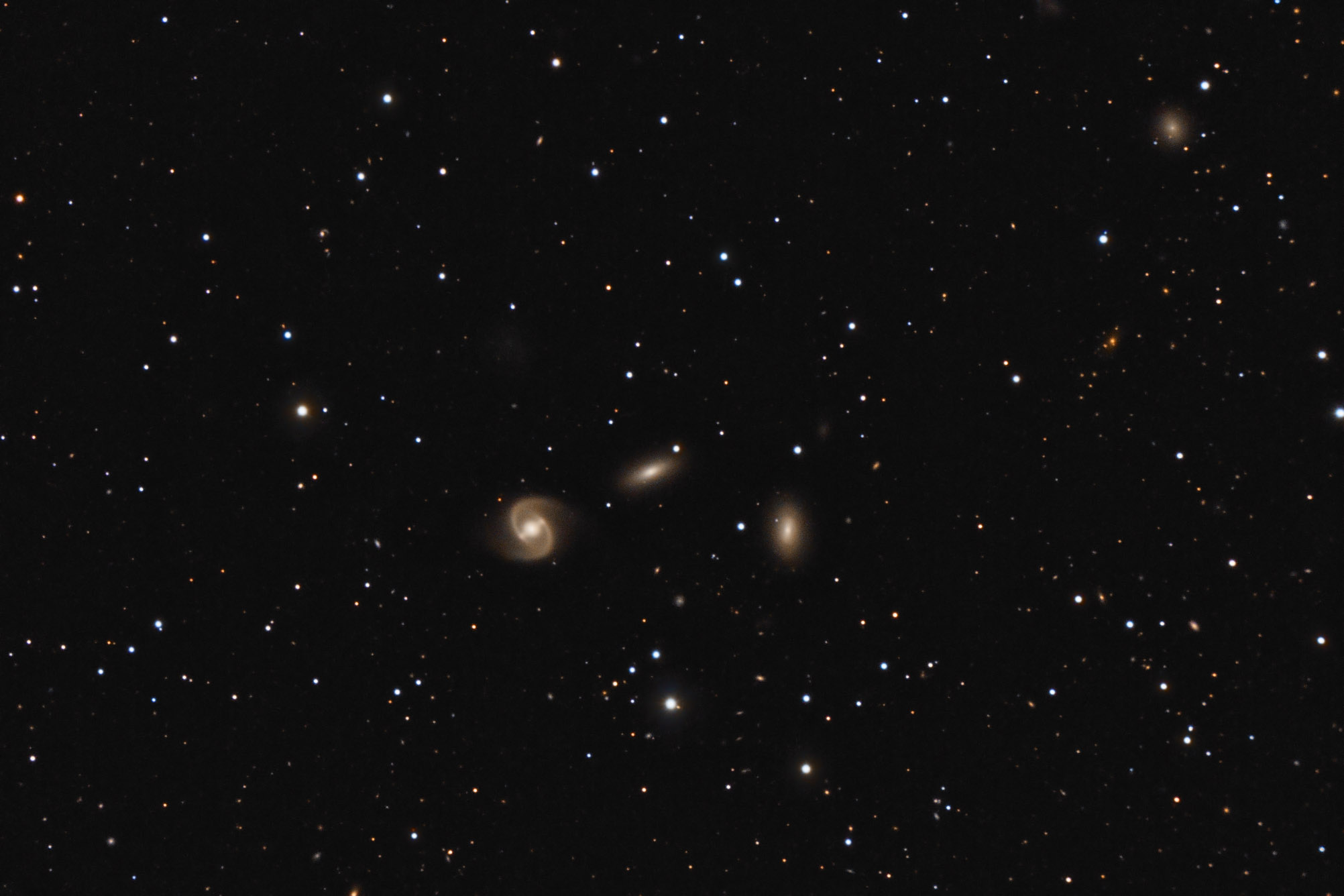
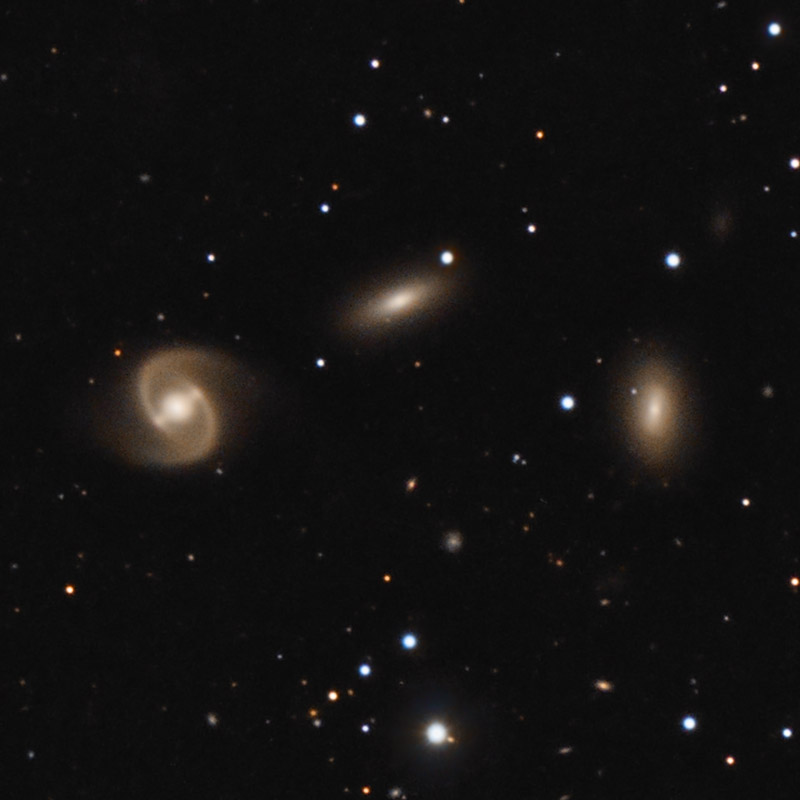
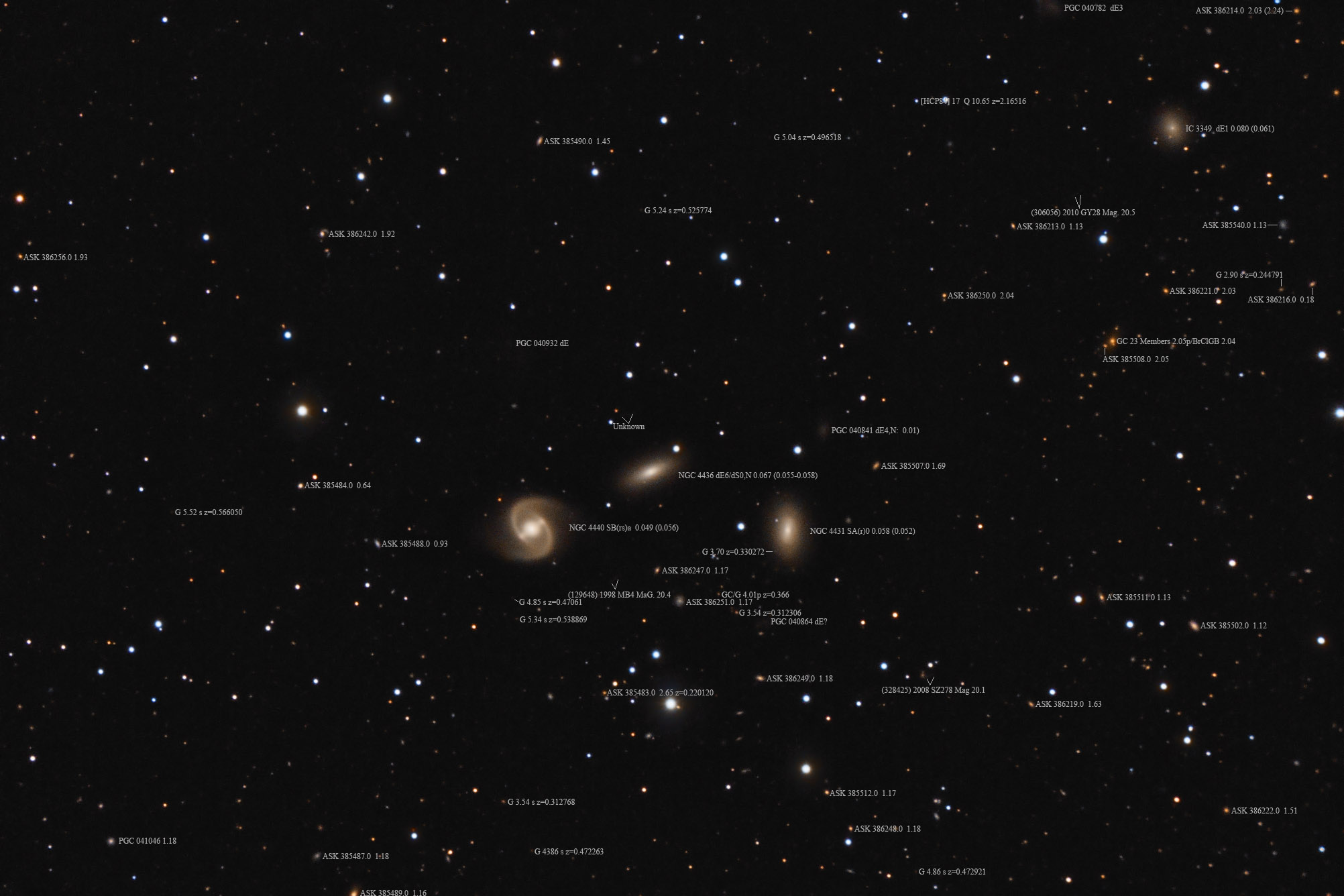
| WBL409WBL 409 is a group of three galaxies about 58 million light-years distant in Virgo not far from its major Virgo Cluster galaxies like M84, M86 and M87. These three are red and dead galaxies with little detail to be seen in them, not even the spiral NGC 4440 has any fine detail being mostly a fuzzy red spiral galaxy. IC 3349 is also likely a member of the group though its redshift puts it 80 million light-years out a non-redshift measurement puts it 61 million light-years. The redshift of Virgo cluster members is very wide-ranging and undependable as a distance measure. The three NGC galaxies were discovered by William Herschel on April 17, 1784. For some reason, NGC 4436 is classified as a dwarf elliptical or dwarf S0 galaxy even though it isn't all the much smaller than the other two. Assuming the 58 million light-year distance I measure NGC 4431 at 30,000 light-years, NGC 4436 at 29,000 light-years and NGC 4440 as being 44,000 light-years across None are in either H400 observing program. IC 3349 was discovered over 120 years later by Royal Frost on May 10, 1904. Assuming it too is about 58 million light-years distant I measure it at 16,600 light-years in size. It does deserve its dwarf label. Related Designations for WBL409WBL 409, NGC 4431, UGC 07569, VCC 1010, VPC 0532, CGCG 070-094, CGCG 1224.9+1234, MCG +02-32-062, 2MASX J12272735+1217252, 2MASXi J1227268+121725, 2MASS J12272738+1217248, SDSS J122727.37+121725.0, SDSS J122727.38+121725.0, GALEXMSC J122727.41+121722.2 , WBL 409-001, LDCE 0904 NED122, HDCE 0720 NED098, USGC U490 NED214, HOLM 408C, MAPS-NGP O_496_0063604, NSA 141405, PGC 040852, UZC J122727.4+121725, EVCC 2112, LGG 292:[G93] 006, [M98j] 174 NED107, [RG2008] J186.86409+12.29029 , v2MCG 50:[DMP2012] 2, RSCG 56:[WBJ2013] B, NGC 4436, UGC 07573, VCC 1036, VPC 0544, CGCG 070-096, CGCG 1225.2+1235, MCG +02-32-066, LCSB L0515O, 2MASX J12274122+1218574, 2MASS J12274122+1218572, SDSS J122741.23+121857.2, SDSS J122741.24+121857.2, GALEXASC J122741.38+121856.7 , GALEXMSC J122741.19+121857.4 , WBL 409-002, LDCE 0904 NED125, HDCE 0720 NED101, USGC U490 NED210, ASK 386246.0, HOLM 408A, MAPS-NGP O_496_0063678, NSA 066749, PGC 040903, UZC J122741.3+121857, EVCC 0670, LGG 289:[G93] 010, [RG2008] J186.92183+12.31590 , v2MCG 50:[DMP2012] 3, RSCG 56:[WBJ2013] C, NGC 4440, UGC 07581, VCC 1047, VPC 0560, CGCG 070-099, CGCG 1225.4+1234, MCG +02-32-067, 2MASX J12275357+1217354, 2MASXi J1227535+121735, 2MASS J12275354+1217358, SDSS J122753.56+121735.8, GALEXASC J122753.48+121735.7 , GALEXMSC J122753.48+121734.8 , WBL 409-003, LDCE 0904 NED127, HDCE 0720 NED103, USGC U490 NED208, HOLM 408B, [BEC2010] HRS 164, MAPS-NGP O_496_0063741, NSA 161820, PGC 040927, UZC J122753.6+121736, EVCC 2121, LGG 292:[G93] 007, [M98j] 174 NED110, [RG2008] J186.97320+12.29328 , v2MCG 50:[DMP2012] 1, RSCG 56:[WBJ2013] A, IC 3349, VCC 0940, VPC 0496, CGCG 070-081, CGCG 1224.2+1244, LCSB F0034O, 2MASX J12264704+1227147, SDSS J122647.06+122714.3, SDSS J122647.07+122714.3, GALEXASC J122647.15+122718.0 , GALEXMSC J122647.01+122716.1 , USGC U490 NED231, [R83] 12deg043, AGC 220591, ASK 385509.0, MAPS-NGP O_496_0054940, NSA 066624, PGC 040744, UZC J122647.1+122714, EVCC 0622, LGG 289:[G93] 075, [RG2008] J186.69610+12.45398 , RSCG 56:[WBJ2013] D, WBL409, NGC4431, NGC4436, NGC4440, IC3349, |
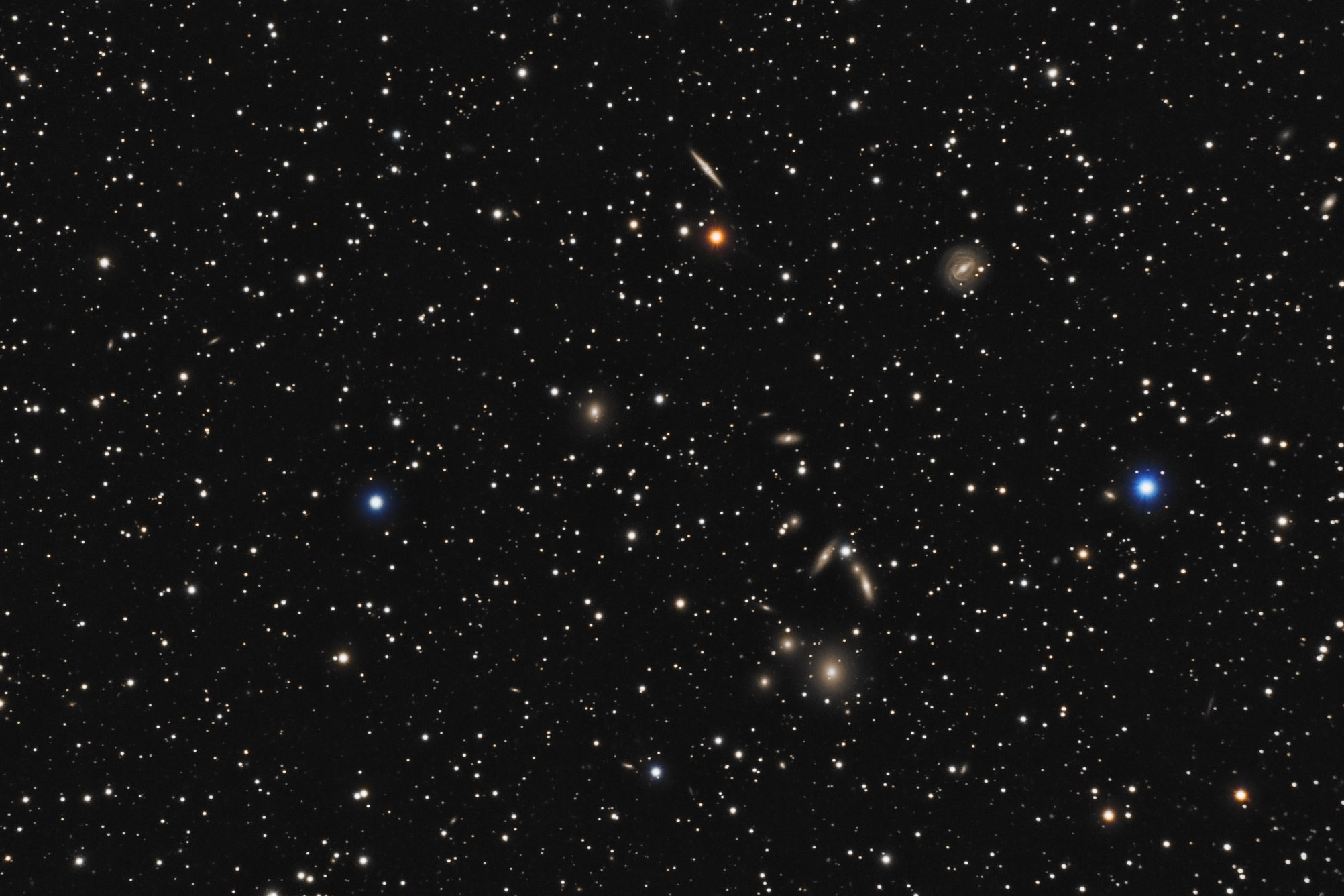
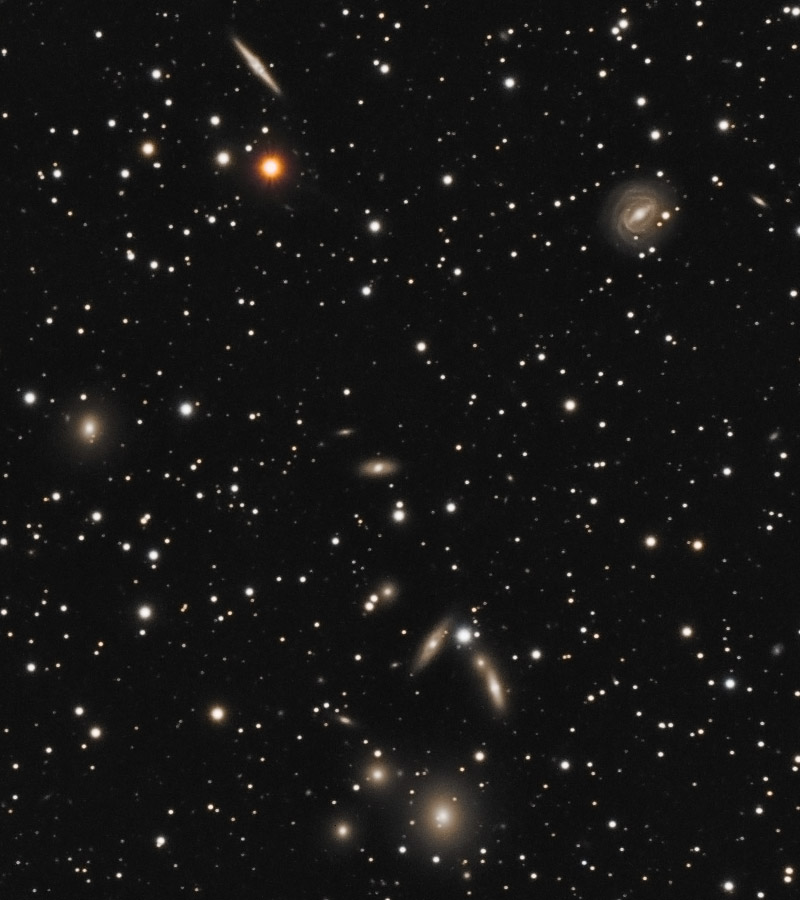
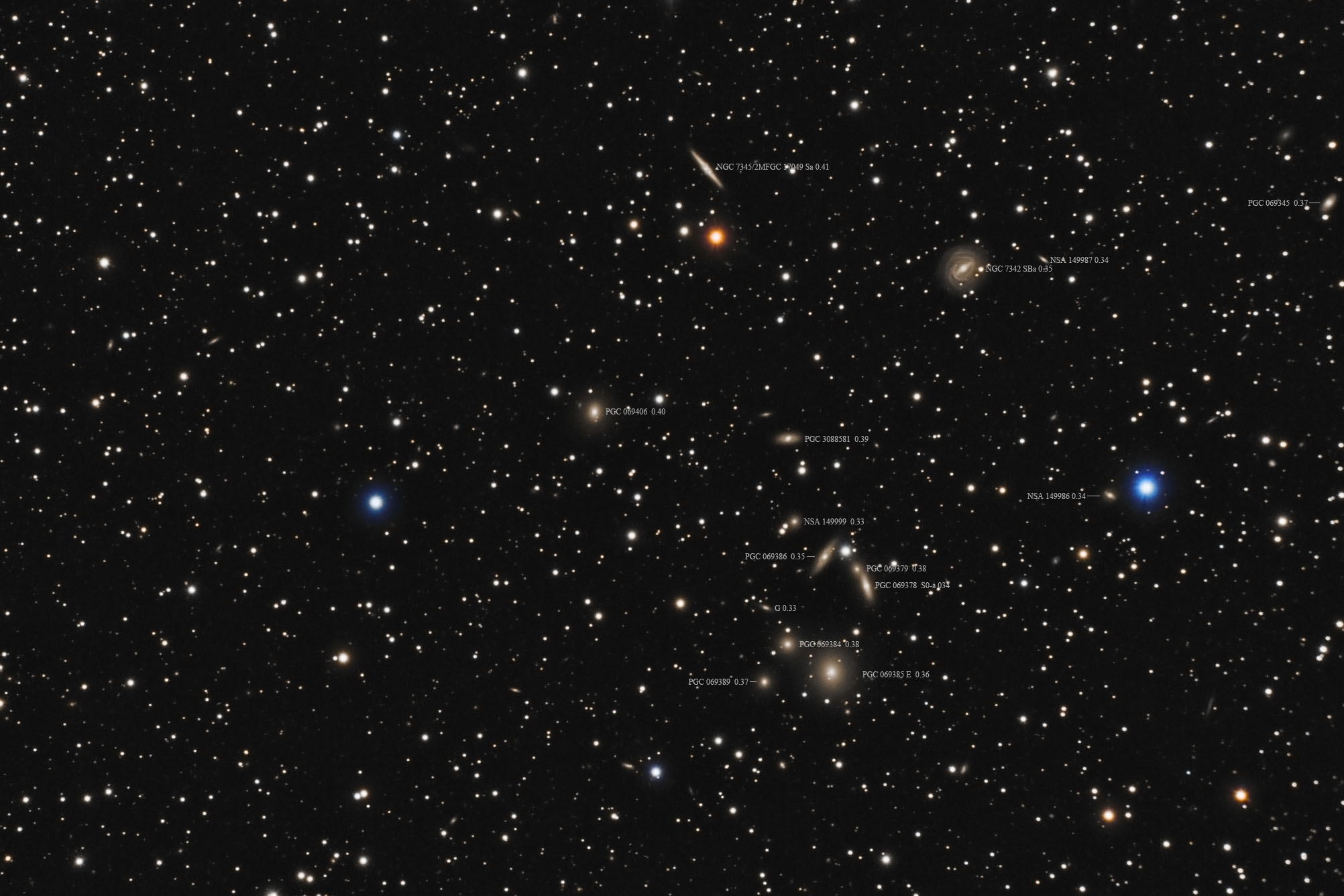
| WBL685This galaxy group is located in northern Pegasus at the border with Lacerta and about 1 degree north of the far more famous Deer Lick Galaxy, NGC 7331. The 6 brightest members are known as the UGC 12127 group and WBL 685. But the group is much larger than this. It is part of the B2 2236+35:[MLO2002] CLUSTER which in turn is part of the Zwicky cluster 2231.2+3732. Each designation has a slightly different distance estimate but it's in the 350 to 400 million light-year range depending on which galaxies redshift you use or average them to about 375 million light-years. Related Designations for WBL685WBL 685, NGC 7342, UGC 12126, CGCG 514-076, CGCG 2235.9+3515, MCG +06-49-054, 2MASX J22381316+3529559, 2MASXi J2238131+352955, 2MASS J22381312+3529557, SDSS J223813.11+352955.7, WBL 685-001, LDCE 1532 NED001, HDCE 1199 NED001, USGC U820 NED08, MAPS-PP O_0778_0859439, NSA 149990, PGC 069374, UZC J223813.2+352956, UZC-CG 280 NED01, [MLO2002] J223813.2+352956, B2 2236+35:[MLO2002] NED06, NGC 7345, UGC 12130, CGCG 514-083, CGCG 2236.4+3517, MCG +06-49-064, 2MFGC 17049, 2MASX J22384486+3532259, 2MASXi J2238448+353225, 2MASS J22384484+3532260, 2MASS J22384499+3532288, WBL 685-005, LDCE 1530 NED005, HDCE 1200 NED002, USGC U820 NED02, MAPS-PP O_0778_0826778, NSA 150004, PGC 069401, UZC J223844.9+353226, UZC-CG 280 NED05, [MLO2002] J223844.7+353225, B2 2236+35:[MLO2002] NED15, WBL685, NGC7342, NGC7345, |
|