Whiting 1 isn't much of a globular cluster. It certainly won't win any photogenic awards but it is quite interesting. Most globular clusters are about 10 billion years old, having formed with the galaxy 10 billion years ago. Whiting 1, however, is much younger, probably about 6.5 billion years old. This is possible because it likely didn't form in our galaxy. In fact, it is part of what is known as the Sagittarius Dwarf Elliptical Galaxy (SagDEG) also known as the Sagittarius Dwarf Spheroidal Galaxy. This galaxy, or what's left of it, was discovered in 1994. It is now mostly a stream of stars representing what was this galaxy before our galaxy began digesting it. In 2002 the star group in my image was discovered, three years later it was shown to be what's left of a globular cluster that likely belonged to the SagDEG.
It is about 112,500 light years from our galaxy's core and 98,100 light-years from earth according to Hartmut Frommert of SEDS. http://spider.seds.org/spider/MWGC/whiting1.html A paper on this cluster with slightly different values is at http://arxiv.org/abs/astro-ph/0702253 .
Always looking to press the limits of my system I had to go after this cluster in central Cetus. It turns out to be not all that difficult to resolve, at least the brighter stars. I assume the bright stars seen against the cluster are just field stars in our galaxy and not members of the cluster. One of the fainter stars turns out to be a galaxy. It is pointed out in the annotated image. NED has little on most galaxies in the field. I've identified all with redshift information and a few without and only known by coordinates. Quite a few more are listed in NED but since they are only known by their positions and have no redshift data I didn't try to list but a very few of them.
Galaxies labeled KISSR are from the Kitt Peak National Observatory International Spectroscopic Survey Red spectral region. Those with an x are candidates according to NED.
14" LX200R @ f/10, L=4x10', RGB=2x10', STL-11000XM, Paramount ME | 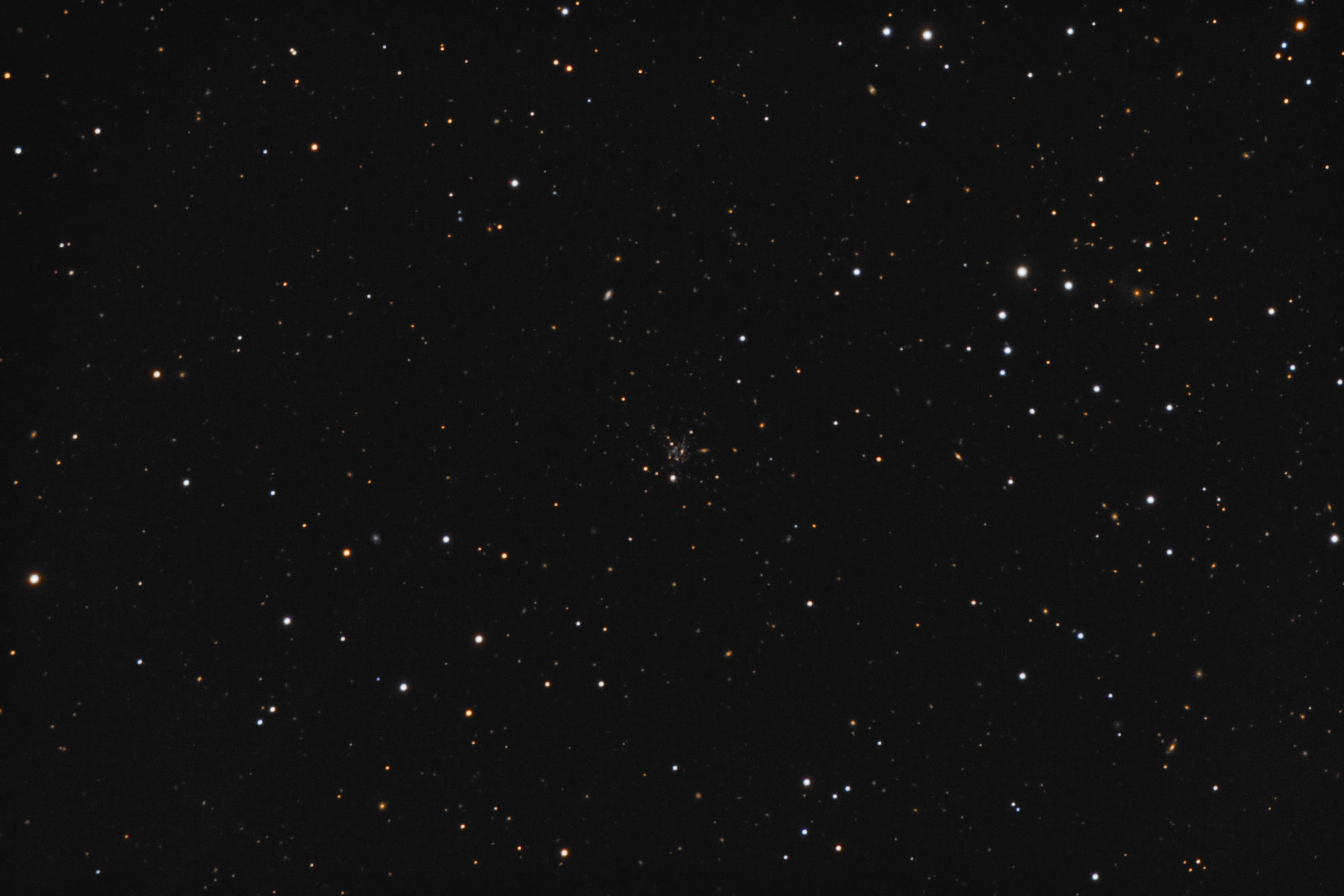
WHITING1L5X10RGB2X10.JPG
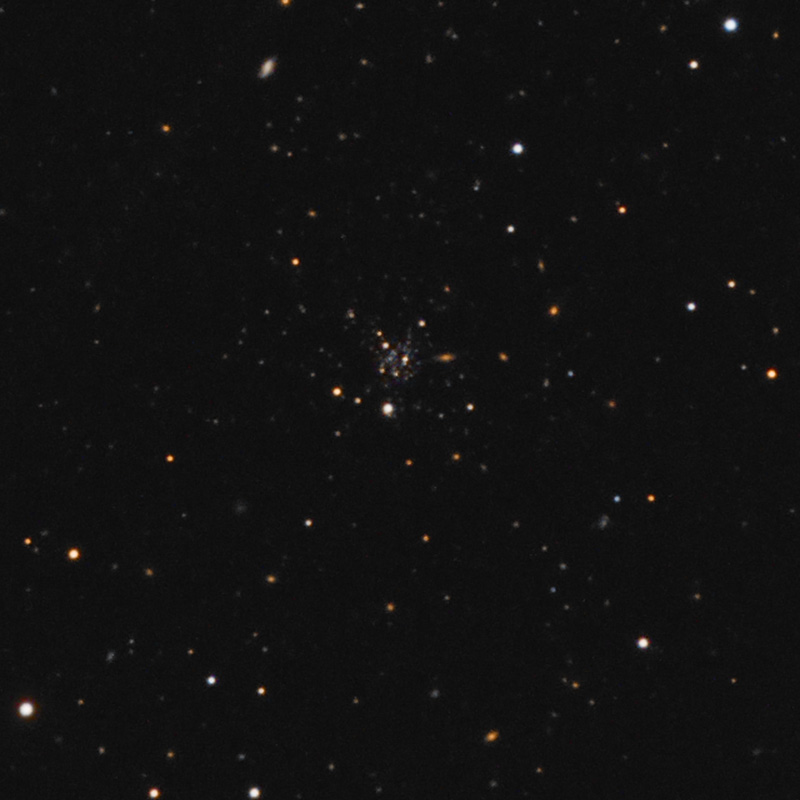
WHITING1L5X10RGB2X10CROP125.JPG
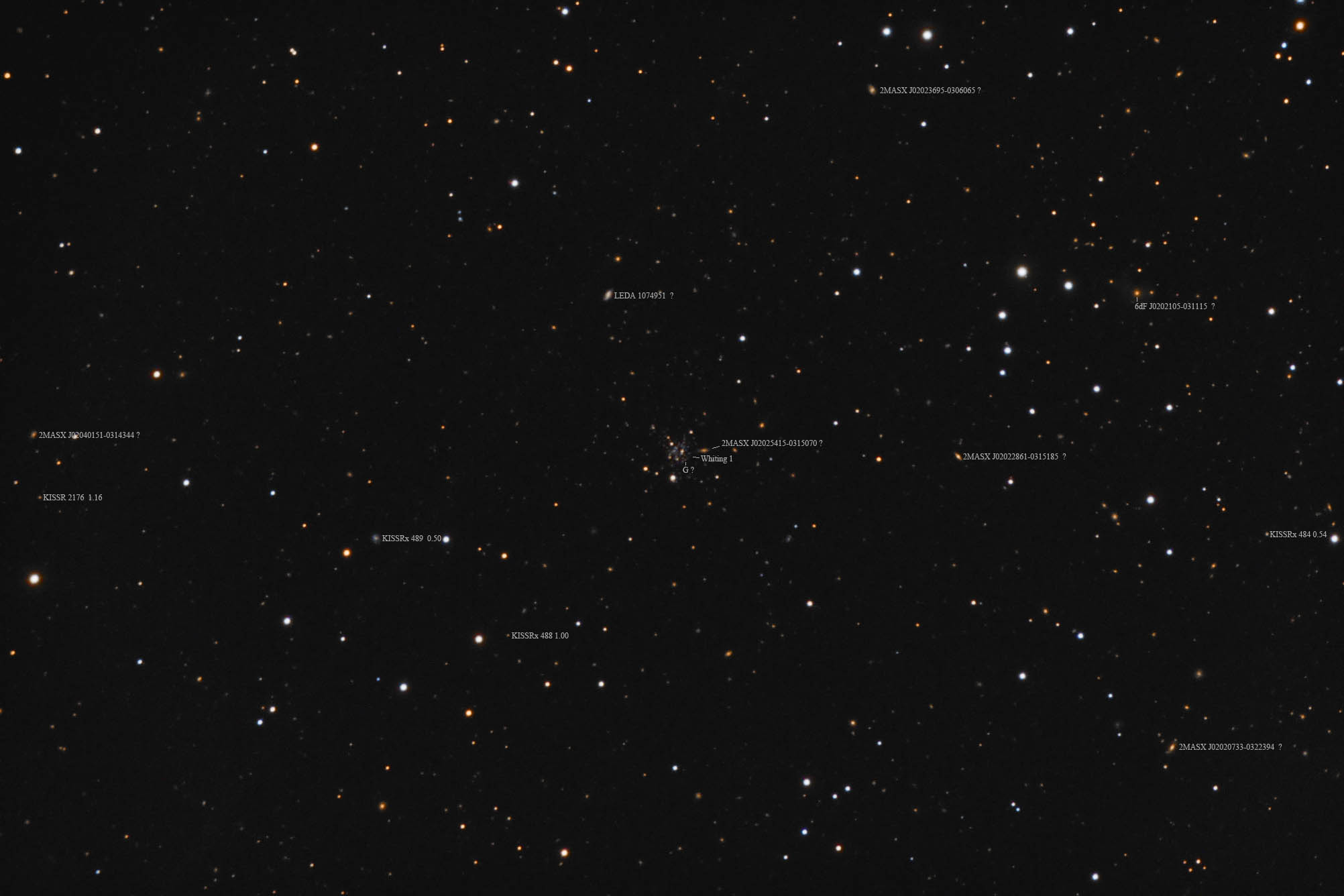
WHITING1L5X10RGB2X10ID.JPG
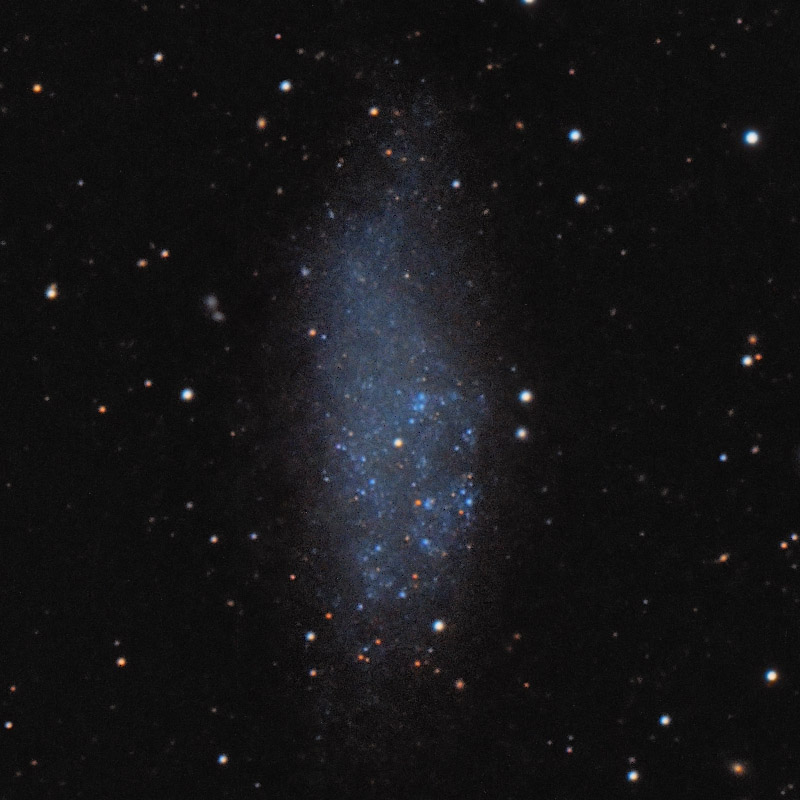
| The Wolf-Lundmark-Melotte galaxy was discovered by Max Wolf as a nebula in 1909. At that time galaxies weren't really recognized. It wasn't until 1926 that Knut Lundmark and P.J. Melotte determined it was a galaxy. It is now recognized as a distant member of the local group being some 3.4 million light-years distant by some sources. NED, using 26 measurements mostly using Tip of the Red Giant Branch and Cepheid variable methods gives a median value of 3.2 million light-years. Others sources say 3.0 million light-years. All agree it is more distant than M31 but like M31 it is moving in our direction and is thus blue shifted. As a member of the local group, it is quite isolated with its nearest neighbor being over 1 million light-years away. That one is the rather well known IC 1613. I do need to retake that one as my data for it from 2007 is awful, especially the color data. The WLM galaxy is located in southwestern Cetus just below my normal 15 degree south declination limit. Fortunately, I had an exceptional night so was able to capture it though not with the detail I'd get if it was up out of the gunk.
The WLM galaxy is classified as IB(s)m at NED. Assuming the 3.4 million light-year distance it is some 10,500 light-years long and 6,200 light-years wide using the extent seen in my raw FITS files. Its actual size is likely larger as the faint halo is hidden by my low transparency this low over the lake even on a good night.
While there are many other galaxies in my image only one 2MFGC 00035 in the upper left quadrant has any redshift data. That puts this rather flat, edge-on galaxy some 460 million light-years distant. NED makes no attempt to classify it or any other galaxy in the image.
If WLM was higher in the sky I think I'd have been able to resolve many more stars than I did. I live too far north to do this one justice. The galaxy goes by other designations such as DDO 221, PGC 143, UGCA 444 and MCG -03-01-015 to name a few.
Adding to the losses is the fact I left the low-level floor lights on in the observatory. Why they were on I don't remember. I see a skewing of my normal color levels toward red due to this. Also, the luminance channel has a somewhat higher background than normal but neither was a significant issue. It being so low did far more harm. Still, I wish I'd not left those floor lights on. The other object taken that night, NGC 784 also has this issue. Other than adding a slight, easily handled gradient, I don't think the lights hurt it.
I should note that's a star in our galaxy at about the center of the galaxy, not its core.
14" LX200R @ f/10, L=4x10' RGB=2x10', STL-11000XM, Paramount ME Related Designations for WLMWolf-Lundmark-Melotte, UGCA 444, DDO 221, MCG -03-01-015, 2MASS J00015816-1527397, CGS 612, [RC2] A2359-15, [RC1] A2359, HIPASS J0001-15, PGC 000143, SSTSL2 J000158.16-152739.6, 11HUGS 002, [SPB93] 276, WLM, | 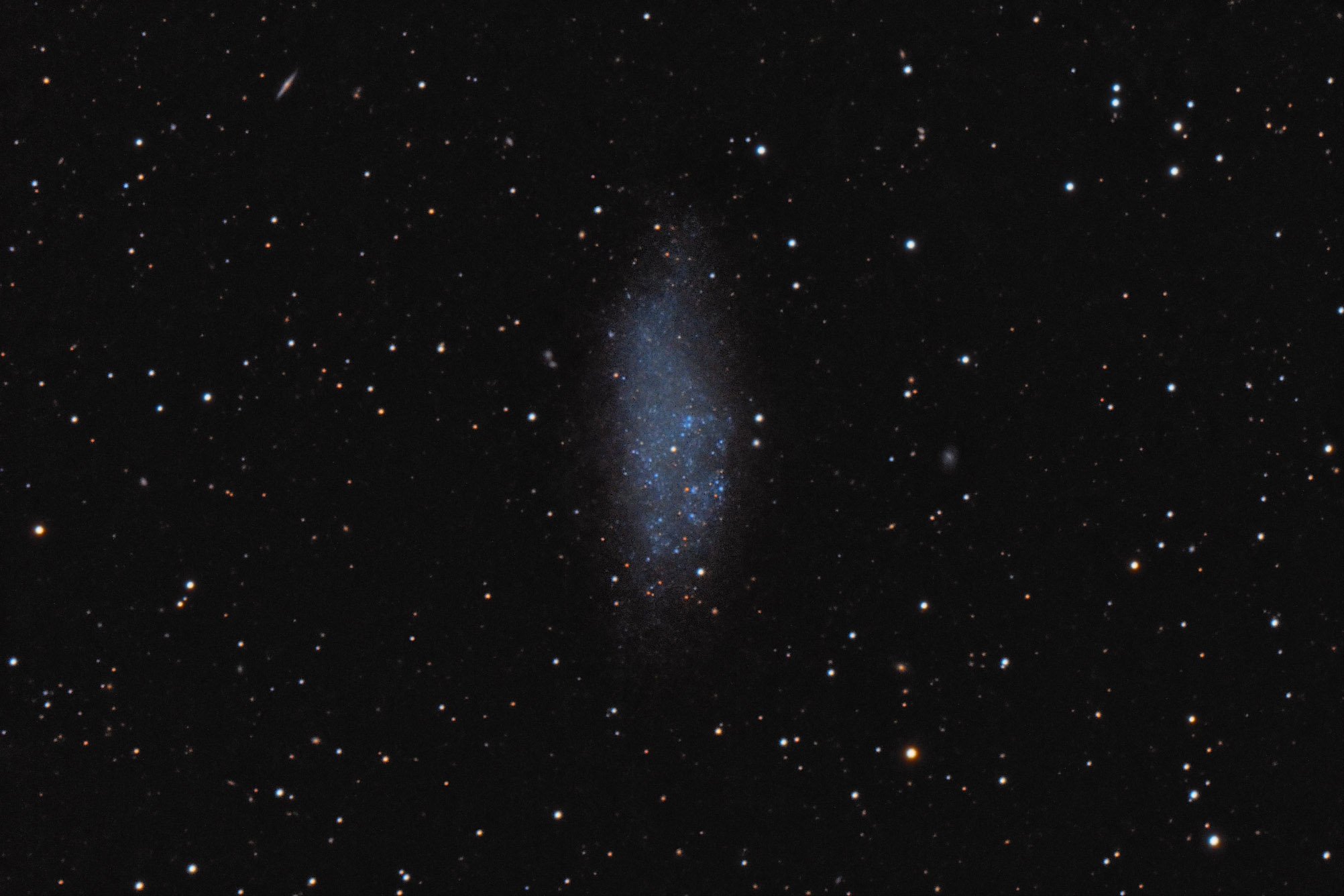
WLM_L4X10RGB2X10.JPG
WLM_L4X10RGB2X10CROP.JPG
|