| Description | Images | NGC7769this is a group of interacting galaxies, NGC 7769, NGC 7770, NGC 7771 and NGC 7771A. They are about 170 millions light years away. NGC 7769 is the face on spiral to the upper right. The other big galaxy is NGC 7771. It shows more tidal distortions than NGC 7769. These are likely caused by NGC 7770 just below it. It is a double nucleus S0 galaxy. It could be the result of the merger of two such galaxies whose cores haven't yet merged. I found one paper in which radio HI emissions were used to try and determine this but there was too much noise in the data and they couldn't come to a conclusion. Note how the tidal arm of 7770 that goes down, ends very suddenly. The bright arm at the top left of NGC 7771 also ends abruptly. Very odd. The blue galaxy between NGC 7769 and 7771 is NGC 7771A. It appears that the interaction has triggered a lot of star formation in it. There are a few dwarf members of this group but they are only easily seen when I leave the data very noisy so I won't try and point them out. Toward the top is the more distant Seyfert galaxy MCG+03-60-031 which is 550 million light years away. Oddly the rather bright and large galaxy below it and above the NGC 7769-71 group is not in either the SIMBAD or NED database. I've determined it is PGC 214992 but that's all I know about it. The PGC catalog has been replaced with LEDA using the same numbers yet it isn't in the LEDA database that I can find. NGC 7771A is LEDA 214993 but there is no LEDA 214992. It apparently isn't a member of the group. A supernova was seen in NGC 7771 in 2003. Not unusual for tidally interacting galaxies. The interaction triggers star formation which tends to favor massive, short lived stars. Though this galaxy looks old by its reddish color. Related Designations for NGC7769NGC 7769, NGC 7771 W, NGC 7771W, UGC 12808, MRK 9005, KUG 2348+198A, CGCG 455-054, CGCG 2348.5+1952, MCG +03-60-030, KAZ 346, 2MASX J23510396+2009014, 2MASXi J2351039+200901, 2MASS J23510397+2009013, GALEXASC J235103.91+200901.9 , GALEXMSC J235103.89+200901.4 , IRAS 23485+1952, IRAS F23485+1952, AKARI J2351043+200859, KTG 82A, KPG 592A, WBL 726-001, LDCE 1598 NED001, HDCE 1255 NED001, USGC U857 NED04, HOLM 820C, NSA 152769, PGC 072615, SSTSL2 J235103.96+200901.5, UZC J235103.9+200900, UZC-CG 290 NED01, UZC-BGP 89A, NVSS J235104+200900, 2XMM J235103.8+200902, 2XMMp J235103.8+200902, LGG 483:[G93] 001, [M98j] 266 NED01, [WZX98] 23488+1949C, NGC 7771:[KCP2006] 3, [TCW2007] 199, NGC 7770, NGC 7771 S, UGC 12813, KUG 2348+198B, CGCG 455-057, CGCG 2348.8+1949, MCG +03-60-034, KAZ 347, 2MASX J23512260+2005485, 2MASXi J2351226+200548, 2MASS J23512261+2005484, KTG 82B, WBL 726-003, LDCE 1598 NED002, HDCE 1255 NED002, USGC U857 NED02, HOLM 820B, NPM1G +19.0594, NSA 152789, PGC 072635, UZC J235122.6+200547, UZC-CG 290 NED02, 2XMM J235122.6+200548, 2XMMp J235122.6+200547, LGG 483:[G93] 004, [WZX98] 23488+1949B, [WGB2006] 234830+19520_d, NGC 7771:[KCP2006] 1, NGC 7771, NGC 7771 N, NGC 7771N, UGC 12815, MRK 9006, KUG 2348+198C, CGCG 455-058, CGCG 2348.9+1950, MCG +03-60-035, KAZ 348, 2MASX J23512488+2006425, 2MASXi J2351248+200642, 2MASS J23512487+2006424, SDSS J235125.02+200641.9, GALEXASC J235124.82+200641.5 , GALEXMSC J235124.84+200641.3 , IRAS 23488+1949, IRAS F23488+1949, AKARI J2351246+200640, ISOSS J23515+2006, KTG 82C, KPG 592B, WBL 726-004, LDCE 1598 NED003, HDCE 1255 NED003, USGC U857 NED01, HOLM 820A, NSA 152791, PGC 072638, SSTSL2 J235124.79+200641.4, UZC J235124.6+200642, UZC-CG 290 NED03, UZC-BGP 89B, MG3 J235128+2006, 87GB 234852.3+194951, 87GB[BWE91] 2348+1949, [WB92] 2348+1949, NVSS J235124+200641, VLSS J2351.4+2006, TXS 2348+198, 2XMM J235124.8+200642, 2XMMp J235124.8+200642, IPC 23488+1950, LGG 483:[G93] 002, [M98j] 266 NED02, [WZX98] 23488+1949A, [SLK2004] 1916, [RHM2006] LIRGs 007, [WGB2006] 234830+19520_e, NGC 7771A, GALEXASC J235113.13+200612.7 , GALEXMSC J235113.12+200612.3 , NSA 152776, LEDA 214993, NGC 7771:[KCP2006] 2, NGC7769, NGC7770, NGC7771, NGC7771A, UVQS J235122.60+200548.3, |
| NGC7778This NGC group in Pisces under the Great Square of Pegasus is located about 220 million light-years distant. All but NGC 7780 are members of the WBL 727 galaxy group. All 5 are members of the USGC U860 group. That group has two other members out of my frame, one to the south the other to the northwest. Related Designations for NGC7778NGC 7778, UGC 12827, ARK 586, CGCG 407-069, CGCG 2350.7+0736, MCG +01-60-043, 2MASX J23531967+0752152, 2MASS J23531966+0752154, GALEXASC J235319.78+075217.3 , WBL 727-001, LDCE 1600 NED001, HDCE 1258 NED001, USGC U860 NED05, NSA 152860, PGC 072756, UZC J235319.6+075215, [M98j] 267 NED01, v2MCG 85:[DMP2012] 3, NGC 7779, UGC 12831, CGCG 407-070, CGCG 2350.9+0736, MCG +01-60-045, 2MASX J23532680+0752322, 2MASS J23532678+0752323, WBL 727-002, LDCE 1600 NED002, HDCE 1258 NED002, USGC U860 NED04, NSA 152862, PGC 072770, UZC J235326.8+075232, [M98j] 267 NED02, v2MCG 85:[DMP2012] 2, NGC 7780, UGC 12833, CGCG 407-071, CGCG 2351.0+0750, MCG +01-60-046, 2MASX J23533218+0807052, 2MASS J23533216+0807052, SDSS J235332.15+080705.0, SDSS J235332.15+080705.1, GALEXASC J235332.19+080707.5 , IRAS 23509+0750, IRAS F23509+0750, LDCE 1600 NED003, HDCE 1258 NED003, USGC U860 NED03, NSA 152865, PGC 072775, UZC J235332.2+080705, v2MCG 85:[DMP2012] 4, NGC 7781, CGCG 407-072, CGCG 2351.2+0735, MCG +01-60-047, 2MFGC 17940, 2MASX J23534595+0751377, 2MASS J23534600+0751378, GALEXASC J235345.79+075138.8 , WBL 727-003, LDCE 1600 NED004, HDCE 1258 NED004, USGC U860 NED02, NSA 152870, PGC 072785, UZC J235346.0+075138, v2MCG 85:[DMP2012] 5, NGC 7782, UGC 12834, CGCG 407-073, CGCG 2351.3+0742, MCG +01-60-048, 2MASX J23535389+0758138, 2MASS J23535388+0758139, SDSS J235353.88+075814.1, IRAS 23513+0741, IRAS F23513+0741, AKARI J2353543+075759, WBL 727-004, LDCE 1600 NED005, HDCE 1258 NED005, USGC U860 NED01, NSA 152873, PGC 072788, UZC J235354.0+075814, [M98j] 267 NED03, v2MCG 85:[DMP2012] 1, WBL 727, PCC S49-139, [M98j] 267, NGC7778, NGC7779, NGC7780, NGC7781, NGC7782, WBL727, |
| NGC7798NGC 7798 is a virtually unheard of galaxy in the eastern side of the Great Square of Pegasus. I found no images of it in Astrobin nor other forms. Why it is so ignored I don't know. My reason for taking it was two-fold. First, with all the dust I'm fighting I needed something bright that could cut through the smoke but not make nasty halos around the object or bright stars. Second, it is a galaxy that could have been put in Arp's catalog under galaxies with one heavy arm as the southern arm is much larger than the northern arm. Still, I couldn't find a decent amateur image of it. After lots of struggles, I think the color is about right. At least eXcalibrator is happy with it after lots of adjustments for the smoke. As a Markarian galaxy, it also attracted my interest as these sometimes can be quite interesting. This one turned out to be one of those. Related Designations for NGC7798NGC 7798, UGC 12884, MRK 0332, KUG 2356+204, CGCG 456-009, CGCG 2356.9+2029, MCG +03-01-010, 2MASX J23592550+2044595, 2MASS J23592550+2044592, IRAS 23568+2028, IRAS F23568+2028, AKARI J2359259+204457, HIPASS J2359+20, NSA 153017, PGC 073163, SSTSL2 J235925.48+204458.7, SSTSL2 J235925.50+204459.4, UZC J235925.6+204458, NVSS J235925+204500, KIG 0004:[VOV2007] 044, NGC7798, MRK0332, |
| NGC7800NGC 7800 is an irregular Magellanic galaxy in Pegasus. Redshift puts it about 64 million light-years distant though a single Tully-Fisher measurement says 77 million light-years. One paper even +put it at 125 million light-years. I'11 call it 70 million as a nice round number that is pretty much in the middle of the two more reasonable estimates. It is a low surface brightness blue galaxy with strong UV emission. This is quite typical of an Im class galaxy. Being blue it has had recent strong star formation. There's an obvious galaxy seen through the western edge of the galaxy. It isn't listed in NED at all even though several thousand galaxies in my field are listed. So I marked it with a question mark. It shows in the POSS plates and other images so is real and not an artifact as I was beginning to suspect. It was discovered by William Herschel on December 24, 1783. It isn't in either H400 program. Related Designations for NGC7800NGC 7800, UGC 12885, KUG 2357+145, CGCG 433-012, CGCG 2357.0+1432, MCG +02-01-007, LCSB L0835O, 2MASX J23593630+1448200, 2MASXi J2359367+144824, 2MASS J23593624+1448200, IRAS 23570+1431, IRAS F23570+1431, HIPASS J2359+14, PGC 073177, UZC J235936.8+144825, CALIFA 937, NGC7800, |
| NGC7814NGC 7814 is an edge on galaxy about 30 million light years away. There's a lot going on in this image so bear with me. First off this is an unusually transparent galaxy. In many ways, it resembles M104 which also is transparent. Note you see a "ghost" dark lane a bit to the left of the "real" one. Since the galaxy isn't perfectly edge on we can see the dust lane on the far side of the galaxy right through it as the ghostly second dust lane. The same is true of M104 but not at optical wavelengths. Also, you will see some fuzzy stars through the core bulge of the galaxy. Normally dust would make this impossible. Since the redshifts of these distant galaxies are very different from NGC 7814 it is easy to separate out what belongs to what galaxy allowing studies of how dust and gas in 7814 absorbs light from the distant galaxies and thus how much dust and gas 7814 contains. This turns out to be low for a spiral galaxy. It was discovered by William Herschel on Oct 8, 1784. It is in the second H400 program. Related Designations for NGC7814NGC 7814, UGC 00008, KUG 0000+158, CGCG 456-024, CGCG 0000.7+1552, MCG +03-01-020, 2MASX J00031494+1608428, 2MASS J00031488+1608431, SDSS J000315.02+160844.3, SDSS J000315.04+160844.7, SDSS J000315.04+160844.8, GALEXASC J000314.98+160842.4 , IRAS F00006+1552, AKARI J0003147+160839, ISOSS J00032+1608, USGC U006 NED03, ASK 147163.0, HIPASS J0002+16b, NSA 126092, PGC 000218, SSTSL2 J000314.91+160843.7, UZC J000314.9+160843, [SLK2004] 0006, IC 5381, UGC 00007, CGCG 456-023, CGCG 0000.7+1542, MCG +03-01-019, 2MASX J00031127+1557563, 2MASS J00031127+1557564, SDSS J000311.26+155756.6, SDSS J000311.26+155756.7, SDSS J000311.27+155756.5, SDSS J000311.27+155756.6, GALEXASC J000311.18+155754.3 , ASK 146902.0, NSA 153075, PGC 000212, UZC J000311.2+155756, [PVK2003] J000.79694+15.96576 , [BFW2006] J000.79695+15.96572 , Mr18:[BFW2006] 02893 NED01, Mr19:[BFW2006] 05732 NED01, NGC7814, IC5381, |
| NGC7822NGC 7822 (see Sh2-171) is a star-forming region in Cepheus. It is also known as Ced 214. It is far larger than my field so I've just picked a part of it including the star cluster Berkeley 59 in the upper right corner and several "elephant trunks) near the bottom. APOD puts it at about 3000 light-years from us. Most images you see of this object are done using narrowband filters and the so-called Hubble palette (SHO) in which SII (sulfur) is mapped to red, H alpha (Hydrogen) is mapped to green and OIII (oxygen) is assigned blue. I've used pure LRGB. I've tried to balance the colors to show what the eye would see if it were equally sensitive to all colors. In fact, the eye is most sensitive to green so the nebula would appear somewhat green to the eye if it were bright enough to register on our cones that see color. It is too faint to do this even in very large scopes so appears just as a faint gray smudge with the stars of Berkeley 59 dominating. It was discovered by John Herschel on November 16, 1829. |
| NOVA VULPECULA2007Nova Vulpecula 2007 Related Designations for NOVA VULPECULA2007NOVA VULPECULA2007, |
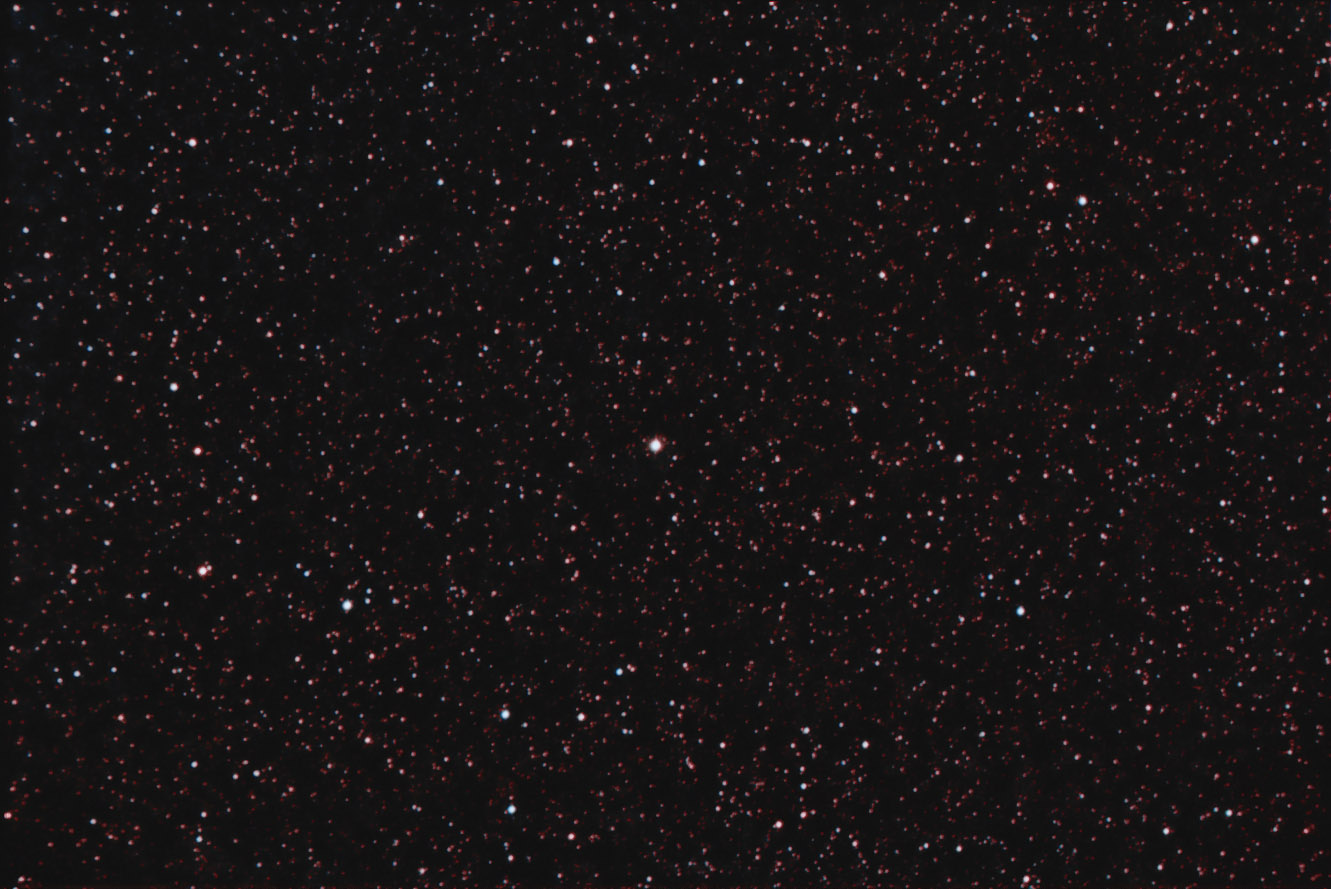
| NovaSagittarius2012No4Nova Sagittarius No. 4 (how's that for a name) was just discovered. Since I thought I had a clear night I decided to give it a try. It is at 18h 20m 27s -27d 44' 27s so well below my limits. It is also below the walls of the observatory and in the trees along my shore, I can't trim as they are in the shoreline impact zone. So this was an interesting image compounded by the sky suddenly turning partly cloudy. At no time was more than the top 4" of my objective above the observatory wall. So while I was using a 14" scope I probably had only the equivalent of about 5" or so of true light gathering power. Then being so low and in the gunk, everything is severely extinguished. Color balance is also a WAG as the amount of wall obstruction got worse with time. I had to use 1 minute frames to catch what I could between tree branches and clouds. It didn't help that some fisherman was using a bright light to see his fishing buoy. It is illegal to use a light to attract fish except you can use a lighted marker buoy. Or, as this guy did, you circumvent the law by shining a 3 million candlepower light on your buoy so you can see it. That it attracts fish illegally, well, that's just a side effect. DNR folks can't cite him as he was just using a light to see his buoy which is allowed. That reflected into the observatory lighting up the wall thus fogging the image. Related Designations for NovaSagittarius2012No4NovaSagittarius2012No4, |
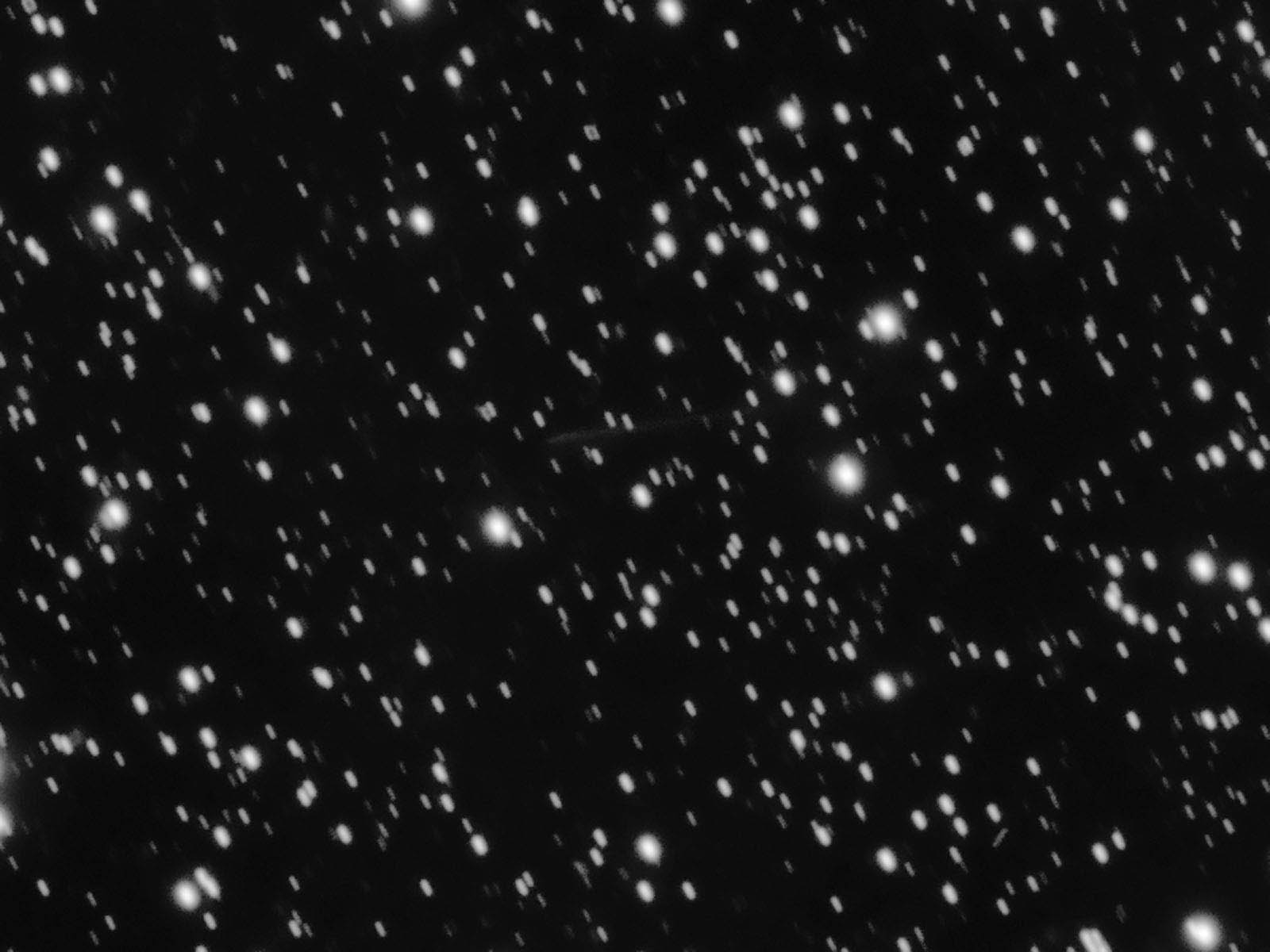
| P2010 A2P/2010 A2 (LINEAR) is cataloged as a comet but it is no comet. It's the remains of two asteroids that smashed together. I've seen no estimate of when this happened. It was discovered in early January. I've been wanting to try and image it since then but until a couple nights ago I didn't have the skies to do it. This is a preliminary processing of the data. It is moving rather slowly but even that motion (about 0.0032" of arc per second) meant I had to have the mount track this motion to get much due to it being so faint. There's no way to guide on a cloud like this so no guiding was used. I had no way to align the 4 subs so this is just a stack as it came from the camera. I believe it is within 1" of the correct alignment but can't prove this. It's been enlarged from the native 1" per pixel to 0.5" per pixel to better show the detail. This is a crop of the entire image. The full image contained two asteroids only one of which made the cropped version. It is in the lower right corner. It is (50060) 2000 AA68 Since the scope was tracking the debris cloud the asteroid trail is distorted from reality. P/2010 A2 (LINEAR) was moving south-southwest while the other asteroid was moving west-northwest. Asteroids do fall into families with similar orbits. These two are unrelated. Related Designations for P2010 A2P2010 A2, |
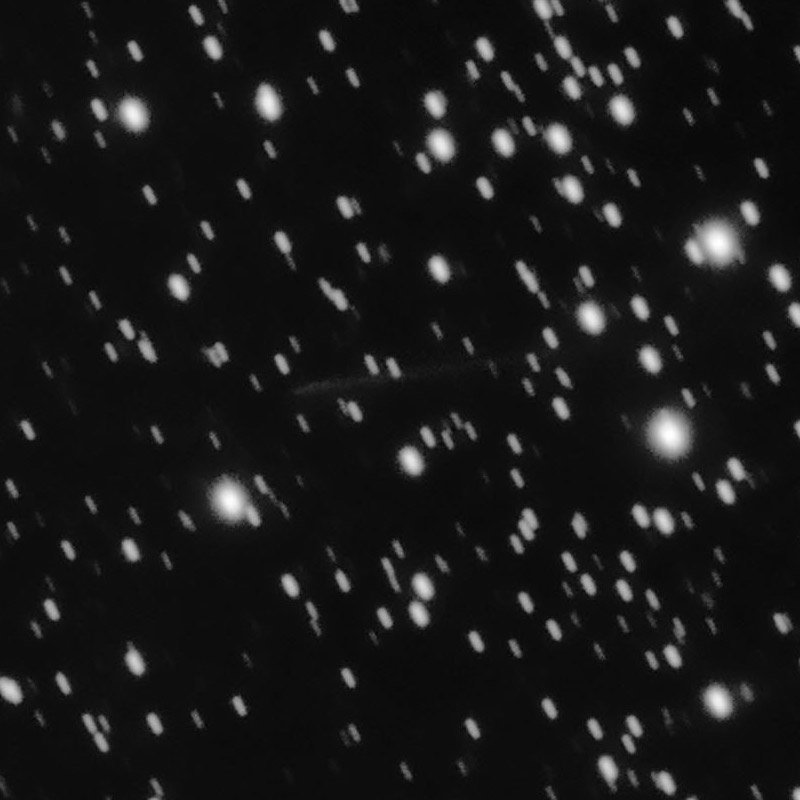
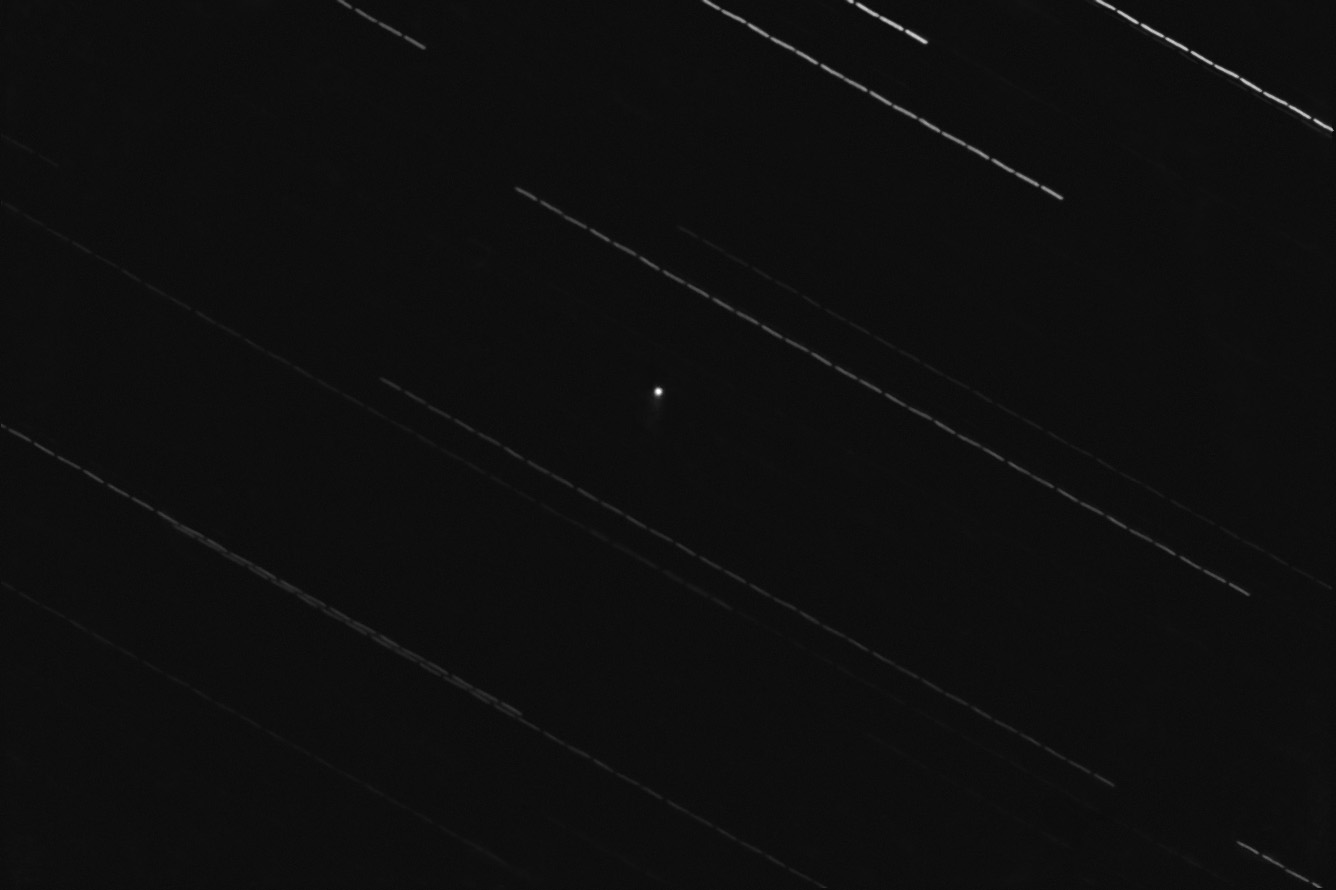
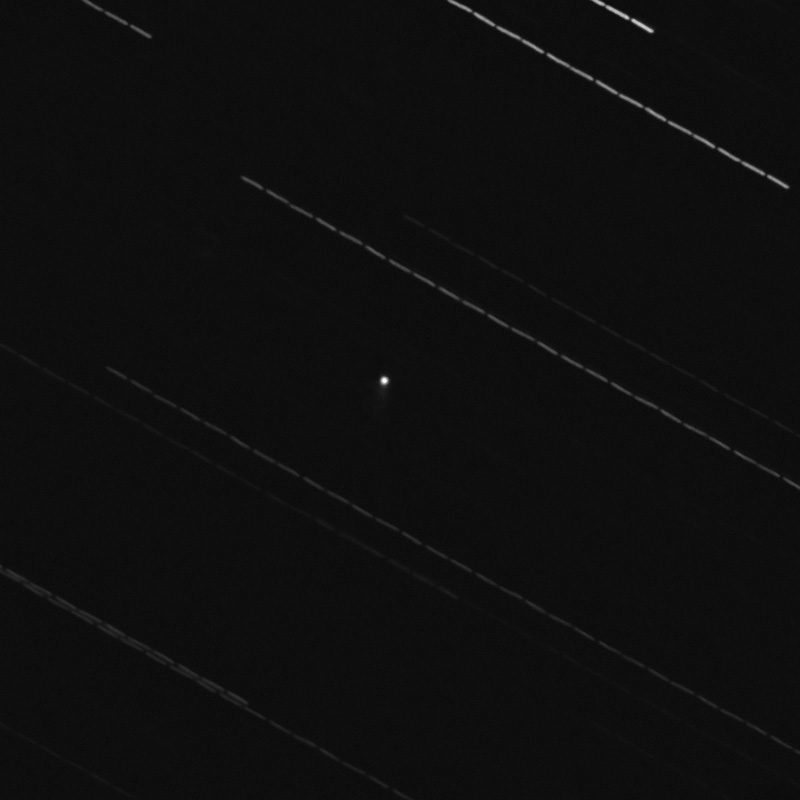
| P2016BA14Due to high clouds and a nearly full moon lighting them up something awful I was unable to catch this piece of a comet at closest approach, about 2.2 million miles (3.5 million kilometers). The next night, March 23UT, 2016, cleared when the moon was full and closer to it and it was 2.5 million miles away (4 million kilometers). You have to go back to 1770 for a comet passing any closer. That one was discovered by Charles Messier himself and passed only 1.4 million miles (2.2 million km) from us. Related Designations for P2016BA14P2016BA14, | Video: https://images.mantrapskies.com//catalog/OTHER/P2016BA14/P2016BA14.WMV
|