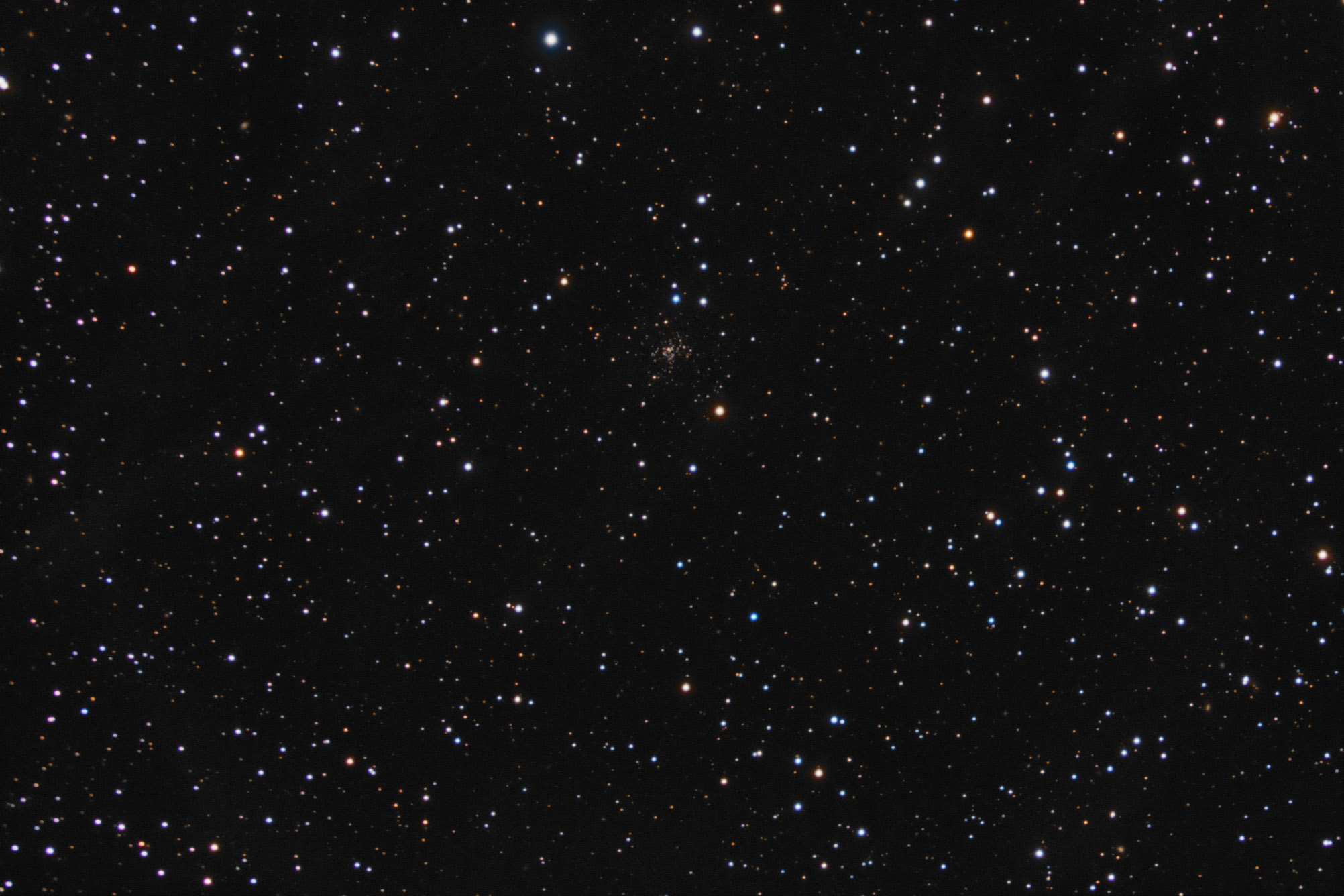
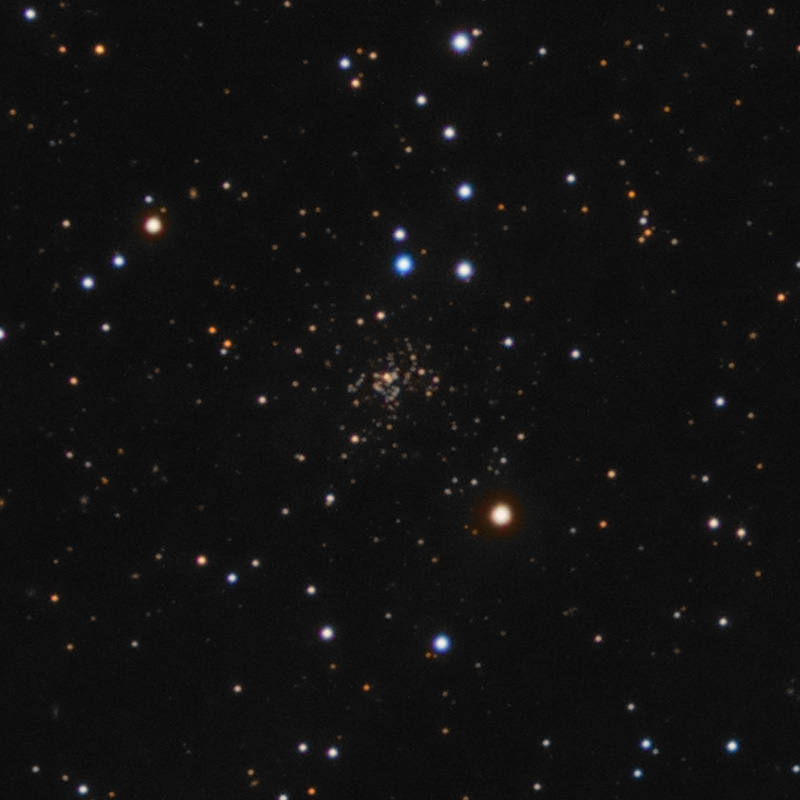
Palomar 1 is in Cepheus about 36 thousand light-years from us and 56,000 light-years from the center of our galaxy. It was discovered by George Abell in 1954 on the original Palomar Observatory Sky Survey plates. Some catalogs show it as a galaxy. The CGCG has this to say about it: "Highly resolved blue pygmy galaxy with possibly compact red nucleus and possible spiral structure. Estimated m(pg) = 17.2." The got the magnitude right but little else. At 79.6 degrees north declination it is one of the most northerly globulars known as most cluster around the core of our galaxy which is well below the celestial equator. In fact, most are too low for me to image from my latitude.
Most globulars are thought to date back to the origin of our galaxy some 10 billion years ago. Palomar 1 is an exception with an age of somewhere between 6.3 and 8 billion years. So it is a young globular. Also, its stars are not very tightly packed and unusually faint. One paper gives three possible reasons for this. "... (A)s gas clouds that survived in the halo after the Milky Way's formation, later to form stars; as captured intergalactic star groups; or as cannibalised dwarf galaxies." Seems to me the latter is most likely given its very high declination. Though it is well within our galaxies halo in which most true globulars reside. http://iopscience.iop.org/1538-3881/115/2/648/pdf/960336.web.pdf
The weather was again a nasty to me. I had planned on doubling my usual frames in hopes of picking out the IFN in the area. But clouds caused the second round to be a near total loss. Only the initial blue frames were usable due to clouds. I didn't discover this until I went to process it a year later. So the IFN is only hinted at and devoid of color as what color I got of it was just too noisy to use. The odd hints of background irregularity is due to the severely underexposed IFN rather than gradients or bad flats.
14" LX200R @ f/10, L=4x10' RG=2x10' B=4x10', STL-11000XM, Paramount ME
| 
PAL1L4X10RG2X10B4X10.JPG
PAL1L4X10RG2X10B4X10CROP150.JPG
| Palomar 13, found in Pegasus, is located about 85 thousand light-years away and about 88 million light-years from the center of the galaxy. While SIMBAD and a note at NED says it is an intergalactic cluster this is likely incorrect. SEDS has this to say about it: "Palomar 13 was discovered by A.G. Wilson (1955) and named by him the Pegasus Globular Cluster, together with globular clusters Palomar 3, Palomar 4 and Palomar 5, and two new Local Group galaxies. That naming was certainly not essentially a happy choice, as Pegasus also contains the prominent globular M15. G.O. Abell (1955) cataloged them with their Palomar numbers."
Note that it has an unusual number of very blue stars. These are likely high mass stars that are the result of the union of smaller, dying red stars. The merger has given them twice the mass causing them to turn into hot blue stars -- for a short time at least. It's orbit about our galaxy, according to the paper below, shows it dives in rather close to the galaxy's core then out into the halo again where we see it is today. This will tend to strip it of its less massive stars leaving mostly the more massive stars, many of which are blue stragglers. Their calculations indicate that it is now so depleted of stars and thus its next nose dive into the core will be its last as there's not enough left to resist the tidal forces of our galaxy's core.
http://xxx.lanl.gov/pdf/astro-ph/0011220v1.pdf
An image of it taken at the Las Campanas Observatory in the Atacama Desert of Chile is at APOD. http://apod.nasa.gov/apod/ap001130.html They don't say which scope took it. It is rotated so west as at the top rather than north in my image. It appears to be a somewhat false-color image.
Interestingly, three of the 4 entries in NED call it a galaxy. I assume they saw it as a nearby dwarf galaxy. Apparently, if you look for galaxies you find them even when they are something else.
There are a couple of asteroids in my image. (287071) 2002 RZ28 at an estimated magnitude of 19.3 is east of Pal 13 while (170485) 2003 UC277 at an estimated magnitude of 18.4 is toward the upper right corner.
For reasons now lost to my memory and not in my notes, I went back the next night and retook my normal 2 frames in each color. While the first night wasn't quite as transparent of a night as the second I did use all four of each in composing the image.
I've not prepared an annotated image. Most of my data for such images come from the Sloan database at NED. That starts at 13 degrees which is the very top of my image so except for the top minute of arc, the image is out of their data at NED.
14" LX200R @ f/10, LRGB=4x10', STL-11000XM, Paramount ME | 
PAL13L4X10RGB4X10-CROP150.JPG

PAL13L4X10RGB4X10.JPG
| Palomar 15 was cataloged by many as a galaxy. The Karachentseva Isolated Galaxy Catalogue says of it; "Resolved dwarf system. ...bright nucleus and diffuse halo." It is also listed by the UGC, PGC, MCG and CGCG catalogs as a galaxy. UGC also calls it a dwarf system. But it is a globular cluster in Ophiuchus where many of our galaxy's globular clusters reside. It is about 145,000 light-years distant on the far side of our galaxy, 125,000 light-years from the center. So it suffers quite a bit of extinction making it even dimmer than it already is. While listed at 14.2 magnitude it is extremely difficult in an 18" scope and hardly better in larger ones. Sources vary as to the discoverer. It was discovered in 1959. Some sources credit George Abell, others Fred Zwicky. It has the largest diameter core of any known globular but is of such low density it obviously has never been near the galaxy's core or it would have been completely ripped apart in one pass. You can read more about it at: http://articles.adsabs.harvard.edu/full/1990AJ.....99..229S
Only a handful of the galaxies in the image are listed at NED and none with redshift data so I've not prepared an annotated image. There's an asteroid in the image, Renaldowebb, near the west edge (right). It is at an estimated 18.3 magnitude. The naming citation reads: "(21674) Renaldowebb = 1999 RG18 Renaldo Michael Webb (b. 1988) was awarded second place in the 2006 Intel International Science and Engineering Fair for his physics project. He attends the Louisiana School for Mathematics, Science, and the Arts, Natchitoches, Louisiana, U.S.A."
14" LX200R@ f/10, L=4x10' RGB=2x10', STL-11000XM, Paramount ME | 
PAL15L4X10RGB2X10.JPG

PAL15L4X10RGB2X10CROP150R.JPG
| The 15 Palomar globular clusters were found by scrounging the POSS 1 plates back in the 1950's. This was done by astronomers looking for other objects so many contributed to the list. Since no one name could be put on the list it was named for the observatory. Those finding one or more include Harlton Arp while looking for his famous peculiar galaxies and George Abell looking for planetaries and galaxy clusters. Other contributors you might have heard of are Edwin Hubble, Walter Baade and Fritz Zwicky.
The Palomar globular list is small so I decided to add it to my project list. Pal 1 is too far north in my Polaris trees (since cut down due to rot) forcing me to start the project with Pal 2 in Auriga which was discovered by A. G. Wilson in 1955. It is thought to be about 90,000 light-years from us and 115,000 light-years from the galaxy's center so this one is far out in the outskirts of the galactic halo. It's brightest stars are about magnitude 18.8 and are surprisingly red. In fact, the entire cluster is very red. This is because it is heavily obscured. The dust gives it a rather odd color somewhat orange instead of golden that you'd expect.
I found this in the abstract of a 1998 paper by W.E. Harris et al of McMaster University. "Palomar 2 is a distant and heavily obscured globular cluster which, unlike the vast majority of such clusters, is located near the galactic anticentre direction. Though it is possibly one of the rare outer-halo clusters that are important tracers of the mass distribution and formation history of the halo, virtually nothing has been known about till now." It continues: "It's integrated luminosity Mvt~=7.9 makes it brighter and more massive than all but one or two other clusters in the outer halo. Very rough arguments based on its half-mass radius and radial velocity suggest that Palomar 2 is now moving in toward perigalacticon on a highly elliptical orbit (e>= 0.7)." Perigalacticon is a fancy word for its closest approach to the galactic center.
Due to the obscuring cloud, external galaxies are mostly missing from this image. NED lists about a dozen in my field. Only their cores survive the obscuring cloud so they look just like very faint stars. No distance data is available for them. All are from the 2MASS IR survey. I didn't try to annotate them.
14" LX200R @ f/10, L=4x10' RGB=2x10'x3, STL-11000XM Paramount ME | 
PAL2L4X10RGB2X10X3.JPG

PAL2L4X10RGB2X10X3RCROP150.JPG
| About 6 days ago I posted my image of Palomar 4, the most distant Palomar globular and second most distant one known. Palomar 3 is the third most distant globular known. It is about 302,000 light years from earth and 313,000 light years from the center of our galaxy. It is located in the constellation of Sextans. I won't be imaging the most distant known as it is always below my horizon.
Palomar 3 was discovered by A.G. Wilson in 1955, he called it the Sextans Globular Cluster. George Abell then cataloged it as Palomar 3 along with Palomar 4, 5 and 13 the same year. But others, unaware of its true nature thought it a nearby dwarf elliptical or spherical galaxy probably in the local group. That resulted in it being named Sextans C (Sextans A and B are real dwarf galaxies still on my to-do list). It doesn't help that it is only 4 degrees from the Sextans Dwarf Spheroidal which is a satellite of our galaxy discovered long before in 1900 even though it is so faint I can't see it on the Palomar plates so haven't tried imaging it. The two are only about 30,000 light-years apart. The Sextans Dwarf Spheroidal is so close it covers more than my field of view. While close to each other they have very different radial velocities indicating they are not related. According to NED Palomar 3 is still listed as a galaxy in the CGCG, MGC, UZC and a couple other catalogs. The UGC lists it as a galaxy, UGC 5439, and as a globular, UGC 5439 ID according to NED.
The annotated image contains quite a few very faint and distant galaxies. There are several galaxy clusters shown in NED but only the anchoring big cluster galaxy of each is seen in my image in most cases. I've indicated the galaxy count as shown by NED even though most don't seem to show in my image. If the distance to the cluster and related galaxy are different the cluster's distance is shown first. As usual, all distances are in billions of light years which results in a lot of zeros for nearby Palomar 3. A "p" after the distance indicates it is a photometric determination of distance. Labels for Galaxies, Quasars, Galaxy Clusters and Ultraviolet Excess Sources are placed just to the right of the object when possible. Otherwise, a line will point from the label to the object. Nearby galaxies are listed by catalog name, those cataloged only by location are simply labeled as to the type of object. A question mark labels one galaxy I happened to notice that wasn't in NED at all. They miss some, usually blue ones though not in this case. Some distant galaxies are so faint you may need to enlarge the image several times to even see them. All that NED had redshift data for are listed using NED's 5 year WMAP light travel time distance calculator.
Light travel time distance is the distance the light traveled to reach us. The object was closer when the light was emitted but during the billions of years it took to get here the universe's expansion forced the light to travel a greater distance. "Now" the object is even further away. In cases of those objects over about 9 or 10 billion light-years distant by light travel time they are likely so distant they are moving away "now" faster than the speed of light so light they emit today will never reach us. Though since they are quasars they are likely dormant by now so no longer visible in any case.
14" LX200R @ f/10, L=4x10' RGB=2x10', STL-11000XM, Paramount ME Related Designations for PAL3Sextans C, UGC 05439, UGC 05439 ID, CGCG 008-035, CGCG 1003.0+0019, MCG +00-26-017, Palomar 03, UZC J100531.5+000423, [SPB93] 132, [LM2010] 16, PAL3, | 
PAL3L4X10L4X10RGB2X10IDR-ID.JPG

PAL3L4X10L4X10RGB2X10R.JPG
| Palomar 4 is the most distant of the Palomar globulars. It is located in Ursa Major some 356,000 light-years from earth. It was originally discovered by Edwin Hubble in 1949 but before that was published A.G. Wilson also found it in 1950. Wilson named it the Ursa Major Globular Cluster and published it along with Palomar 3, 5 and 13 as well as two galaxies. Wilson's classification as a globular was considered unsure and it was cataloged in the UGCA Catalog as a dwarf galaxy in our local group. The UGCA is an appendix of 400 galaxies added to the UGC catalog limited to late-type spirals, irregulars and dwarf systems -- and an occasional globular cluster it would seem. It was even given the common name "The Ursa Major Dwarf."
I could find only one globular that is more distant than Palomar 4. That is AM 1 but at declination -49.6 degrees it is always below my horizon. Its distance is listed as just under 400 thousand light-years. It is also the most distant from the core of our galaxy at just over 400 thousand light-years. Palomar 4 is the second most distant both from the sun (354,400 light-years) and from the galaxy's center (362,500 light-years). I'm a bit confused about the orange stars seen against the cluster. Most sources say the brightest star in the cluster is 18th magnitude but 7 brightest orange stars are 16th to 17th magnitude by my measurement. Some or all may not be cluster members. I just don't know.
While I was able to resolve quite a few stars in the globular seeing was quite poor running about 3.7" FWHM. Under better seeing, I'd likely pull in a lot more stars in the cluster. It's on the reshoot list but it is in a part of the sky with several hundred objects I've never imaged. I might get to it if I live to be 100 so don't hold your breath.
Normally globulars are seen looking toward the core of our galaxy but this one is almost opposite the galaxy's core which means it is in a very unobscured part of the sky. For a change, there are a lot of galaxies in this globular image. They seem more common than foreground stars. While NED lists a couple thousand galaxies in the field only a few have redshift data. I annotated all of those. Nearly all have catalog names that are just their position in the sky. I list those only by type of object all of which are galaxies in this image. There was one galaxy, a flat galaxy from the 2MASS survey, that is listed by name and one galaxy group. It consists of 4 members, all of which are easily seen in my image A line points to the center of the group as defined by NED. Distances are noted in billions of light-years which makes for a lot of leading zeros in the case of Palomar 4!
14" LX200R @ f/10, L=10x10' RGB=2x10', STL-11000XM, Paramount ME | 
PAL4L10L10X10RGB2X10.JPG

PAL4L10L10X10RGB2X10CROP150.JPG

PAL4L10L10X10RGB2X10ID.JPG
| Palomar 5 is located about 61,000 light-years from earth and 75,000 light-years from the center of our galaxy. We see it in the constellation of Serpens Caput. Palomar 5 was discovered twice. First in 1950 by Walter Baade then in 1955 by A.G. Wilson. Wilson gave it the rather useless name of the Serpens Globular Cluster as if it was the only such cluster in the constellation, the others are all larger, brighter and with more stars including M5 only 2 degrees to the north. Maybe Serpens Least Globular Cluster would be a better name. Still, it was named Serpens Dwarf by some who thought it a dwarf galaxy rather than a globular cluster. The UGC says "Resolved dwarf -- Very uncertain diameter values". The CGCG and MCG also list it as a galaxy.
It has been discovered that our galaxy is shredding the globular creating a long tidal stream on either side of the cluster that contains far more stars than are left in the cluster. This explains its weak structure. You can read about this at: https://arxiv.org/pdf/astro-ph/0209555v1.pdf
Color data is a bit weak as I was only able to get one round before clouds moved in. Located on the celestial equator I needed a better than average night to get more which never happened then I forgot about it until I processed the image.
Thanks to the excellent seeing (for my location) this night I was able to go rather deep even under the somewhat hazy conditions. The annotated image shows some really faint on odd objects. One, on the east side of Palomar 5 has two listings in NED. One as a quasar and another as AbLS which stands for Absorption Line System. The Red Shift of the quasar is z=3.749290 while the AbLS has a z of 3.030000 putting it some 480 million light-years closer. My interpretation of this is that there is an object, dust and gas cloud for instance) that lies between us and the quasar adding its absorption lines to the spectrum of the quasar. The combined light is green in the Sloan survey image due to it mapping blue to green and Uv -- likely lost to the dust cloud -- mapped to blue but with none, the object turned green in the SDSS pseudo color image.
One quasar at 7.91 billion light-years had its redshift determined from a single spectral line. This only works if you are absolutely certain what that one line is.
There are quite a few galaxies in the upper part of the image a bit left of center at about 1.5 billion light-years. They are likely member of Abell 2050, a galaxy cluster about 18 minutes across (nearly the height of my image) centered a couple minutes of arc above my image and a bit left of center.
I found 20 quasars or likely quasars (UvES) in this small field. The most of any field I have imaged as best I can recall. A dozen more are just beyond the borders of the image. Arp made a big deal about quasars being ejected from nearby galaxies but none of his examples had more than a half dozen quasars in a similar area. Apparently nearly washed up globulars eject far more or else his theory is seriously flawed. I vote for the latter. One of those quasars lies at a measured z value of over 3 though NED notes this is uncertain. How uncertain they don't say.
14" LX200R @ f/10, L=4x10' RGB=1x10', STL-11000XM, Paramount ME | 
PAL5L4X10RGB1X10-ID.JPG

PAL5L4X10RGB1X10.JPG

PAL5L4X10RGB1X10CROP.JPG
| Parsamyan 21/Parsamian 21 is a reflection nebula caused by the outflow from the young FU Orionis star HBC 687. Coming from its south end is the Herbig Haro object HH221 which may be the little jet seen below the bright cloud that hides the star. This nebula is located in Aquila. I was unable to find a distance estimate for it. Some papers likened this nebula to the far more famous Hubble's Variable Nebula. Though about the only similarity I see is the faint southern jet. It certainly doesn't have the ringlike shape of Parsamyan 21. See also Jim Shuder's fine image of this object at: http://www.pbase.com/jshuder/image/137713564/large .
The illuminating and creating star is listed as a variable but photometric data in one paper found only a very tiny fluctuation in its brightness over the years so while it varies it is barely noticeable. The star itself is hidden by the dust and gas around it though it can be seen in IR light according to one paper which had a picture showing just the star and no hint of nebulosity. If you look very closely at my image it appears there is a bit of faint nebulosity to the northeast and north-northwest. It would take a lot of hours to bring that out at my image scale. Except for that, it appears there may be dark dust not illuminated by the star around the nebula as it sits in a slightly dark hole in the stars. Some of the lack of stars matches where the faint nebulosity is in my image. WISE shows a red circular blob that is centered on the star, not the nebula or the dark cloud that I see. http://irsa.ipac.caltech.edu/applications/wise/#id=Hydra_wise_wise_1&projectId=wise&startIdx=0&pageSize=0&shortDesc=Position&isBookmarkAble=true&isDrillDownRoot=true Enter Parsamian 21 in the search box and hit search. Click on the Multi-color tab above the IRAS image. The circle in all images is centered on the illuminating star according to their position cursor. The longer the wavelength the larger the blob and the cooler the dust it is seeing.
I imaged this one at 0.5" per pixel. The professional images I found on the net show it bluer than either Jim or I saw it. I can't explain the difference.
14" LX200R @ f/10, L=6x10'x1 RGB=2x10'x2, STL-11000XM, Paramount ME | 
PARSAMYAN21L6X10RGB2X10X2R.JPG

PARSAMYAN21L6X10RGB2X10X2R2004.JPG

PARSAMYAN21L6X10RGB2X10X2R3500.JPG

PARSAMYAN21L6X10RGB2X10X2R800.JPG
| the Pegasus Dwarf is a nearby galaxy also known as UGC 12613 and Pegasus DIG (Dwarf Irregular Galaxy). You'd think that being a very nearby galaxy we'd know its distance very accurately. NOT! There is much disagreement here. Some say it is a distant satellite of M31, others say it is a member of the M31 group. These would put its distance at about 3 million light years. Others say it is a neighbor of IC 1613 which would put it some 5.5 million light years away. The annotated image goes with the median of 24 measurements at NED. Though if you leave out the older measurements and go with just the newer ones then its distance is about 3 million light-years, a bit beyond M31. The galaxy was discovered by A. G. Wilson sometime in the 1950's according to Wikipedia. They put it a companion of M31 at 3 million light-years.
Pegasus DIG contains so little dust and gas you can see right through it's densest region. What looks like possibly the core of the galaxy (a tad off center) is really a distant galaxy with the catalog name of SDSS J232835.87+144413.5. As with much of Sloan Digital Sky Survey catalog, its distance hasn't yet been determined. Since other galaxies in the area of its brightness are in a small cluster 900 million light years away, I'll assume it is a member of that group. Such assumptions can be risky, however. The obvious near edge on spiral is UGC 12613 at 900 million light-years. Off the Southeast (lower left) end Pegasus DIG is the spherical, near star-like galaxy, IV Zw 152 at 910 million light-years. Off the opposite end is a much smaller star-like galaxy surrounded by a fairly large fuzzy halo. This is SDSS J232817.48+144509.2 at 1.8 billion light years. The field is full of galaxies, half of which are fainter than my limiting magnitude due to the snow. NED lists well over 500 within 5 minutes of arc of this galaxy. That's about its length in my shot. So nearly every star-like object you see that isn't perfectly round, and some that are, are really distant galaxies. Maybe next time I can image it without snow on the ground.
14" LX200R @ f/10, L=4x10' RGB=2x10', STL-11000XM, Paramount ME Related Designations for PEGASUSDWARFPegasus Dwarf, PegDIG, UGC 12613, DDO 216, CGCG 431-072, CGCG 2326.0+1427, MCG +02-59-046, [RC2] A2326+14, [RC1] A2326, NSA 151644, PGC 071538, UZC J232835.2+144435, 11HUGS 428, [SPB93] 272, PEGASUSDWARF, UGC12613, | 
PEGASUSDWARF-UGC12613L4X10RGB2X10X3R.jpg

PEGASUSDWARF-UGC12613L4X10RGB2X10X3RID.JPG
| The Pegasus II galaxy cluster is anchored by three NGC elliptical-like galaxies, NGC 7499 classified by NED as SA(s)^0^, NGC 7501 E1 and 7503 E2, all three are listed as being Bright Cluster Galaxies. All three were discovered by Albert Marth on September 24, 1864. The cluster is located a bit over a half billion light-years from us. NED describes the cluster as being 68, minutes across 4 times the size of my field. They list it as having 175 members and fitting Zwicky's Compact classification.
In my annotated image I listed the redshift distances of all galaxies NED had redshift data for. I probably should have listed only those not a cluster member and saved a lot of time but as there were some background galaxies that appeared virtually identical to the much closer group members I ended up listing all of them. Though most only had designations at NED that were their position which made their names very long. So long they'd often overlap. So I just used G for galaxy followed by the distance unless they had a shorter catalog name.
14" LX-200R @ f/10, L=4x10' binned 2x2, RGB=2x10' binned 3x3, STL-11000XM, Paramount ME Related Designations for PEGASUSIIAndromeda VI, Peg dSph, Pegasus Dwarf Spheroidal, Pegasus II, GALEXASC J235146.50+243450.4 , kkh 099, LEDA 2807158, [KK99] 472.2, NGC 7499, UGC 12397, CGCG 406-007, CGCG 2307.8+0718, MCG +01-59-005, 2MASX J23102237+0734501, 2MASS J23102238+0734505, SDSS J231022.37+073450.6, GALEXASC J231022.36+073450.9 , WBL 698-002, WINGS J231022.37+073450.5, WINGS J231022.38+073450.6, NFP J231022.4+073451, NPM1G +07.0508, NSA 150746, PGC 070608, UZC J231022.4+073451, PCC S49-132:[LLB96] 262, ZwCl 2307.6+0713:[CAE99], NGC 7501, CGCG 406-008, CGCG 2308.0+0718, MCG +01-59-007, 2MASX J23103039+0735201, 2MASS J23103040+0735205, WBL 698-003, WINGS J231030.43+073520.6, NFP J231030.4+073521, NPM1G +07.0509, NSA 150759, PGC 070619, UZC J231030.5+073521, PCC S49-132:[LLB96] 250, RX J2310.4+0734:[ZEH2003] 06 , NGC 7503, CGCG 406-012, CGCG 2308.2+0717, MCG +01-59-008, 4C +07.61, PKS 2308+07, 2MASX J23104223+0734033, 2MASS J23104227+0734034, SDSS J231042.27+073403.8, GALEXASC J231042.52+073404.4 , WBL 698-004, WINGS J231042.27+073403.7, NFP J231042.3+073404, NPM1G +07.0512, NSA 150773, PGC 070628, UZC J231042.3+073404, PKS B2308+073, PKS J2310+0735, PMN J2310+0734, MRC 2308+073, 87GB 230810.1+071810, 87GB[BWE91] 2308+0718, [WB92] 2308+0718, VLSS J2310.7+0735, Cul 2308+072, PCC S49-132:[LLB96] 201, ZwCl 2307.6+0713:[AAV2011] BCG, PEGASUSII, NGC7499, NGC7501, NGC7503, SDSS J231022.42+073450.4, SDSS J231030.40+073520.6, SDSS J231042.22+073403.6, | 
PEGASUSII-LUM4X10RGB2X10X3R.JPG

PEGASUSII-LUM4X10RGB2X10X3RID.JPG
|