KUG 2348+270A also known as PGC 72600 is an Arp like galaxy that happens to be on the edge of the galaxy cluster Abell 2666. It is in Pegasus, about 350 million light-years distant. It's in the Great Square not far from Alpheratz (Alpha Andromedae). While I have many Abell clusters on the to-do list this came as a surprise. I raised KUG 2348+270A high to pick up much of the cluster but not so high vignetting reduced my ability to pick up the plumes. Arp put many galaxies with plumes just like this one on his list. He put them under many different categories however not realizing they were all caused by gravitational interaction with some other galaxy. In the case of KUG 2348+270A, the galaxy involved seems to have hit and run. Now there's a whole cluster of them to choose from. None of which seem all that disturbed. I suppose it could be a merger situation though I see no real evidence for this.
KUG 2348+270A has both a large but faint arm on its eastern side that wraps around under the galaxy then explodes in the plume as well as an odd arm pointing north (up) that also seems to have a lot of tidal stars pulled from it creating a puff of stars about it. The arms seem to create a ring that doesn't attach to the core. NED makes no attempt to classify it other than as a LINER spiral galaxy of magnitude 15. I see a hint of a bar running from the north-northwest to the south-southwest. I found no papers discussing either tidal feature. It has likely had an interaction with another member of Abell 2666.
Abell 2666 is described at NED as having a diameter of 50 minutes which puts its edges well beyond my field though it seems to have run out of members to the north at KUG 2348+270A's distance from its core. Its core as defined by NED is nearly the same as the cD galaxy anchoring the cluster, NGC 7768, a huge elliptical galaxy of 13th magnitude. It was discovered by John Herschel on September 6, 1828.
The field is outside the DR7 Sloan Survey area that has been picked up by NED. It is in the DR8 survey area that NED has not yet incorporated in its database. The Sloan image I've included came from this later survey. Without Sloan data, I didn't expect much in the way of redshift data but apparently, the Abell 2666 cluster has been well studied making for a good deal of data on its galaxies. I've identified all that are in my image that NED knows about. I even identified them along with showing their redshift light travel distance in billions of light-years. Some had no redshift data indicated by a question mark after the catalog name. I used the primary designation NED used so the catalogs are quite varied. Many are likely new to you.
KUG = Kiso Ultraviolet Galaxy Catalogue
GIN = Galaxy Index Number
AGC = Arecibo General Catalog
LCSB = Low Central Surface Brightness
Just east of NGC 7768 is a blue star-like object whose position matches that of 2MASX J23510292+2708335. It is listed also as a radio galaxy in the NRAO VLA Sky Survey. I find nothing on its visual or IR listing. By radio, it is listed as being from 5 to 10 seconds in size. Problem is that on my image it appears starlike with a PSF matching that of stars in the area. I see no galaxy. Adding to the problem is that its location has an error bar of 1.25 seconds. Nor does the DR8 survey show anything other than what appears to be a blue star at this position. I can't help but think something is in error here. I put 2 question marks after its designation for this reason.
The image contains three other NGC objects. NGC 7765. an SB(rs)c? galaxy discovered by R. J. Mitchell on October 12, 1855; NGC 7766 a compact galaxy and NGC 7767 an S0/a? galaxy. These last two were discovered by Ralph Copeland on October 9, 1872.
In the lower right corner is the asteroid (19711) 1999 TG219 shining at an estimated 18th magnitude. It is partly overlapping a distant galaxy.
14" LX200R @ f/10, L=4x10' RGB=2x10'x3, STL-11000XM, Paramount ME Related Designations for PGC72600KUG 2348+270A, CGCG 477-016, CGCG 2348.2+2701, MCG +04-56-014, 2MASX J23504749+2717167, 2MASXi J2350474+271716, 2MASS J23504748+2717168, GALEXASC J235047.45+271718.0 , GALEXMSC J235047.43+271717.3 , IRAS F23482+2700, WBL 724-002, USGC U858 NED07, AGC 330953, NSA 171229, PGC 072600, UZC J235047.5+271716, NVSS J235047+271727, ALFALFA 2-466, LT 36, ABELL 2666:[H80c] 004, [AO95] 2348+2700, ABELL 2666:[HO98] 210, [MO2001] J235047.5+271715.7, NGC 7768, UGC 12806, CGCG 477-019, CGCG 2348.4+2653, MCG +04-56-018, GIN 738, 2MASX J23505859+2708507, 2MASXi J2350585+270850, 2MASS J23505853+2708503, SDSS J235058.55+270850.4, WBL 724-005, LDCE 1595 NED009, HDCE 1256 NED002, CAN 084 NED01, USGC U858 NED05, HOLM 818A, NSA 152761, PGC 072605, UZC J235058.6+270849, ABELL 2666:[MS77] 01, ABELL 2666:[H80c] 007, ABELL 2666:[L84] G1, ABELL 2666:[CBW93] A, ABELL 2666:[PL95] BCG, ABELL 2666:[BTM97] 1, [M98j] 265 NED03, ABELL 2666:[HO98] 201, ABELL 2666:[CAC2009] BCM, NGC 7767, UGC 12805, CGCG 477-017, CGCG 2348.3+2649, MCG +04-56-016, 2MFGC 17897, 2MASX J23505634+2705137, 2MASXi J2350563+270513, 2MASS J23505636+2705136, GALEXASC J235056.38+270513.7 , GALEXMSC J235056.35+270514.6 , WBL 724-003, LDCE 1595 NED008, HDCE 1256 NED001, USGC U858 NED06, HOLM 818B, NSA 152759, PGC 072601, UZC J235056.4+270513, ABELL 2666:[H80c] 005, [M98j] 265 NED02, ABELL 2666:[HO98] 205, NGC 7766, CGCG 477-018, CGCG 2348.3+2651, MCG +04-56-017, 2MASX J23505589+2707347, 2MASXi J2350558+270734, 2MASS J23505589+2707350, GALEXASC J235055.89+270736.7 , GALEXMSC J235055.93+270735.2 , WBL 724-004, AGC 331546, HOLM 818D, NPM1G +26.0551, NSA 152758, PGC 072611, ABELL 2666:[MS77] 03, ABELL 2666:[H80c] 006, NGC 7765, CGCG 477-015, CGCG 2348.2+2654, MCG +04-56-015, GIN 739, 2MASX J23505214+2709587, 2MASXi J2350521+270958, 2MASS J23505214+2709586, 2MASS J23505242+2709583, GALEXASC J235052.16+270958.6 , GALEXMSC J235052.16+270958.7 , WBL 724-001, CAN 084 NED02, AGC 330954, HOLM 818C, NSA 152757, PGC 072596, ABELL 2666:[MS77] 02, ABELL 2666:[H80c] 003, ABELL 2666:[WCB96] B, ABELL 2666:[HO98] 202, ABELL 2666, CID 84, CAN 084, ZwCl 2335.5+2449 NED02, SCL 215 NED02, RASSCALS SRGb 046, PGC72600, NGC7768, NGC7767, NGC7766, NGC7765, ABELL2666, | 
PGC072600L4X10RGB2X10X3R-ID.jpg

PGC072600L4X10RGB2X10X3R.jpg

PGC072600L4X10RGB2X10X3R1-CROP150.jpg
| I've had PGC 72910 on my Arp-like to-do list for some time. I finally imaged it in November 2010. Sakib Rasool sent me his list which included VV 697. I imaged that one in October 2010 and posted it 11-25-2011. Processing PGC 72910 seemed familiar to me. Yep, turns out the Tower of babble nailed me again. I had it under different names under both lists. I wasn't going to run this but conditions were better so it shows a bit more detail and better color so I'll bore you with a redo. Besides dummy spent an afternoon on this and hates to waste it. Yes, I've been processing so fast of late my brain is numb.
VV 697 is a triple galaxy system (quad?) in the northeast corner of the Great Square of Pegasus. It lies about 750 million light-years beyond the Great Square to be more accurate. The three galaxies, left to right (east to west) are PGC 72909, PGC 72910 and PGC 72911. Yes, this is backward from the normal west to east numbering system for the PGC catalog. A fourth anonymous galaxy is hiding partly behind the middle galaxy PGC 72910. There's little on this field in NED. The area is included in Data Release 8 of the Sloan Digital Sky Survey but the data hasn't as yet been included in NED's database. I imagine the 4th galaxy will be in that data. I hope with redshift data to see if it is related to the other three.
PGC 72911 is the only one that appears to be significantly distorted by interaction with the others. It is classed by NED simply as peculiar and is noted to be a Seyfert 1 galaxy. While interaction isn't needed to create a Seyfert 1 AGN (Active Galaxy Nucleus) it may be the cause in this case. The center galaxy, PGC 72910 is classed simply as a spiral with a note that it is a starburst galaxy with HII emission. So while it looks rather sedate something (interaction possibly) has triggered massive star formation hidden behind dust in its core. NGC 72909 is also classed simply as a spiral with HII emission but no starburst activity nor AGN.
Except for these three galaxies, NED has no redshift data on any other galaxy in the field. All the others it does list are from the 2MASS IR survey. One, 2MFGC 17969, is also in the 2MASS Flat Galaxy Catalog. It is the obvious edge on flat galaxy northeast (upper left) of the VV 697 group. While it doesn't appear very bright in my visible light image it is listed as magnitude 12.2 in the IR K band. Sounds like it is a very dusty galaxy.
14" LX200R @ f/10, L=6X10' RGB=2X10'X3, STL-11000XM, Paramount ME Related Designations for PGC72910VV 697 NED02, CGCG 477-030 NED02, CGCG 478-002 NED02, CGCG 2353.3+2514 NED02, MCG +04-01-003, 2MASX J23555019+2530214, 2MASS J23555018+2530216, AGC 331012, PGC 072910, UZC J235550.1+253023, NVSS J235549+253022, ALFALFA 4-208, [WZX98] 23532+2513A, RX J2355.7+2530:[BEV98] 002, RX J2355.7+2530:[ZEH2003] 07 , KIG 1050:[VOV2007] 019, PGC72910, | 
PGC72910L6X10RGB2X10X3R.JPG

PGC72910L6X10RGB2X10X3RCROP150.JPG

SDSSPGC72910.JPG
| PGC 84446 is a rather obscure small outlying member of the ABELL 2040 galaxy cluster about 620 million light-years distant. It is located in the very southeast corner of Bootes. The galaxies along the bottom edge of the image are in Virgo while those on the eastern edge are in Serpens Caput so this small field of about 0.2 square degrees includes three constellations. LEDA 84446 is about 60,000 light-years across but at its distance only about 20" of arc across. it is classified as S0/a and as a Narrow Emission Line Galaxy (NELG). It is also sometimes called SDSS 1510+07.
So why did I take such an insignificant galaxy? It turns out to be one of a handful of galaxies known to contain voorwerpjes as they are called. I had to try and see if I could pick up these green objects recently imaged by the HST. They are thought to be illuminated gas clouds outside the galaxy that were left by a galaxy digested by the main galaxy. The illumination coming from a quasar that has since died down to where the galaxy is now just NELG class but the light path from the quasar to the cloud then to us is longer so we are seeing the light echo left by this now quiescent black hole. Most of the voorwerpjes are seen around NELGs. Though only a very few NELGs have voorwerpjes.
The green color is more a result of LRGB filters as the true color is somewhat bluer than seen here. This is because the light from the voorwerpjes is red shifted just enough that instead of falling in the overlap of the green and blue filters it falls entirely in the green filter. The HST uses tunable filters for both the oxygen III seen as green and red for H alpha. Since that is out of my passband I didn't even try for it. The included HST image maps the oxygen to green and the hydrogen to red. As I had no way to isolate the hydrogen and my camera sees the green emission far more strongly than the red of H alpha by almost a 2:1 ratio I see even the red portion in the HST image as green. Also since it was the faint green I was interested in I used more time on the green data allowing it to be pulled out of the noise better than the red. I should have paid more attention to the HST image and put some extra time in on the red filter but didn't.
Seeing was better than it has been much of the last year the night I took this but still far below what I used to get a few nights of the year. Still, it helped to bring out the southern green band.
While the galaxy and several others, mostly on the eastern half of my image are members of the Abell 2040 galaxy cluster most, especially those to the lower right are members of the more distant Abell 2028 galaxy cluster that's about 1.03 billion light-years distant. It is centered in the lower right corner. With two overlapping galaxy clusters, this makes for a very cluttered annotated image. Fortunately, there were no asteroids in the field at the time to add to the clutter.
14" LX200R @ f/10, L=4x10' RB=2x10' G=6x10', STL-11000XM, Paramount ME Related Designations for PGC844462MASX J15100402+0740370, 2MASS J15100400+0740372, SDSS J151004.01+074037.1, SDSS J151004.01+074037.2, GALEXASC J151004.18+074037.2 , GALEXMSC J151004.26+074036.6 , ASK 459441.0, NSA 079468, LEDA 084446, CXO J151004.0+074037, CXOMP J151004.0+074037, ABELL 2040:[D80] 088, ABELL 2028:[TCC97] 007, [TTL2012] 250361, ABELL 2028, ZwCl 1509.4+0745 NED01, SCL 154 NED01, PGC84446, ABELL2028, | 
HST_84446.JPG

PGC84446L6X10RB4X10G6X10.JPG

PGC84446L6X10RB4X10G6X10CROP200.JPG

PGC84446L6X10RB4X10G6X10ID.JPG
| LEDA 087293 (also known as PGC 087293) is a strange ring galaxy in the southwest corner of Bootes. NED classifies it as, well, nothing, which I found surprising. Another catalog, the Low Surface Brightness Catalog lists it as a Ring galaxy but then things get confusing. Their position has an error bar radius of 37.5" but the position is about 45" from the galaxy's core. With nothing else looking like a ring it appears they are talking about the ring I imaged. Both LEDA and the LSBC have redshifts for it but again they can't agree. LEDA says 1.72 billion light-years while LSBC says only 520 million light-years, less than one third the distance. But then there seems to be a second galaxy within the ring. A fainter one is seen to the left of the central one. LEDA's position matches the brighter central one. Could it be that they really meant the fainter and possibly more distant one? The GALEX satellite records a UV source halfway between and slightly below the two "cores" but its error bar radius is 3" and thus can include both objects! It is closer to the faint galaxy. So which it means can't be determined. If the LEDA distance is used the ring is 250,000 light-years across. If the LSBC distance is used then it is only 75,000 light-years across. Neither NED nor SIMBAD shows an object at the position of the second core unless it is the GALEX object. Here I thought I was imaging a neat galaxy. I didn't realize I was actually imaging a can of worms.
The LEDA distance of 1.72 billion light-years is echoed by many other galaxies in the field as shown by the annotated image. NED shows several small galaxy groups with this distance and one large galaxy cluster GMBCG J208.39970+09.70305 centered to the easy at 1.69 billion light-years and having 23 members. With no size given, I can't tell if it encompasses all galaxies at about the 1.7 billion light-year distance but I assume it likely does.
The field contains two possible quasars besides some identified ones. One is lists as a candidate quasar by NED so is labeled CQ while the other is listed as an Ultraviolet Excess Source so is listed as UvES in the annotated image.
Transparency was poor for this image. I tried over several nights but much of the data was unusable. One luminance frame was taken a night when an asteroid, (460453) 2014 SV218 was in the frame. It was listed as 19.4 magnitude but appears a magnitude fainter showing how poor the night was. With only a single 10 minute trail, some of which was lost to clouds it hardly looks like an asteroid in the image. Look west of LEDA 087293 to find it in the annotated image. I used the three best color frames for color data due to very low transparency. Turned out one RED one hurt more than it helped so only 2 red ones were used though one happened to be when skies were rather good so that alone likely would have been sufficient though I used two.
14" LX200R @ f/10, L=4x10' R=2x10' GB=3x10', STL-11000XM, Paramount ME | 
PGC87293L4X10R2X10GB3X10.JPG

PGC87293L4X10R2X10GB3X10CROP150.JPG

PGC87293L4X10R2X10GB3X10ID.JPG
| http://www.pbase.com/jshuder/image/136810005/original NB IMAGE
aka MINKOWSKI 4-9
http://articles.adsabs.harvard.edu/cgi-bin/nph-iarticle_query?2004MNRAS.353..589P&data_type=PDF_HIGH&whole_paper=YES&type=PRINTER&filetype=.pdf
______________________
On the Edge of Darkness
Minkowski 4-9 aka PK 024+05.1 is a nice planetary nebula in a great field. The dark Nebula to the west is LDN 472 with LDN 469 to the southwest. Strips of dust can be seen even on the eastern side of the field as the color of the stars seems very uneven being redder in thin veins indicating a lot of dust in the area. Distance estimates are all over the place for this one. The newest I could find says about 5,600 light-years. The paper goes into how this was determined showing the difficulties involved with measuring planetary nebulae distances. The PDF is at: http://articles.adsabs.harvard.edu/cgi-bin/nph-iarticle_query?2004MNRAS.353..589P&data_type=PDF_HIGH&whole_paper=YES&type=PRINTER&filetype=.pdf
Assuming the 5,600 light-year distance the nebula is about 1.3 light-years across its longest dimension and 1.1 across its semi-major axis.
I get asked a lot why I use such a large chip when I image such small objects. This image is a good answer to that question. To me the setting is as important as the object. This one could use an even larger FOV for this small object.
For a great high resolution narrow band image of this nebula see Jim Shuder's image at: http://www.pbase.com/jshuder/image/136810005/original
14" LX200R @ f/10, L=4x10' RGB=2x10', STL-11000XM, Paramount ME
Rick Related Designations for PK24+5.1PK24+5.1, | 
PK24+5-1L4X10RGB2X10.JPG

PK24+5-1L4X10RGB2X10CROP.JPG
| PN G049.4+02.4/M 4-12/Hen 2-428/PK 049+02.1 among its many designations is a rather distorted planetary nebula in northern Aquila. Its shape is likely due to distortions caused by its interaction with the interstellar medium. I found one paper putting it at 1000 parsecs +/- 100 parsecs. Several papers say the central star is a binary star.
As a bonus, there's a second planetary in the image. Its central star is very bright and hides most of it. This would be a good candidate for narrowband imaging which would dim the central star allowing the nebula to be seen. It is PN G049.3+02.3. See the cropped annotated image at 0.67" per pixel to find it.
14" LX200R @ f/10, L=4x10' RGB=2x10, STL-11000XM, Paramount ME Related Designations for PK49+2.1PK49+2.1, | 
PK49+21L4X10RGB2X10.JPG

PK49+21L4X10RGB2X10CROP150-ID.JPG

PK49+21L4X10RGB2X10CROP150BOTH.JPG
| M2-48/Hen 2-449/PK 062-00 1/PN G062.4-00.2 among other designations is a small planetary nebula in Vulpecula near the far more famous M27. I found two very different distance estimates for it, one says 1100 +/- 300 Parsecs (3600 +/- 1000 light-years) and the other says 7160 parsecs (23,300 light-years). Now that's a discrepancy! Interestingly the first paper listed many planetary distances from several sources including the source for the 7160 estimate but left that entry blank! Apparently, they didn't trust it enough to include. So, for now, its distance is "still to be determined" as best as I can tell.
More of a mystery is why I imaged it in the first place. I normally keep good notes about this but drew a complete blank on this one. I can't even find it in my to-do list yet I took it anyway. I also come up blank for any amateur images of it on the net. I did file it under one of its catalog names so knew what I was taking. The why is totally lost, however. So this is a short entry.
I did find a somewhat readable paper on it by some astronomers who knew why they looked into it.
http://cds.aanda.org/articles/aa/pdf/2002/23/aa2425.pdf
14" LX200R @ f/10, L=4x10' RGB=2x10', STL-11000XM, Paramount ME Related Designations for PK62PK62, 01, | 
PK62-01L4X10RGB2X10.JPG

PK62-01L4X10RGB2X10CROP150.JPG
| PK 217+14.1 aka Abell 24 is a rather large planetary nebula in Canis Minor. Distances to planetary nebulae are hard to determine. This one is close enough a ballpark answer can be obtained by parallax though working at the extreme limits of this mode. The best value I could come up with is 1700 light-years with an error bar going from 1525 to 2063 light-years. A surprisingly small range for this distance. At least to me. The paper is at:
http://iopscience.iop.org/article/10.1086/510348/pdf;jsessionid=73E25EF08CA5CB9C039A2584E798C213.c3.iopscience.cld.iop.org
Assuming the 1700 light-year distance the nebula is about 3.3 light years across assuming it is 400 seconds of arc across. All sources say it is only 285" but measuring my FITS images I get 400 seconds. The 285 is from measuring only the brighter portions it appears. The full image is at 1.01 seconds per pixel so you can measure it yourself with any decent image program. The central star is very obvious as the blue star at its very center. It is providing the energy to illuminate the nebula. It may be a dead star (no longer creating energy by fusion) and a very small white dwarf (well blue dwarf) but it is pouring out the ultra-violet light that causes the hydrogen and nitrogen in the nebula to glow bright red. Red planetaries like this are rather uncommon. Most shine with a teal color of glowing oxygen III ions.
While a few dozen galaxies are scattered about the field, none have any redshift data. Though one just off the frame is sending its glow into the very bottom of my image below the nebula. It is CGCG 002-018. A rather large elliptical galaxy some 260 million light years away. I didn't realize it was there or I'd have planned to include it.
14" LX200R @ f/10, L=6x10' RGB=2x10'x3 (no H alpha), STL-11000XM, Paramount ME | 
PK217+141L6X10RGB2X10X3CROP.JPG

PK217+141L6X10RGB2X10X3R.JPG
| PK 59-18.1 or Abell 72 is a planetary nebula in Delphinus. I can't find any distance estimate for it. There's a tight pair of possibly interacting galaxies just below it. The barred spiral is MCG +02-53-005. I can't find any catalog entry for the small spherical one above it. The other "major" galaxy in the image, to the west, is 2MASX J20493655+1335042. It is blue yet a strong IR galaxy. This is because it is likely forming stars like crazy in the core which is hidden by dust. That dust is heated by the intense stars being formed deep inside it. This causes it to shine strongly in IR light. The blue color indicates star formation is going on strongly in less dusty areas as well, though again, the very newest stars are likely hidden behind the dust clouds that gave birth to them and they too will glow in IR light. Slightly older ones have thrown off their dust veils giving the galaxy its strong blue color.
Odd how I can image a planetary and then talk about field galaxies. I can't find much on this particular planetary so had to say something.
14" LX200R @ f/10, L=4x10' RGB=2x10'x3, STL-11000XM, Paramount ME | 
PK59-18.1L4X10RGB1X20X3R-1200.jpg

PK59-18.1L4X10RGB1X20X3R-800-150.jpg
| Abell 82 is a planetary nebula in western Cassiopeia about 1000 light-years by the only measurement I could find. The central star is a puzzle being a K0 subgiant star by this paper http://www.aanda.org/articles/aa/full_html/2011/02/aa13984-09/T4.html . Their table lists two K0 and two K3 stars along with a few M class central stars. This goes against the central star being a white dwarf so what's wrong? A K0 subgiant shouldn't put out enough UV to excite a SN. Besides, its the outer envelope being blown off that forms the PN yet a K0 star still has its outer shell. I have no idea how this can happen. Is the central star a double star in which the white dwarf is swamped by the much brighter giant or subgiant star? Is the central star too faint and there just happens to be a handy nearby one that gets tabbed for this? The planetary's size in my LRGB image is 80" of arc which makes it about 0.39 light-years across. This doesn't consider the faint ears seen in OIII light. They give it a diameter of about 113" for a size of 0.55 light-years assuming the 1000 light-year distance is correct. Lots of ifs in this so the error could be substantial.
I had started this one years ago but only got a couple frames. Somehow it never was finished until I was reminded of it by a narrow band post by Derek Santiago http://www.pbase.com/dsantiago/image/160958220 . That got it back on my to-do list. Last October I managed to get it in LRGB and then in January get some H alpha data. Not having an OIII filter I wasn't able to pick up the "ears" that Derek did. Not having seen anyone try it in LRGB I had to see what that would show. I then added the H alpha data which pretty much wiped out the OIII even in the parts where OIII is stronger than H alpha since I couldn't isolate that frequency. Adding the H alpha brought out its classic "apple core" appearance. Each has something to offer. Note that the H alpha filter at 6nm bandwidth also picks up NII emission which is often found in planetary nebulae. How much of the red is H alpha and how much NII I don't know.
There's nothing else in the field worth mentioning that I noticed so I didn't prepare an annotated image.
14" LX200R @ f/10, L=4x10' RGB=2x10', HA=4x30', STL-11000XM, Paramount ME | 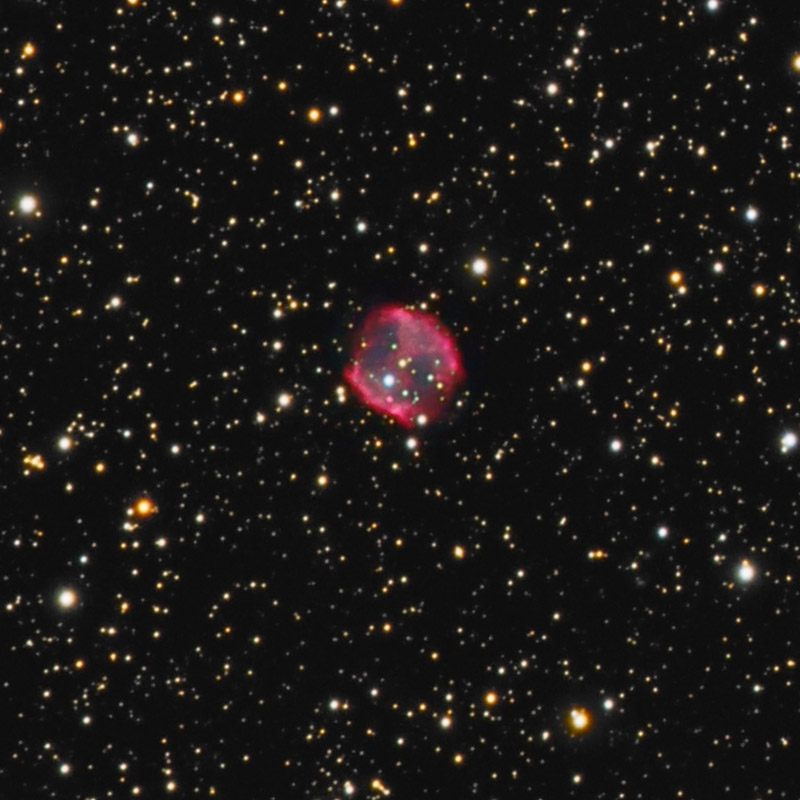
PNABELL82L4X10HA4X30RGB2X10R-CROP125.JPG
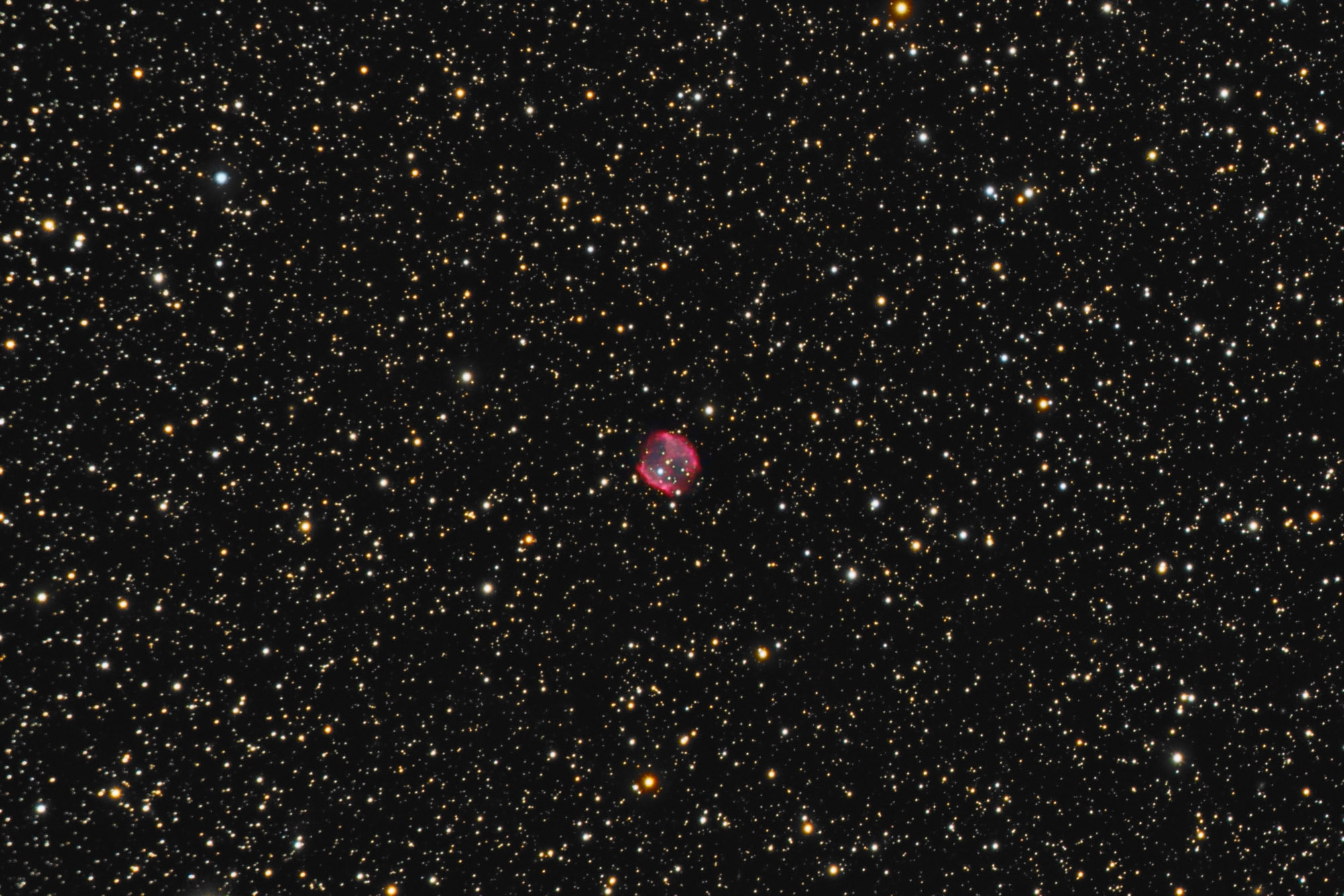
PNABELL82L4X10HA4X30RGB2X10R.JPG
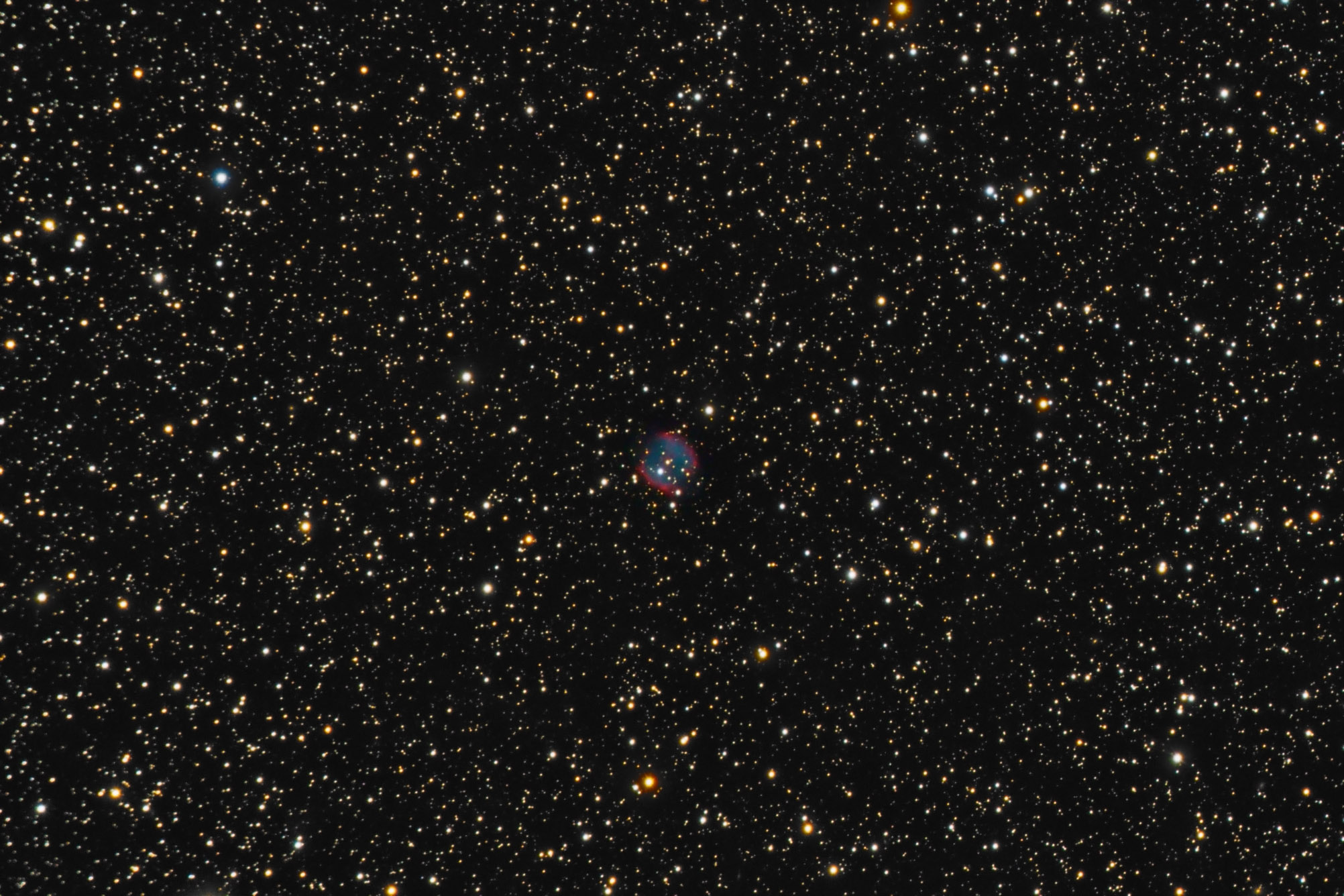
PNABELL82L4X10RGB2X10.JPG
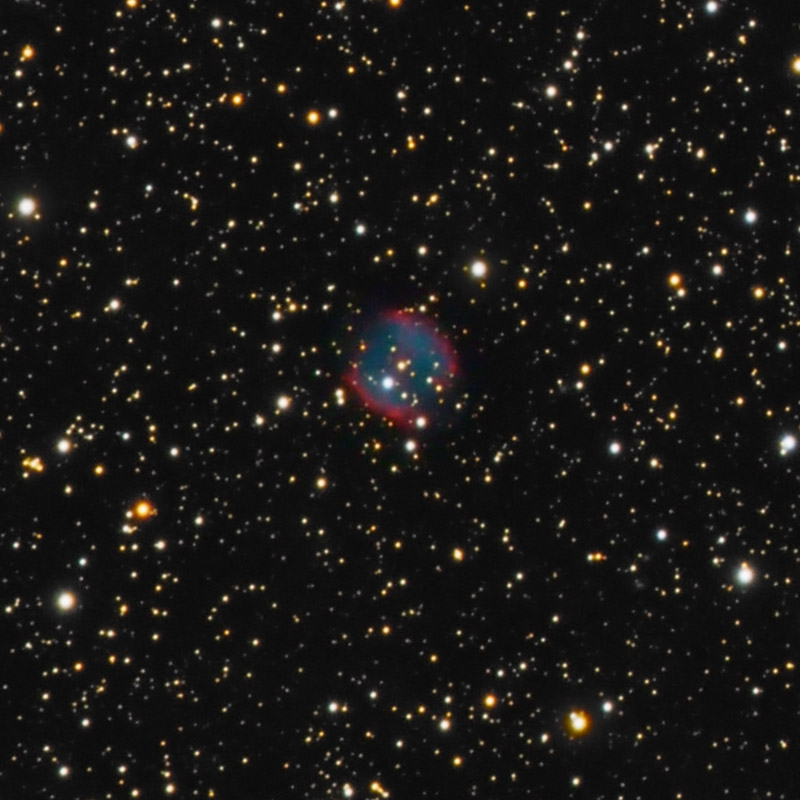
PNABELL82L4X10RGB2X10CROP125.JPG
|