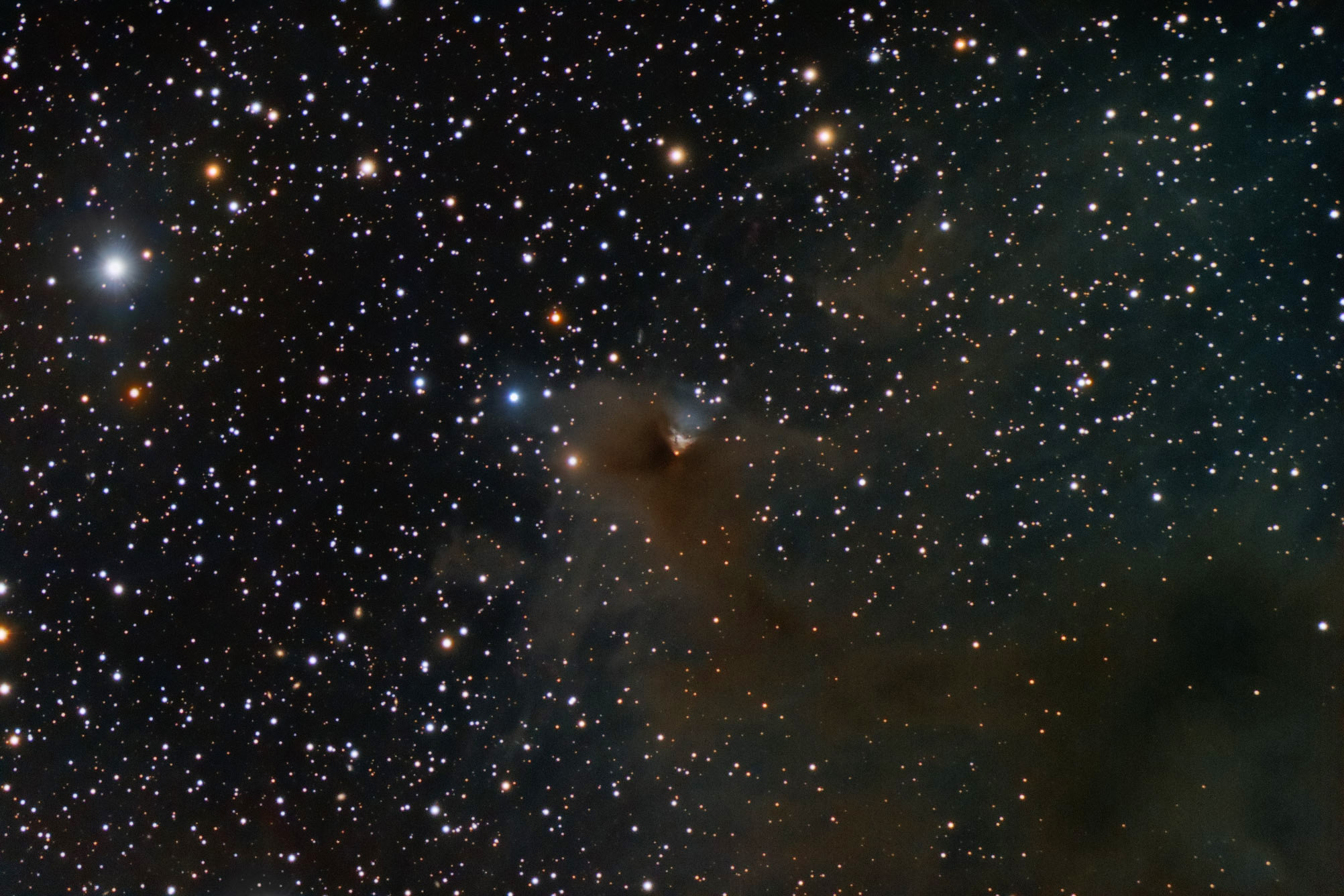
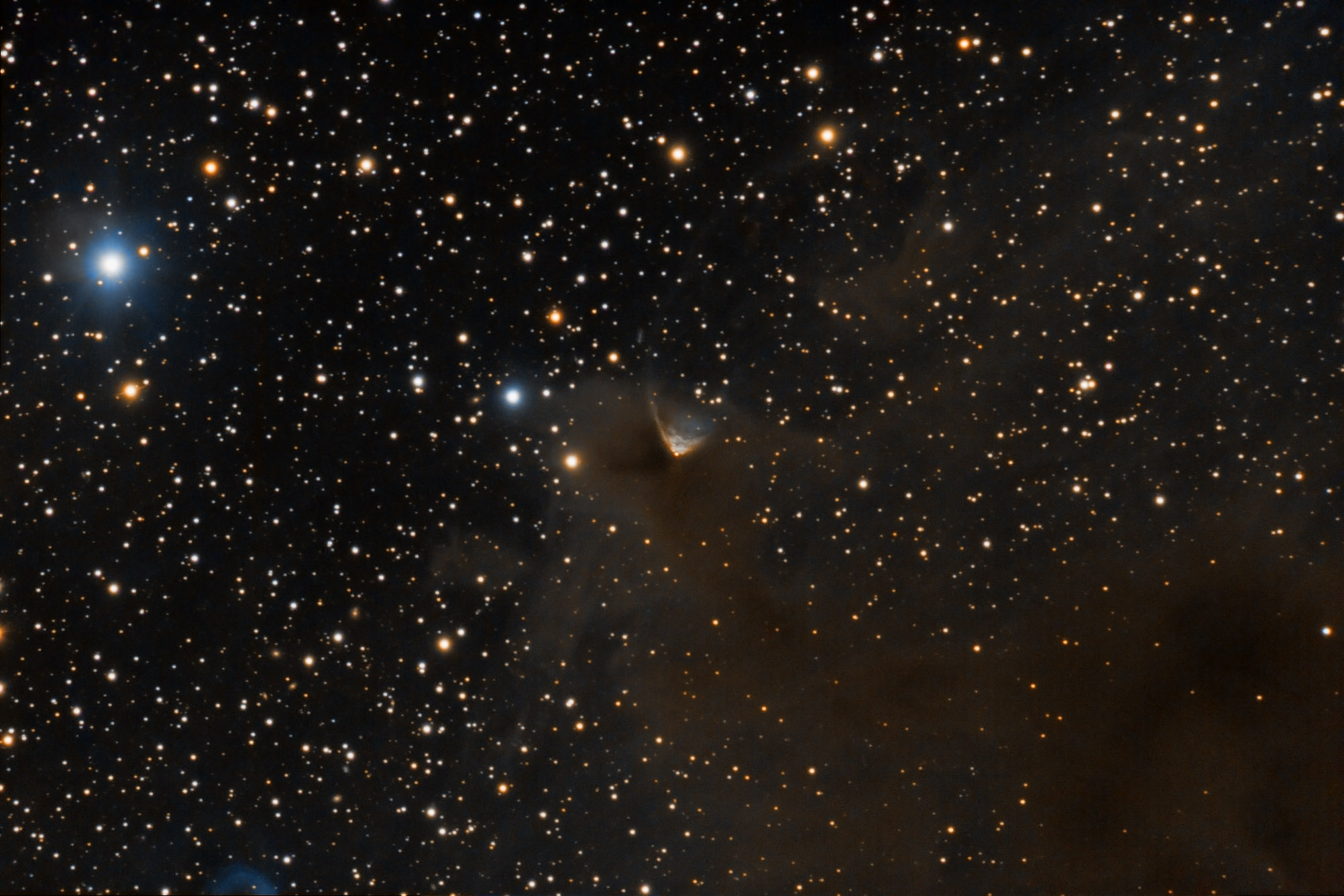
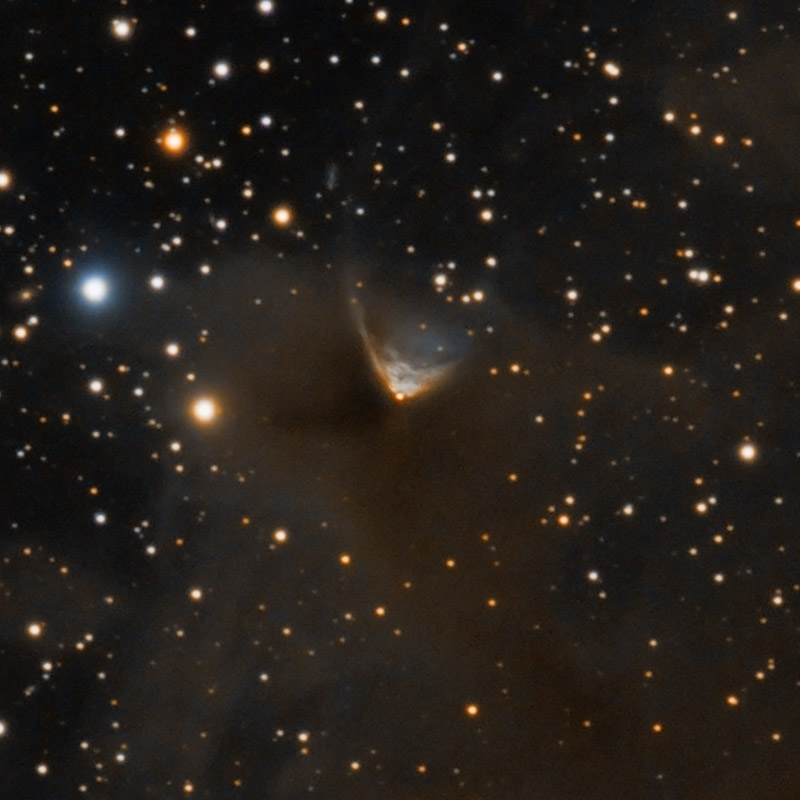
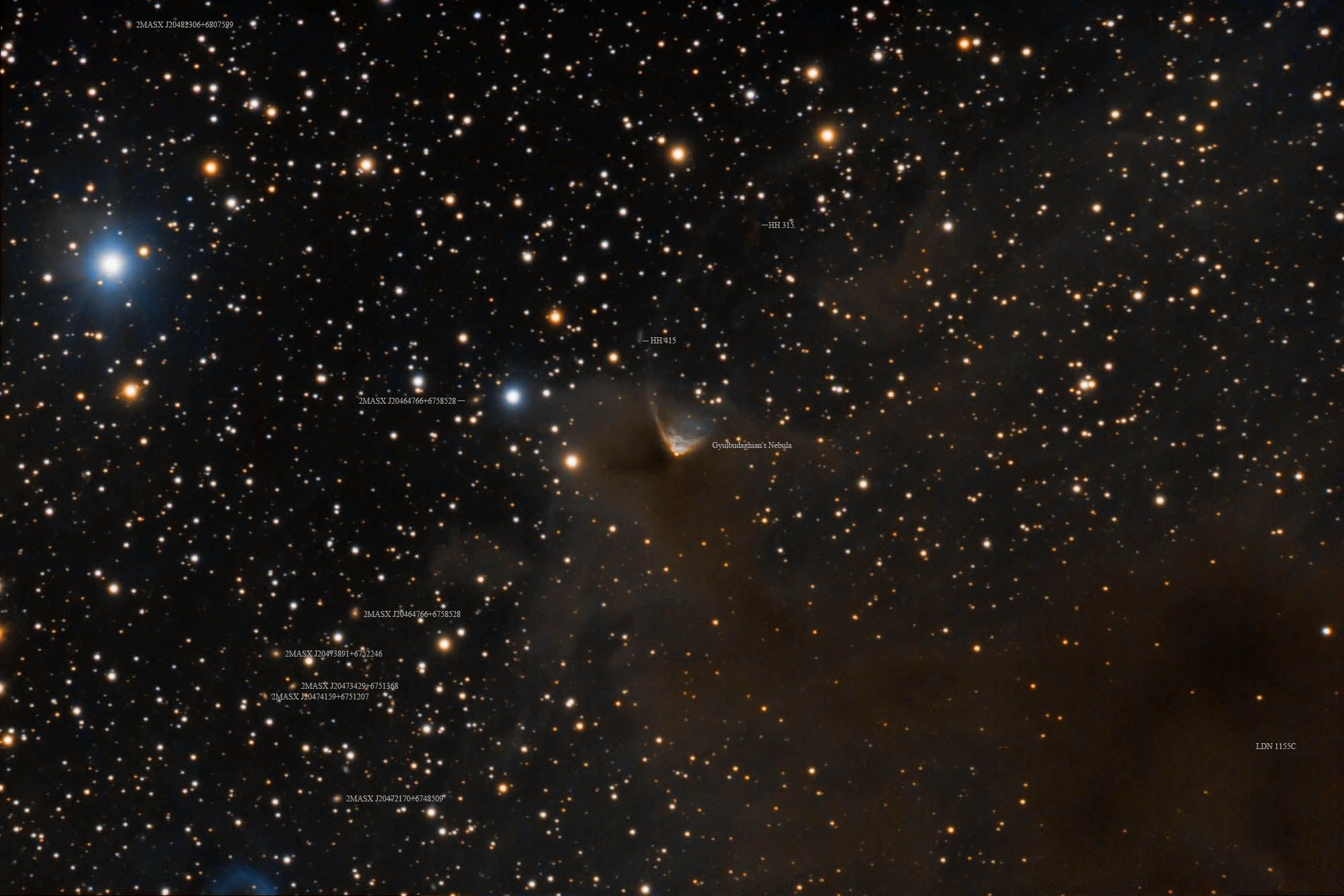
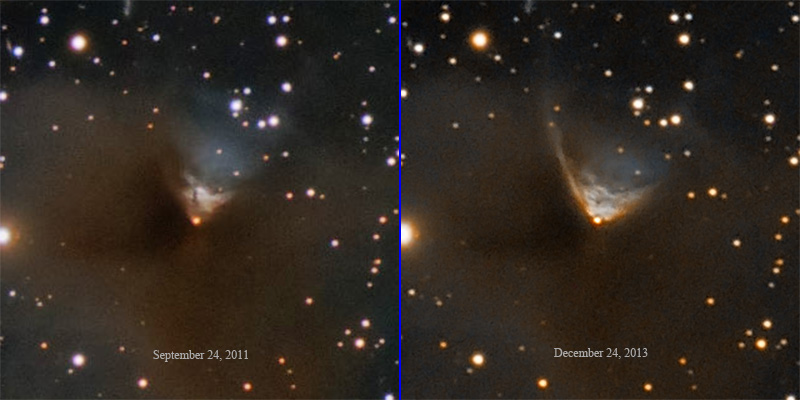
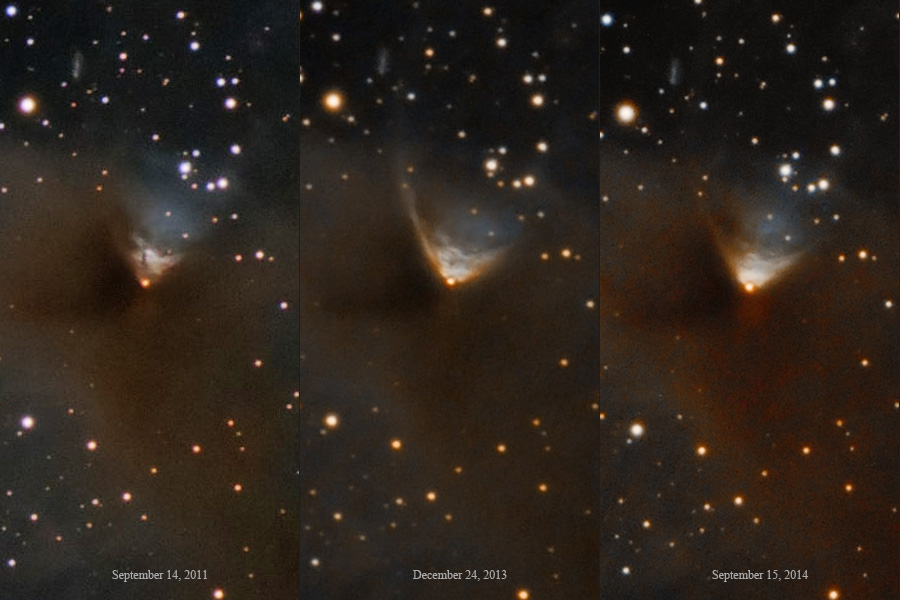
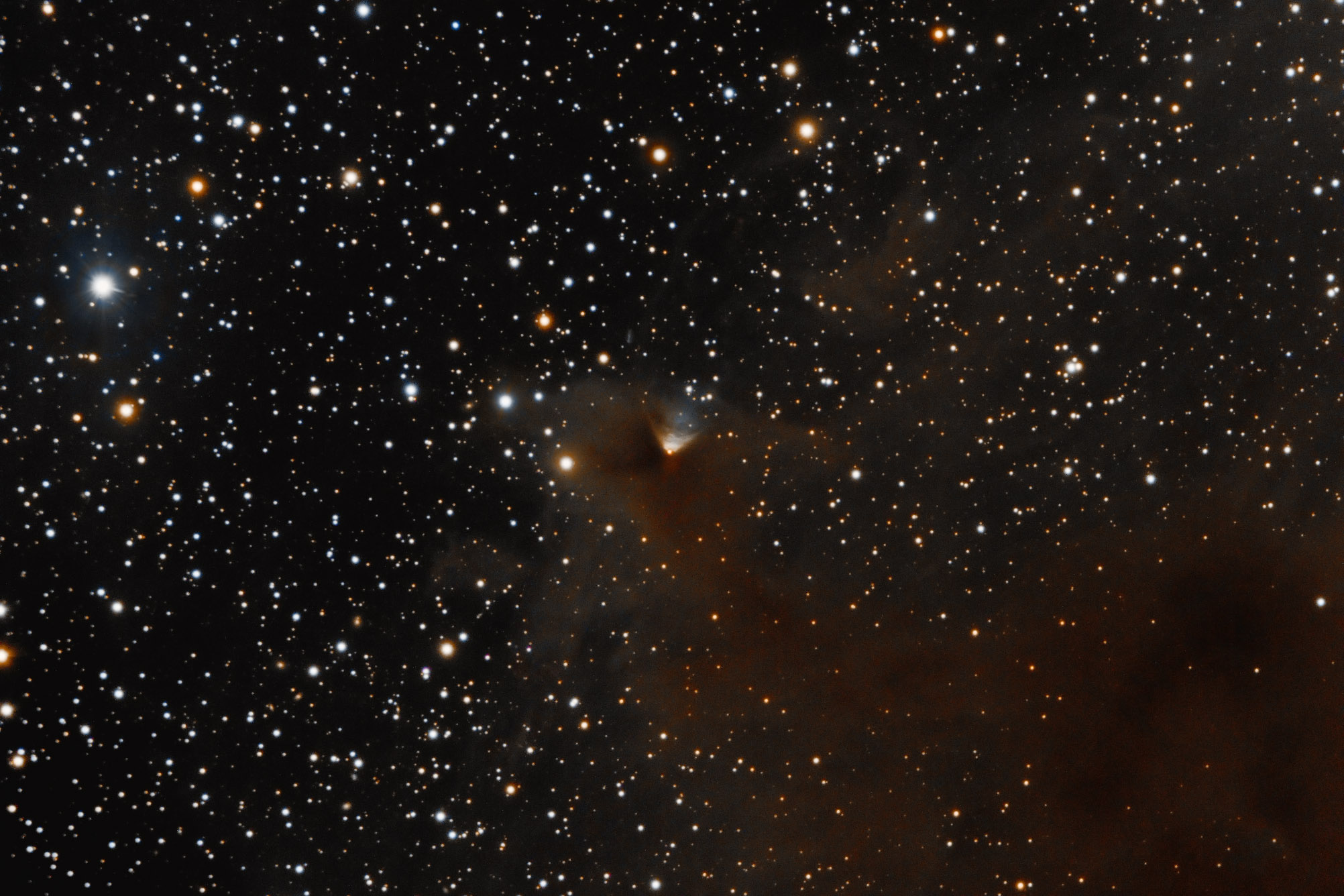
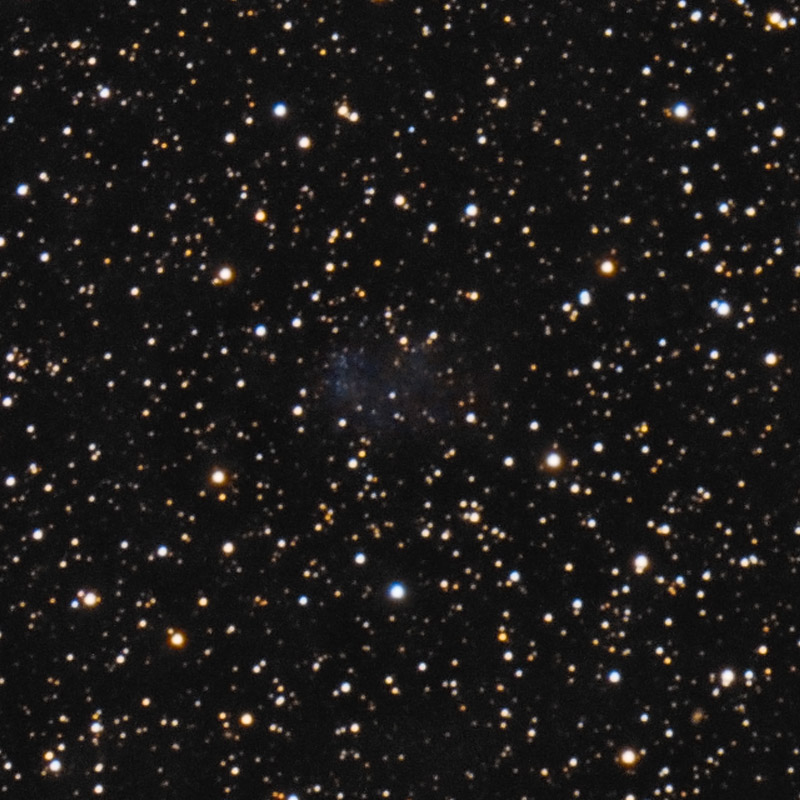
I've always updated my image of Gyulbudaghian's Nebula, a variable nebula, about once a year. I took this year's version in July earlier than usual hoping to try again in a few months. It didn't get processed until earlier this month which reminded me I was going to try again. Unfortunately conditions so far this month have been very bad. Fog and haze moved in even as the first frame was starting. I ended up taking 8 luminance frames none of which were very good but combining all 8 I sort of got something useful. There were nasty fog halos around bright stars I sort of dealt with. Removing them but not the nebula behind them was quite a challenge. Color data was very poor due to the fog. I about gave up on processing this but finally managed to get something useful by using the color data from last July so if it changed color this image won't show that. I could try again once the moon is out of the way. If so that would give a very short term view of how it changes. Looking at the November 8 image it looks much like it did a year ago rather than as it did in July. So it may very well show variations in only two or three weeks time. If the weather ever cooperates maybe I can find out. But it's biggest change appears to be in PV Cephi itself. Being a protostar it is an irregular variable commonly running about magnitude 16.5 but with sudden peaks to 15 and slow dips to 18th magnitude. Except for this image all the others appear rather constant at mid 16th magnitude. Due to it being embedded in nebulosity I can't get a good measurement but it appears about 14.8 in my images which would put it near a typical maximum. Something none of my other images have caught before.
For more on this nebula see my November 4th post
14" LX200R @ f/10, L=8x10' RGB=2x10', STL-11000XM, Paramount ME Related Designations for PVCEPPV Cep, IRAS 20453+6746, IRAS F20453+6746, AKARI J2045533+675743, PVCEP, 12, 13, 14, 15, 15N, | 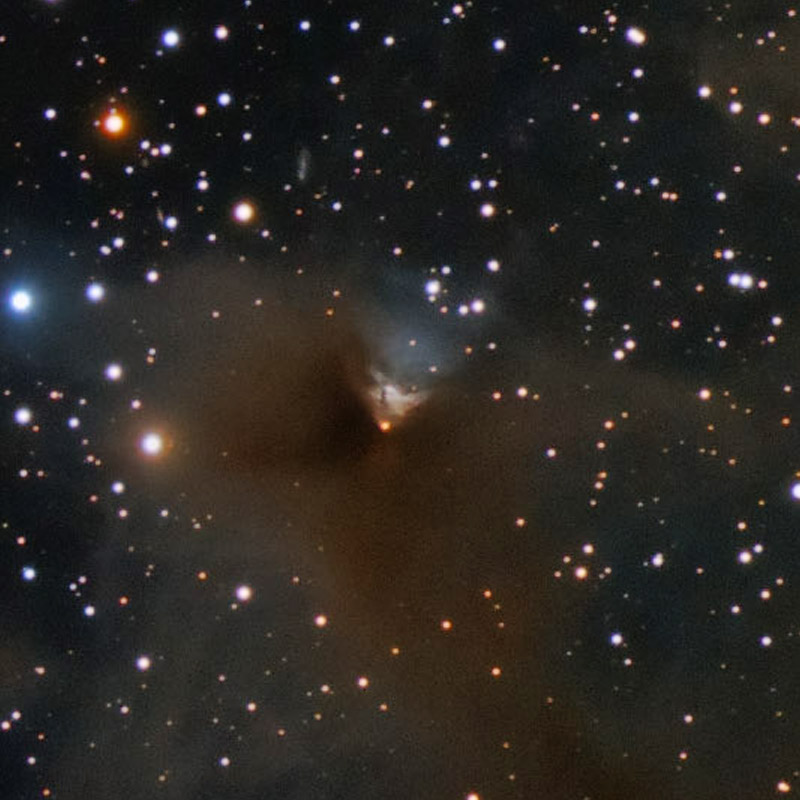
PV-CEPL8X10RG2X10B4X10R1-CROP150.JPG
PV-CEPL8X10RG2X10B4X10R1.JPG
PVCEPHI_L8X10RGB2X10.JPG
PVCEPHI_L8X10RGB2X10CROP125.JPG
PVCEPHI_L8X10RGB2X10ID.JPG
PV_CEPHI_COMPARE.JPG
PV_CEP2011-14.JPG
PV_CEPL8X10RGB2X10.JPG
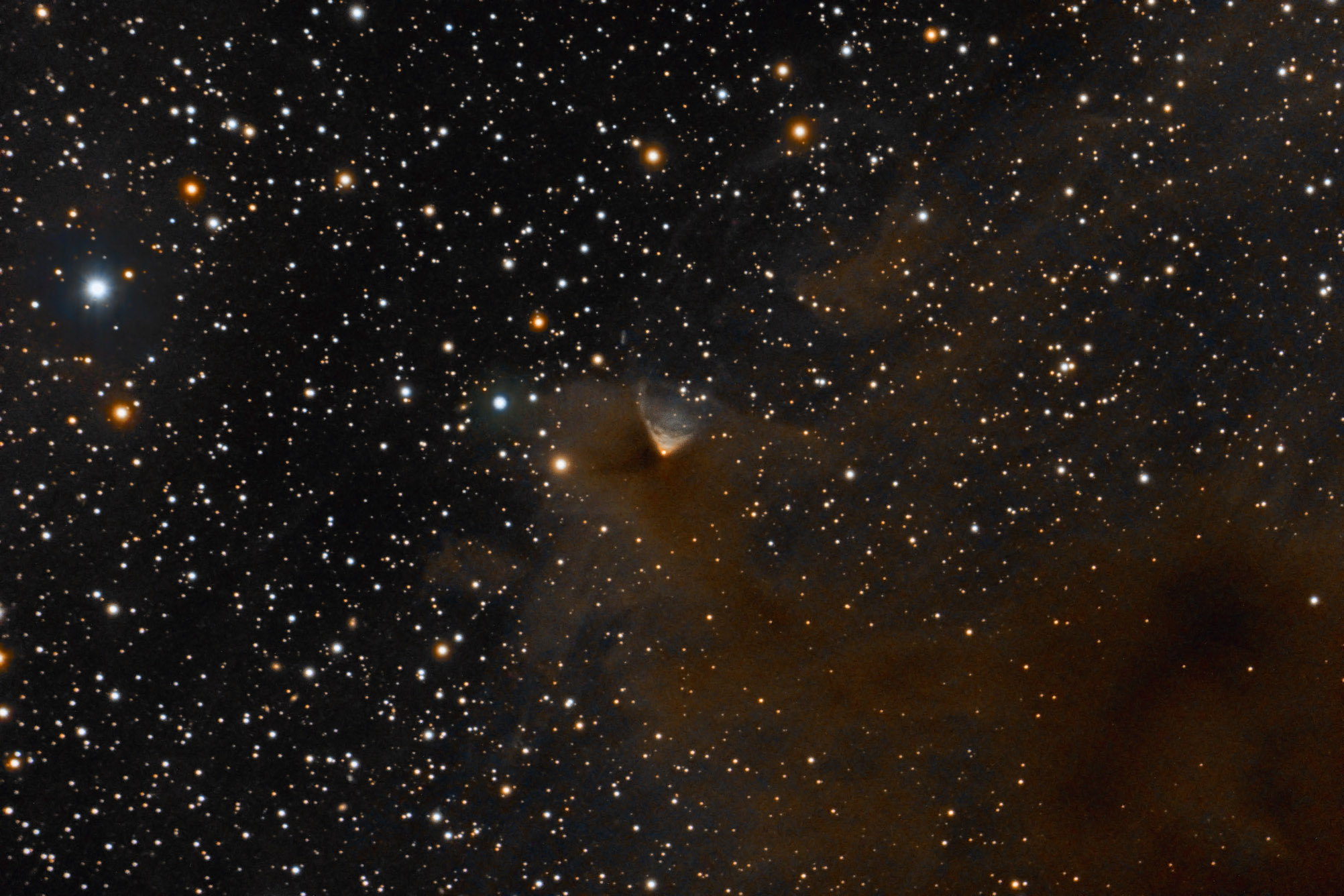
PVCEPH15L5X10RGB2X10R.JPG
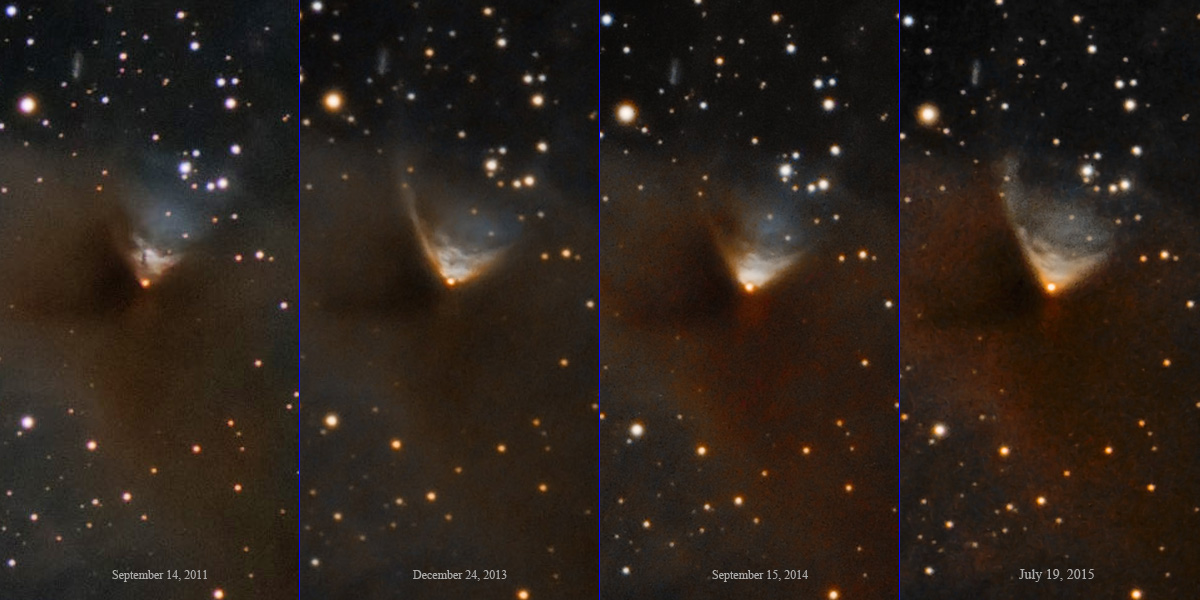
PV_CEP2011-15.JPG
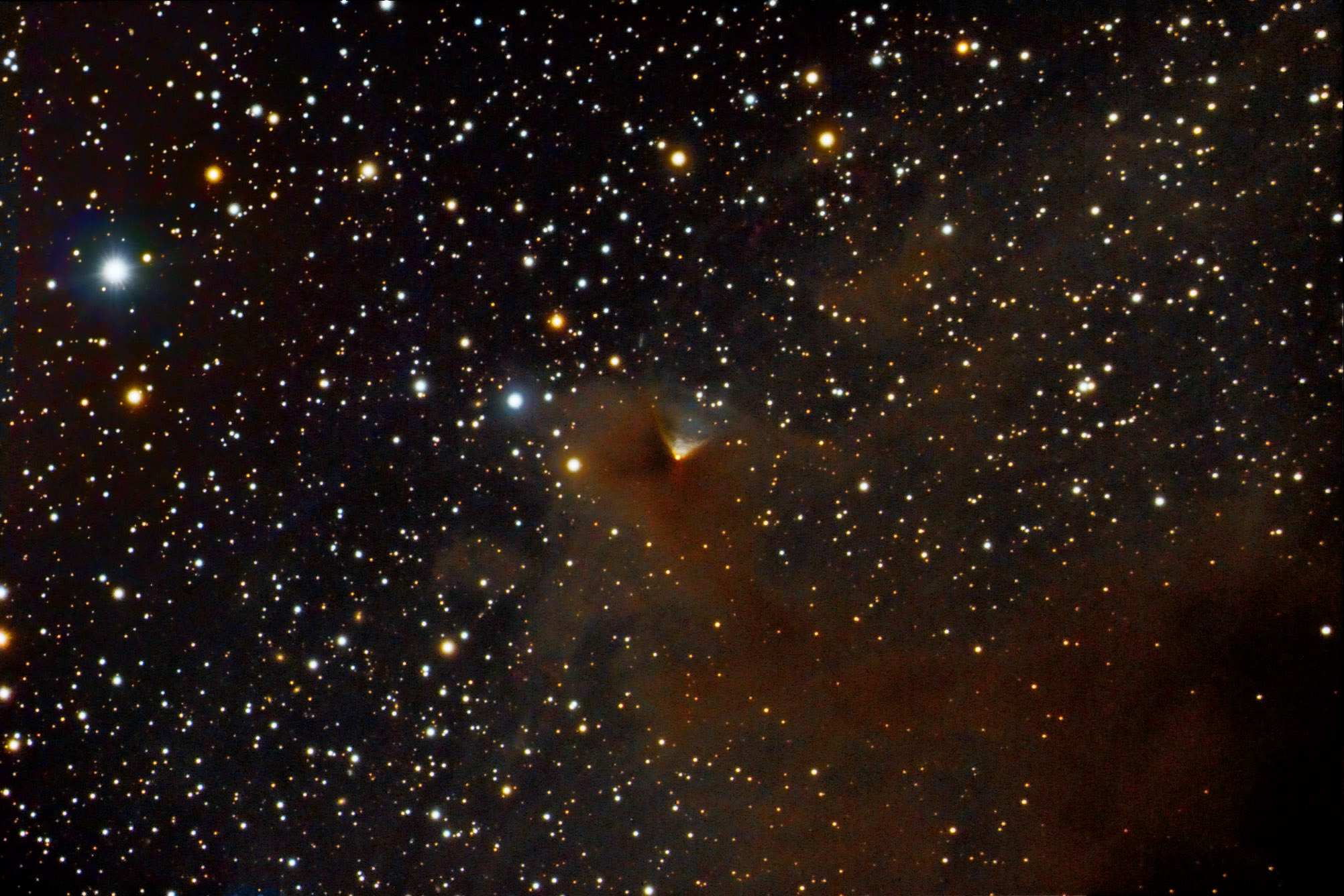
PVCEPHI-L8X10RGB2X10N.JPG
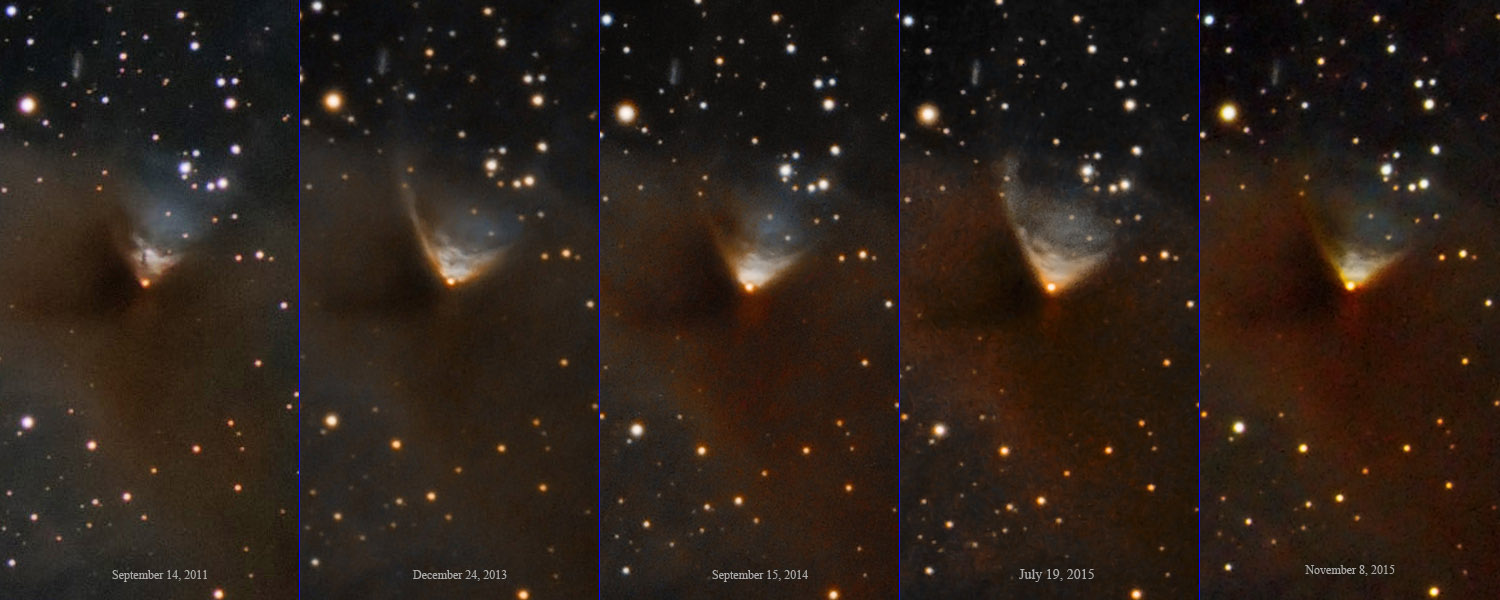
PV_CEP2011-2015NOV.JPG
| In my entry of NGC 3079, I mentioned a nearby twin quasar just out of the field. Einstein's concept of gravity is a warping of space-time by an object with mass says that if you have a great enough mass it can deflect light much like a lens can bend light. This is called a "gravitational lens". Astronomers searched for decades but didn't turn up much. As scopes could go farther and farther into space a few candidates turned up. Some were seen and not recognized. This is an image of one of these unrecognized gravitational lenses. The first picture shows NGC 3079 at the very bottom with a "double star" circled. This is no star, however.
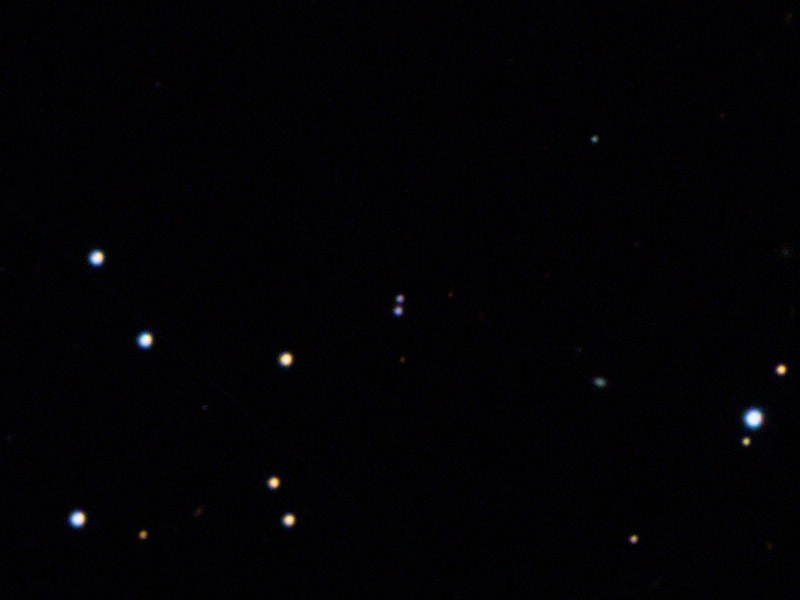
The close up below shows the "stars" to be blue in color. Eventually, some astronomer noticed that these were variable stars. Their light output varied slightly. So slightly it was best seen in a spectroscope as a change in the spectral lines along with a slight brightness variation. The odd thing was the spectra of these two objects was almost but not exactly the same. This was a bit of a puzzle as the spectra were very different from that of a star. In fact, it didn't match any known star type. To have two so close together made no sense. Nor could any lines be identified to help give a distance in case this was a galaxy rather than a star. Eventually, it was realized these were quasars. Star like objects so redshifted their spectra made no sense to astronomers used to "normal" redshifts. After more study, they realized this was not two objects but was one. This is the first gravitational lens to be recognized. The spectra were virtually identical if you took time into account. One spectrum lagged about 430 days behind the other! This meant the light traveled 430 light days further to reach us than the light making up the "other" quasar. The announcement was first made in 1979, Hubble answered another puzzle. The spectra of the lower object also had lines in it that were to be expected of a much nearer galaxy. It turns out this galaxy is the lens and at my resolution of about 2.5" of arc due to my local seeing it can't be seen. You need sub arc second resolution to separate the two. Something possible in space but not normally on earth at blue wavelengths. I see it only as the lower one being brighter as it is the light of both the lensed QSO and the galaxy. Hubble's image and a bit more on this guy can be seen at: http://www.astr.ua.edu/keel/agn/q0957.html
My exposure is very short due to clouds cutting me off and doesn't go very deep compared to most of my images. A nearby moon didn't help! Also, it is taken at 0.5" per pixel compared to my more normal 1" per pixel. The quasar images are 6" of arc apart (a quarter seen nearly one kilometer away). The quasar QSO 0957+561 is about 8.85 billion light-years away light travel time. The path followed by the upper image is 430 days shorter than the lower image.
14" LX200R @ f/10, L=4x10'x1 RGB=1x10'x2, STL-11000XM, Paramount ME Related Designations for QSO0957+561[HB89] 0957+561, SBS 0957+561, WISE J100120.68+555355.4, SDSS J100120.69+555355.6, LQAC 150+055 010, 87GB 095758.5+560808, 87GB[BWE91] 0957+5608, [WB92] 0957+5608, NVSS J100121+555355, VLSS J1001.3+5553, 6C B095757.6+560821, 7C 0957+5608, 8C 0958+561, TWIN QUASAR, TXS 0957+561, IERS B0957+561, RGB J1001+558C, WB J1001+5553, WIBRaLS J1001+5553, MS 0957.9+5607, RIXOS F252_031, E 0957+561, RX J1001.3+5553, RX J100120.3+555349, RX J100120.6+555355, 1RXS J100121.5+555351, AX J1001+5555, [YGK80] 0957+561, NGC 3079:[PTV98] H09, NGC 3079:[PTV98] P12, RX J1001.3+5553:[BEV98] 001, [JBB2007] J100120.69+555355.6 , [RLH2011] J1001+5553, QSO0957+561, TWIN QUASARS, | 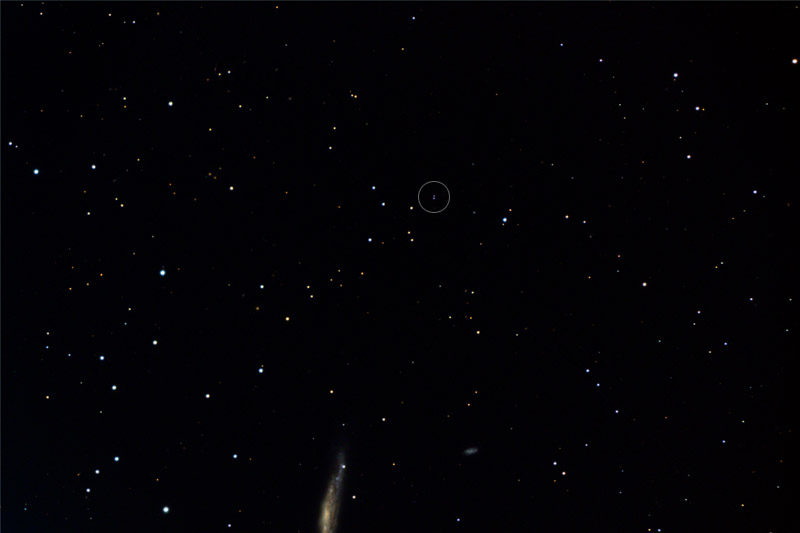
L4X10X1RGB1X10X2-20r.jpg
L4X10X1RGB1X10X2cropr.jpg
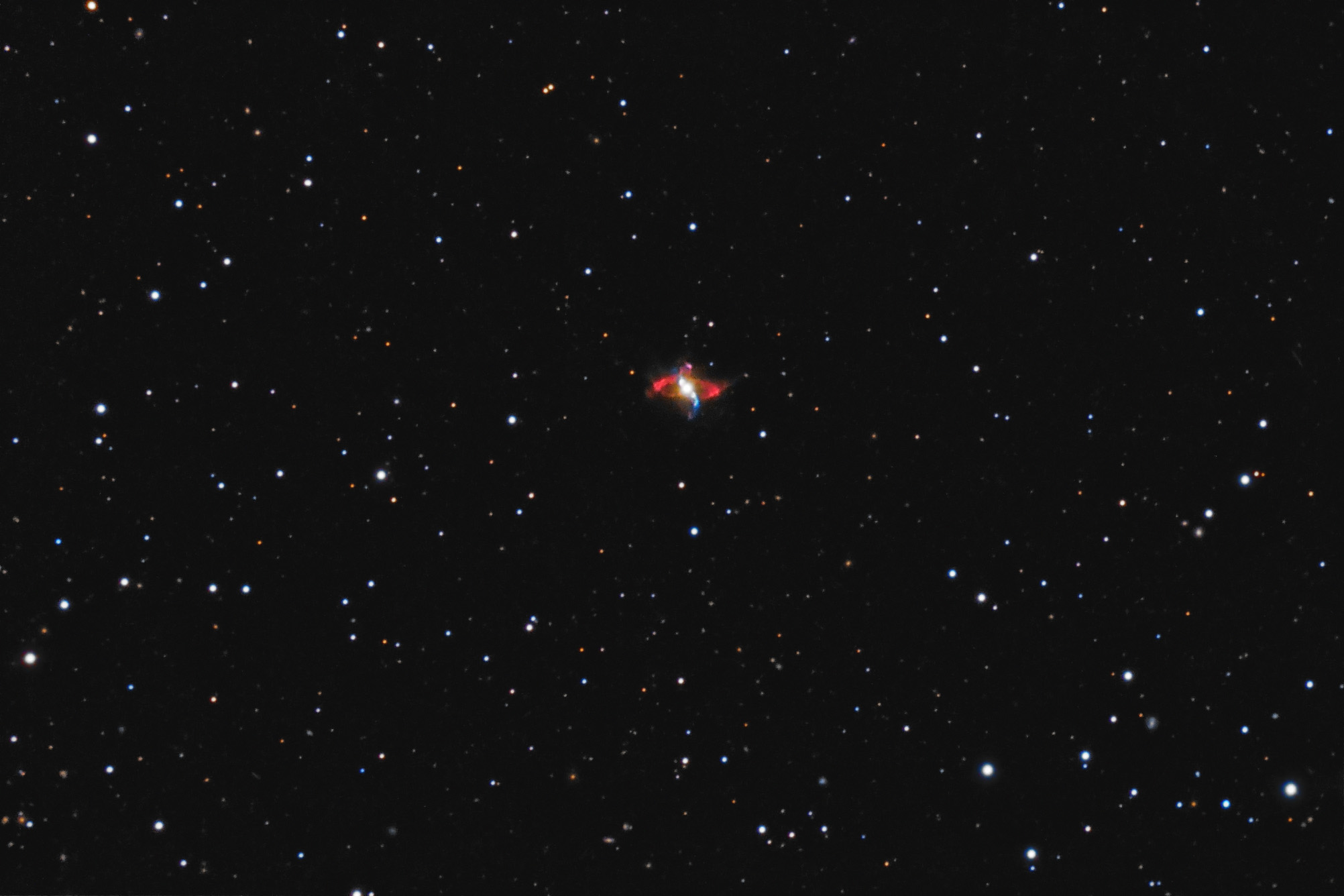
| I know of nothing else like this object yet many of you probably never heard of it. Amateur images of it are rare. R Aquarii/HD 222800 is a most interesting variable star. It is a Mira type double star with a white dwarf companion with a period of around 44 years that can't be resolved (except maybe by the HST) but is seen in the spectrum. The pair form what is known as a symbiotic star at a distance of about 650 light-years from earth. The relationship has resulted in at least one, likely two, nova-like eruptions. The result of all this is a nebula around the star known as Cederblad 211 which consists of blue jets and red loops making for a very colorful nebula complex. There are two jets. The one running from the southwest to northeast is easy to see in my image. The smaller one going from the southeast to northwest is seen simply as making the star appear oval in shape. I was unable to resolve any more than that. The star is located at 15° south so down in my poor seeing low to the horizon. I had to try many nights just to get the seeing I did to capture this system. You can read a lot more about this star and nebula at http://www.aavso.org/vsots_raqr .
The star ranges rather widely in brightness. The minimum in current years is usually around magnitude 11 or lower but its brightest can hit 5th magnitude and it has been even brighter and dimmer. To best capture the nebula I had to wait for it to be near minimum which was only 1% of its normal brightest illumination. Unfortunately, conditions were poor at minimum I had to wait two weeks later when it was starting to rapidly brighten and move into my Meridian Tree. That meant fighting a moon, tree and the very short imaging time I have for objects this low. I had to go for it anyway or the star would be bright enough to cause real problems. Clouds then clobbered the green frames. One was sort of usable. Fortunately weak green is rather easy to compensate for. Especially since it has little green light. But, after years of trying I finally captured this elusive (for someone at my latitude) object.
The appearance of the nebula is said to change rather rapidly. Apparently, the illumination of it by the star is partly controlled by dust clouds moving around the star. As they move various parts of the nebula get more or less light. Unfortunately, this one is so low in my sky it is hard for me to get more than one night's view at a minimum when it isn't drowned out by a bright star. Though I suppose that too will change the nebula's appearance. Anyway, it is an interesting object to keep an eye on. I hope to revisit it again at another minimum. Hasn't happened as yet.
The HST probably has resolved the two stars. See this link for details: http://hubblesite.org/images/news/release/1990-15
I've seen claims the nebula can't be seen visually. While small I find that surprising. Those with large Dobs might want to take on this challenge. I can see it being lost when the star is bright but at minimum, I'd think it wouldn't be lost in the glare.
There are three asteroids in the image. All moving in direct motion which is rare for most of my images which have them moving in retrograde. So, in this case, they are moving from right to left. The one listed at 20th magnitude seems far fainter than what the Minor Planet Center predicted. The other two seem about right to me. It may be this one asteroid is very red and thus hitting the insensitive part of my chips response curve. Asteroid (76690) 2000 HZ73 passed right through a star. I'd have passed it off as an edge on galaxy if not for the Minor Planet Center pointing to the linear part as being an asteroid. I doubt there was an eclipse of the star as it appears just north of the star.
Only two galaxies have redshift data in NED. Both in the lower left corner. But for the asteroids, I'd not have made an annotated image.
14" LX200R @ f/10, L=4x10' RB=2x10' G=1x10', STL-11000XM, Paramount ME | 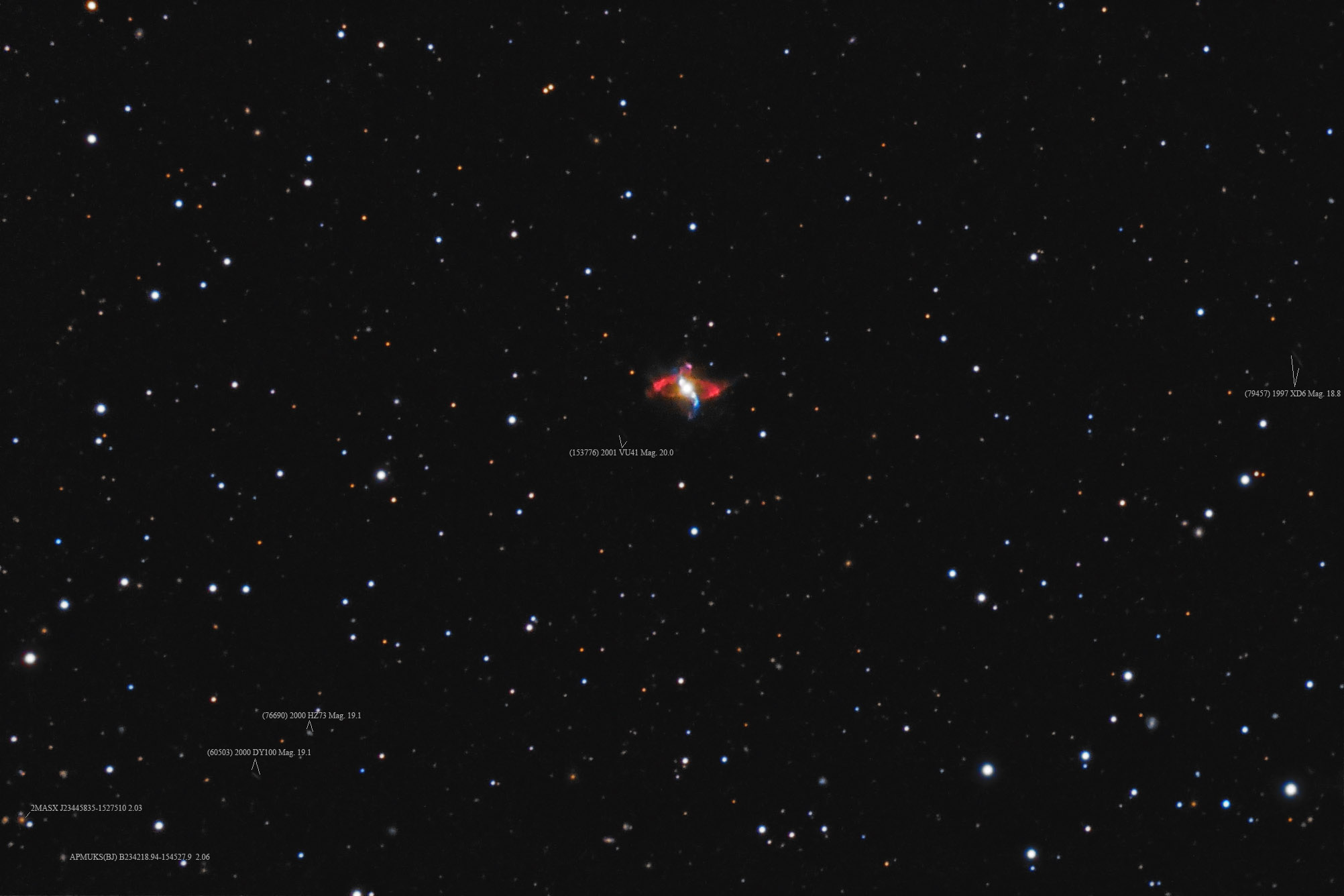
HD222800L4X10RB2X10G1X10R-ID.JPG
HD222800L4X10RB2X10G1X10R.JPG
| SagDIG (Sagittarius Dwarf Irregular Galaxy) is a distant member of the local group at about 3.4 million light-years. The stars in it have been known for years to be extremely metal poor. By that they mean it's stars have very few elements other than hydrogen and helium. This could mean it is very young or very old. The Hubble Space Telescope determined the stars are mostly fairly old. 4 to 8 billion years meaning only yellow to red stars should be seen. Yet its stars are very blue. Blue stars live only a few million years, not the many billions of years this study shows them to be. Turns out very old stars can be blue as well when metal poor. The supernova in 1987 in the Large Magellanic Cloud was blue rather than red for this reason. Also, star formation is still going on in this galaxy though not at a high rate. The galaxy wasn't discovered until June 13, 1977 on a one meter telescope survey plate.
My image also shows it to be quite blue even though it is low in Sagittarius and seen through much of dust and gas of our galaxy. After reading how old it was I expected it to be red. I even convinced myself the HST image showing it blue was due to the use of narrow band filters. They were used but that's not why the image showed it blue. I should have realized this but it took my image to drive the concept through my thick skull. While most stars are very metal poor 27 possible carbon stars have been seen in it.
I'd wanted to image this one for years but at nearly 18 degrees south it was so low I needed an extraordinary night. I got one though being very low atmospheric dispersion created some color alignment issues. That also meant the luminance data wasn't quite as sharp as the night would have allowed otherwise. Still, I've had less resolution at the zenith so I can't complain. I'd have liked more time but at this time of the year, I have too little dark time in a night. No other night compared to the seeing this night so I went with what I could do in one night. This low I have to catch it east of the Meridian so my window for the year has closed.
There's an asteroid (27159) 1999 AA2 making a near horizontal trail to the upper right of SagDIG about halfway to the upper right corner. There are a couple others, much fainter. Due to the high star count, they are mostly hidden behind stars so I won't try and point them out or make an annotated image.
A high-resolution image by the Hubble Space Telescope can be seen at: https://www.spacetelescope.org/images/opo0431b/ It is oriented with north to the right rather than at the top as mine is.
14" LX200R @ f/10, L=4x10' RGB=2x10', STL-11000XM, Paramount ME Related Designations for SAGDIGSagittarius Dwarf Irregular, ESO 594- G 004, ESO 192706-1747.0, UKS 1927-177, Sagittarius Dwarf, SGR Dwarf, SGC 192706-1747.0, AGC 590011, HIPASS J1929-17, PGC 063287, 11HUGS 403, [SPB93] 260, SAGDIG, PGC63287, | 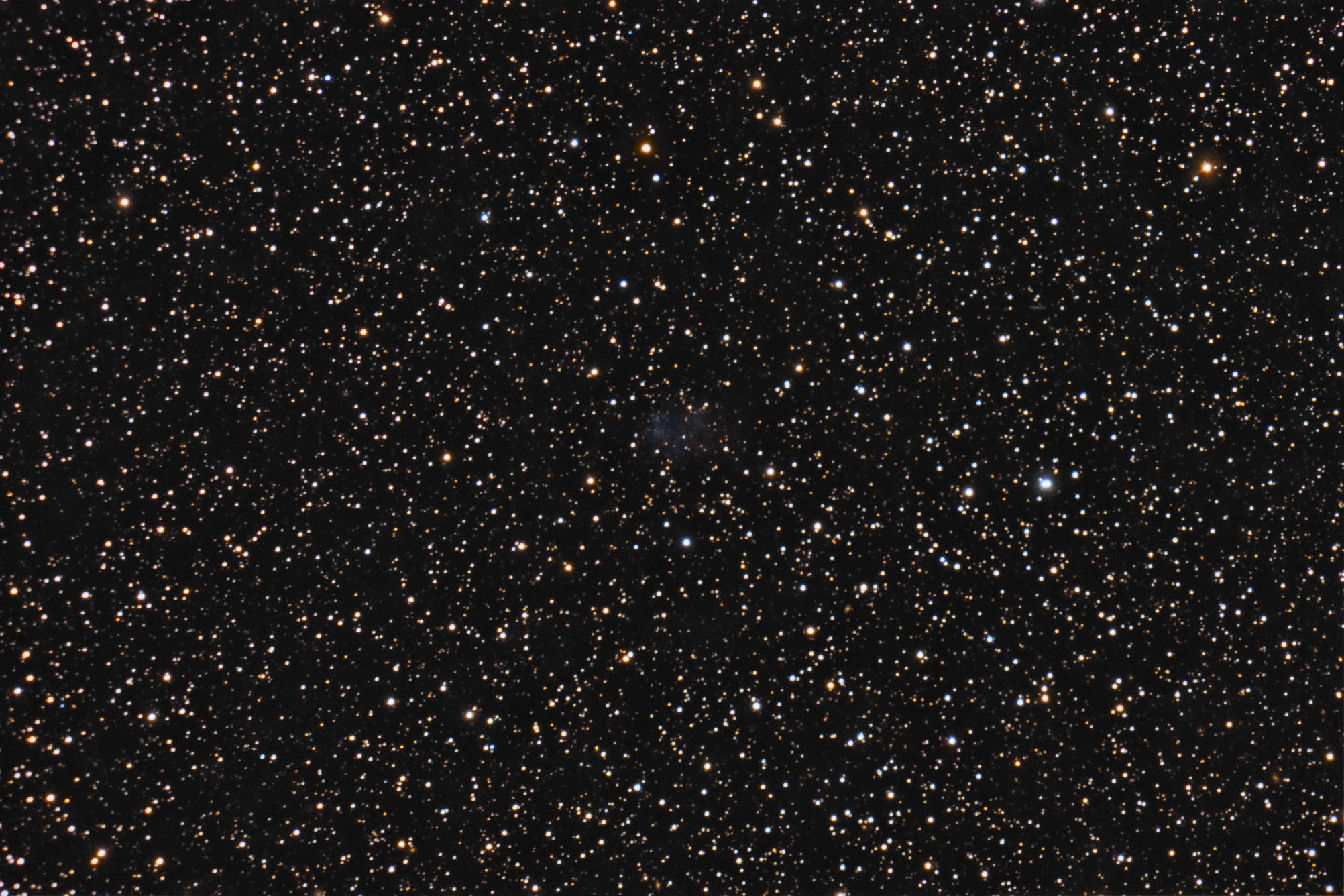
SAGDIG_L4X10RGB2X10.JPG
SAGDIG_L4X10RGB2X10CROP125.JPG
| Related Designations for SH2IC 1470, 2MASX J23050983+6014560, 87GB 230304.2+595825, 87GB[BWE91] 2303+5958, [WB92] 2303+5958, NVSS J230510+601438, TXS 2303+599, [ZHB90] G110.109+00.047, [KC97] G110.1+00.0, [GMT2008] IR 23030, NGC 1624, 2MASX J04403475+5027419, 87GB 043647.6+502152, 87GB[BWE91] 0436+5021, [WB92] 0436+5021, NVSS J044036+502744, 6C B043646.6+502153, 7C 0436+5022, SHARPLESS 212, [KC97] G155.4+02.6, SH2, | | Sh2-120 and Sh2-121 are a pair of emission nebula in Cygnus about 5 degrees north of the far more well known North American Nebula, NGC 7000. There is a lot of confusion in the catalogs about these two much to my surprise. Sh2-121 is listed as a galaxy in The Sky, PGC 2349711. SIMBAD misses the position of Sh2-120 by about 4 minutes of arc putting it where nothing is to be seen. Galaxy Map says that both 120 and 121 are at the same distance of 7500 parsecs (24,500 light-years) under their entry for Sh2-120. Under Sh2-121 they cite another source as putting it at 4500 parsecs +/- 1000 Parsecs (14,500 light-years +/- 3000 light-years). Then in a third paragraph says it is at a distance of 6500 parsecs (21,000 light-years). In other words, determining the distance to these is full of uncertainties. The citation that puts it at 6500 light-years adds that it is surrounded by an expanding shell containing about 39 solar masses of gas that is about 650,000 years old. All this driven by an O8.5 star. Which star that is I don't know.
The H alpha data was mixed using lighten mode with the percentages shown. I've found this mix retains the color seen in RGB images, at least with my system.
14" LX200R @ f/10, L=4x10'+Ha=2x30', R=2x10'+80% of the Ha data, G=2x10'+5%Ha, B=2x10+20%Ha, STL-11000XM, Paramount ME | 
SH2-120L4X10HA2X30RGB2X10R.JPG

SH2-120L4X10HA2X30RGB2X10R_CROP125.JPG
| SH2-271 and SH2-272 are two emission nebula, part of a much larger mostly invisible to visibly light molecular cloud in northern Orion just east of his club. The naked eye B9 blue giant star, 73 Orionis, is in the upper left of my image. It created havoc in processing this image as it scattered a blue gradient everywhere. I have severely retarded this star so it appears many times dimmer than it really is at magnitude 5.4.
Many catalogs, including the database in my The Sky 6 program say the larger nebula, SH2-271, a planetary nebula calling it PK 197-02.1. It's in other planetary nebulae catalogs as well according to SIMBAD. The nebulae are excited by the two stars seen in their centers, an 09V and B1V stars. For some reason, SIMBAD locates SH2-271 4.5 minutes of arc east of its location and SH2-272 0.4 minutes west of its location. I don't know why the errors. The Sky makes the same error for SH2-271. SIMBAD also places a star cluster midway between the two nebulae's actual positions. Most of these stars are seen in IR rather than visual light as they are buried deep in the molecular cloud, two small parts of which make up the two visual nebulae.
While sources vary for a distance to these nebulae most say it is in the Perseus arm and give a distance of 15,600 light-years. Some include an error bar of 4,000 light-years. Distances for objects like this can be hard to determine. Assuming the 15,600 light-year distance the two nebulae span a distance of about 19 light-years.
Conditions were lousy when this was taken. So bad I threw out all the luminance data as too blurry to use due to fogging from high clouds and 73 Orionis. Instead, I used the two red images as less blasted by the star plus the H alpha data to make a pseudo luminance image. The H alpha data was added 80% to the red and 20% to the blue when making the RGB image. That left a severe issue with blue and to some extent green due to 73 Orionis and high clouds scattering its light. I had to use a lot of gradient tools to restore the color balance. Still, there's some glare around many stars. I need to redo this one on a night of much better transparency. I tried this one another night under slightly better conditions and moved 73 Orionis out of the field but that caused highly distorted ghostly images all over the image. These were even worse to deal with and the halos around the stars from the thin clouds just as bad. I never had weather conditions sufficient to try again.
This is my 6th and last February image. I see I saved quite a few more March images. I haven't had time to look at them to see if they are all usable. I am hoping this means conditions improved in March. I just can't remember. I do see this was taken before the end of February and the March images start about a week later due to weather issues.
14" LX200R, HA=4x30' RGB=2x10', STL-11000XM, Paramount ME | 
SH2-272PL2X10HA4X30RGB2X10.JPG

SH2-272PL2X10HA4X30RGB2X10CROP125.JPG
| Sh2-54/Gum 85 is a huge star-forming region in Serpens Cauda. It is part of the Serpens OB2 Association, a large star-forming region. I couldn't find any distance for it but most consider it related to the open star cluster NGC 6604 (a couple degrees out of my frame). That does seem to have a good distance measurement of 5,500 light-years based on Hipparcos and other sources. Though I've found a very wide range on the net these seem to be based on older, less accurate measurements. For more on this area of the sky see:
http://www.ifa.hawaii.edu/publications/preprints/08preprints/Reipurth_08-209.pdf
Sh2-54 is far too large for my system being about 9 square degrees in area. It does have a brighter area that does fit my image scale so that's the part I centered on. Note there are several "elephant trunk" features in the image. They all point back to NGC 6604 confirming its association with this nebula.
You can see the entire nebula at Dean Salman's website:
http://sharplesscatalog.com/Sharpless.aspx?Sharp=54
Normally I display images with north up. I am making an exception here and have oriented it south up. This is because my sick brain sees this nebula looking like a chihuahua making a rather rude gesture with its front legs. Maybe it should be known as the Rude Chihuahua Nebula? Since a chihuahua's leg can't bend in that direction without breaking that may explain why it is mad. I should mention I'm no fan of that breed. My maternal grandmother carried one wherever she went (long before Paris Hilton). I was 4 and told to kiss grandma good night. The dog chomped on my nose so hard I needed quite a few stitches. Next night I was told to do the same. I put up quite a fight but lost. This time the bandages helped, I only needed two stitches replaced. A couple days later my cat killed the blankety-blank dog much to my glee. The dog annoyed it one too many times. The cat was 20 pounds of muscle (Maine Coon), chihuahua 3.5 pounds of trembling "Jello" and sharp teeth. Is it getting back at me from the skies? My wife claims it looks like a pig but she had no encounters with that chihuahua.
14" LX200R @ f/10, L=4x10' RGB=2x10'x3, STL-11000XM, Paramount ME
I'm falling more and more behind. This was taken August 13, 2010. I've got to start turning them out like crazy it seems. I need some 36 hour days. | 
SH2-54L4X10RGB2X10X3.jpg
| Sh2-65/LBN 91 is a small emission nebula in Aquila just north of Scutum. The bottom quarter of the image is in Scutum in fact. Another emission nebula [KC97c] G029.0-00.6 lies to the west-southwest (right and a bit lower). Many dark clouds are seen in the image. All of these are identified only by their galactic coordinates from the SDC (Spitzer Dark Cloud) catalog so I won't list those. I found one paper putting its distance at 3.3 kpc (~11,000 light-years). The bright star near it, SAO 142615 at a magnitude of 9.65 is listed as an A2 star. These usually aren't strong enough in UV light to cause emission nebulae to glow so I doubt it is the exciting star. I was unable to find any hint of what star or stars are likely supplying the energy to make the clouds glow.
14" LX200R @ f/10, L=4x10' RGB=2x10' STL-11000XM, Paramount ME | 
SH2-65L5X10RGB2X10R1.JPG
| Sh2-71/LBN103 is a planetary nebula in Aquila a bit over 3000 light-years distant though the distance is a bit uncertain. Some sources consider the bright star at its center as the center star that created the nebula. It is an eclipsing double star which may explain the nebula's squashed shape. Others however say the central star is the very faint star seen barely in my image to the upper right of the bright star about half way to the double star above it. The nebula was discovered by Rudolph Minkowski in 1946.
14" LX200R @ f/10, L=6x10' RGB=2x10', STL-11000XM, Paramount ME | 
SH2-71LUM6X10RGB2X10X3.jpg
|