This is another twofer image. I had both Berkeley 26 (west) and Berkeley 27 (east) on the to-do list. I discovered I could catch both in one image. I also caught some nasty reflections. Normally I move the scope a bit and they vanish. Didn't help as there were several. I'd get rid of two and another appeared. I gave up and put it back to between the two clusters and tried to clone out the reflections. It's sort of obvious but with star clusters not too distracting. I've never mastered cloning out defects as large as these. One was as large as Berkeley 26 that was just to its west.
WEBDA says Berkeley 26 is a very old cluster, as clusters go. They show its age as just under 4 billion years. Most clusters are torn apart even at a third its age. Also, it is quite distant, some 14,000 light-years beyond the sun. That makes it nearly 30,000 light-years from the galaxy's core. This means it spends most of its time on the outskirts of the galaxy where tidal and ram pressure forces are low. This is how it has survived so long. But its bright stars that make cluster's sparkle have long since died leaving a dim cluster. Also, it is reddened by 0.75 magnitudes. This further reddens its remaining stars.
Since Berkeley 27 is brighter and somewhat bluer I expected it to be younger and closer. It is younger at 2 billion years of age rather than 4 but it is more distant at 16,400 light-years. Even more surprising is that it is reddened by only 0.05 magnitudes. I notice even field stars are fewer in the lower right quadrant than the rest of the image though I don't see any reddening. Is this dust cloud to blame? The younger age helps explain why it is bluer and brighter as its F type stars are still around.
The field is 4.75 degrees west of the Rosette Nebula, an area known for dust. I just expected it to be more evenly distributed across my small field. At 17 degrees below the ecliptic, it isn't too surprising I didn't pick up any asteroids.
While a few faint galaxies can be found in the image none have distance data and most are very faint so I've not prepared an annotated image.
14" LX200R @ f/10, L=4x10' RGB=2x10, STL-11000XM, Paramount ME
http://www.mantrapskies.com/image-archive/OTHER/BERKELEY026-BERKELEY027/BERKELEY27-27L4X20RGB2X10-67.JPG
http://www.mantrapskies.com/image-archive/OTHER/BERKELEY026-BERKELEY027/BERKELEY27-27L4X20RGB2X10.JPG
| 
BERKELEY27-27L4X20RGB2X10.JPG
| Berkeley 29 is considered the most distant known open cluster residing nearly 72,000 light-years from our galaxy's core. Most cite a size of 100,000 light-years for the galaxy but it really is much larger as this cluster indicates. It's located in southern Gemini some 50,000 light-years from us. I measure its size at about 3 minutes of arc though defining it is pretty fuzzy at best. That would make it some 40 light-years across. That's pretty large for an open cluster. Apparently, only its great distance makes it looks so compact.
WEBDA gives an age of just over 1 billion years for the cluster though a 2004 paper http://adsabs.harvard.edu/full/2004MNRAS.354..225T puts the age at 3.4 to 3.7 billion years. In either case, it is quite old for an open cluster. Usually, tidal forces rip clusters apart rather quickly but residing so far out it may not see those forces very often. I don't know if its orbit is known. It may never come close in to experience such forces. The age makes it possible the orange stars seen it are red giant members. It also explains why most of the stars are white, rather than blue. The blue ones have lived their lives and are gone leaving only older stars. The red main sequence stars are too faint for me to pick up leaving white as the color I'd expect for a cluster of this age at this distance.
Being deep in the Zone of Avoidance none of the many galaxies seen in the background have redshift data at NED so I didn't prepare an annotated image. None even made the PGC except for the cluster itself. I can't explain it but the UGC, MCG, CGCG, UZG (Updated Zwicky Catalog) and PGC all list this cluster as a galaxy. Even my The Sky shows it as a galaxy rather than an open cluster. There must be an interesting historical reason for this but I was unable to find it. If anyone knows please let me know.
To keep the file size down with all the Milky Way stars and because there's really nothing to see but for stars, I cropped the image but it is reproduced at my normal 1" per pixel. I actually had seeing making this reasonable for a change.
With reasonable transparency and no satellites, I took only one color frame rather than my normal two.
14" LX200R @ f/10, L=4x10' RGB=1x10', STL-11000XM, Paramount ME | 
BERKELEY29L4X10RGB1X10.JPG
| Berkeley 67 turned out more interesting than I expected when Sh2-211 showed up unexpectedly in the frame. While many Sharpless objects show up in my default settings for The Sky this wasn't one of them. Also, the field has a lot of very faint dark nebulae in it, especially to the north of the cluster. The field is located in the northeast corner of Perseus.
WEBDA puts the distance to Berkeley 67 at about 8100 light-years and says it is reddened by 0.79 magnitudes. The main reason its stars are red however is its age which is one billion years per WEBDA. The really blue stars have long since died leaving mostly white and cooler stars. Couple that with the reddening and the star colors make sense. Amateur images of this cluster in color are very rare. I found only a couple.
The dark nebula immediately north of the cluster is DOBASHI 4098. At the very top of the image is the dark nebula TGU H1036 P1. The ill-defined dark nebula north of Sh2-211 is [DB2002b] G154.61+2.53.
Sh2-211 has an infrared star cluster embedded in it. Some of the stars can be seen in visible light. The three brightest stars are part of this cluster. Like Berkeley 67 I found little in the way of amateur images of this nebula. Those also included the Berkeley cluster and one was wide field enough to catch Sh2-212 out of my frame to the southeast. It is a much better and more commonly imaged object.
Trying to find distance estimates for Sh2-211 wasn't easy. I came up with three at one source ranging from 11,500 light-years to 25,000 light-years. Some say it may be part of the same molecular cloud as Sh2-212. But the distance estimated for that object ranged from 19,500 light-years to 21,500 light-years. A much smaller range. There is some overlap. Lots of uncertainty here.
Why this interesting field is so rarely taken by amateurs is a mystery to me as there's a lot going on here.
14" LX200R @ f/10, L=4x10' RGB=2x10', STL-11000XM, Paramount ME
Rick
http://www.mantrapskies.com//image-archive/OTHER/BERKELEY067-SH2-211/BERKELEY067L4X10RGB2X10.JPG
http://www.mantrapskies.com/image-archive/OTHER/BERKELEY067-SH2-211/BERKELEY067L4X10RGB2X10CROP.JPG
| 
BERKELEY 67L4X10RGB2X10.JPG
| Berkeley 82 is a small open cluster in northeastern Aquila. It resides on the edge of the dark rift that runs through much of the constellation. This is why the lower right corner has far more visible stars than the upper left portion of my image. WEBDA puts its age at 31 million years. Still, it is old enough to have two stars that have evolved into red giants in that short time. Its distance is just under 3,000 light-years according to WEBDA. I'd have thought that would put it in front of most of the dust of the Milky Way but WEBDA says it has been reddened by just over 1 magnitude indicating the dust from this portion of the rift is apparently rather close to us.
As with many Berkeley clusters, the coordinates of this one vary quite a bit from source to source. The Sky wanted to put it about 3 minutes northwest of its real position. WEBDA shows it about the same north of their position for example. For such a small group how it's position in many catalogs be outside the boundaries of its major stars, I don't know. Unless they are off center from a large faint group of stars not obviously part of the group. But since no two sources agree as to its position I doubt that's the problem. Fortunately, I took this one in the evening just after it was dark enough to start an image so saw The Sky's position error and recentered on the cluster. Though I didn't see this until the first luminance frame came in. Then I forgot to retake that frame so ended up with only 3 luminance frames. Including the first one would have severely cropped the image losing some of the fall-off in star numbers so I went with only 3 frames. Star clusters, being bright, can survive a lower signal to noise ratio than can nebulae and galaxies with their faint outer regions.
There may be another cluster to the upper right of Berkeley 82. SIMBAD shows the small group of bright stars there as DSH J1910.8+1312. DSH stands for Deep Sky Hunters. They are cataloging all types of previously unknown deep-sky candidate objects. So is this a true cluster or just a bright asterism? I'm voting for it being an asterism. Hipparcos puts the brightest star at only 54 light-years from us. It's highly doubtful it could be a member of any cluster-like object this small. But could the other stars be part of a true cluster? I couldn't find anything on them to help decide this.
This image is at 1.5" per pixel rather than my usual 1" per pixel.
14" LX200R @ f/10, L=3x10 RGB=2x10', STL-11000XM, Paramount ME | 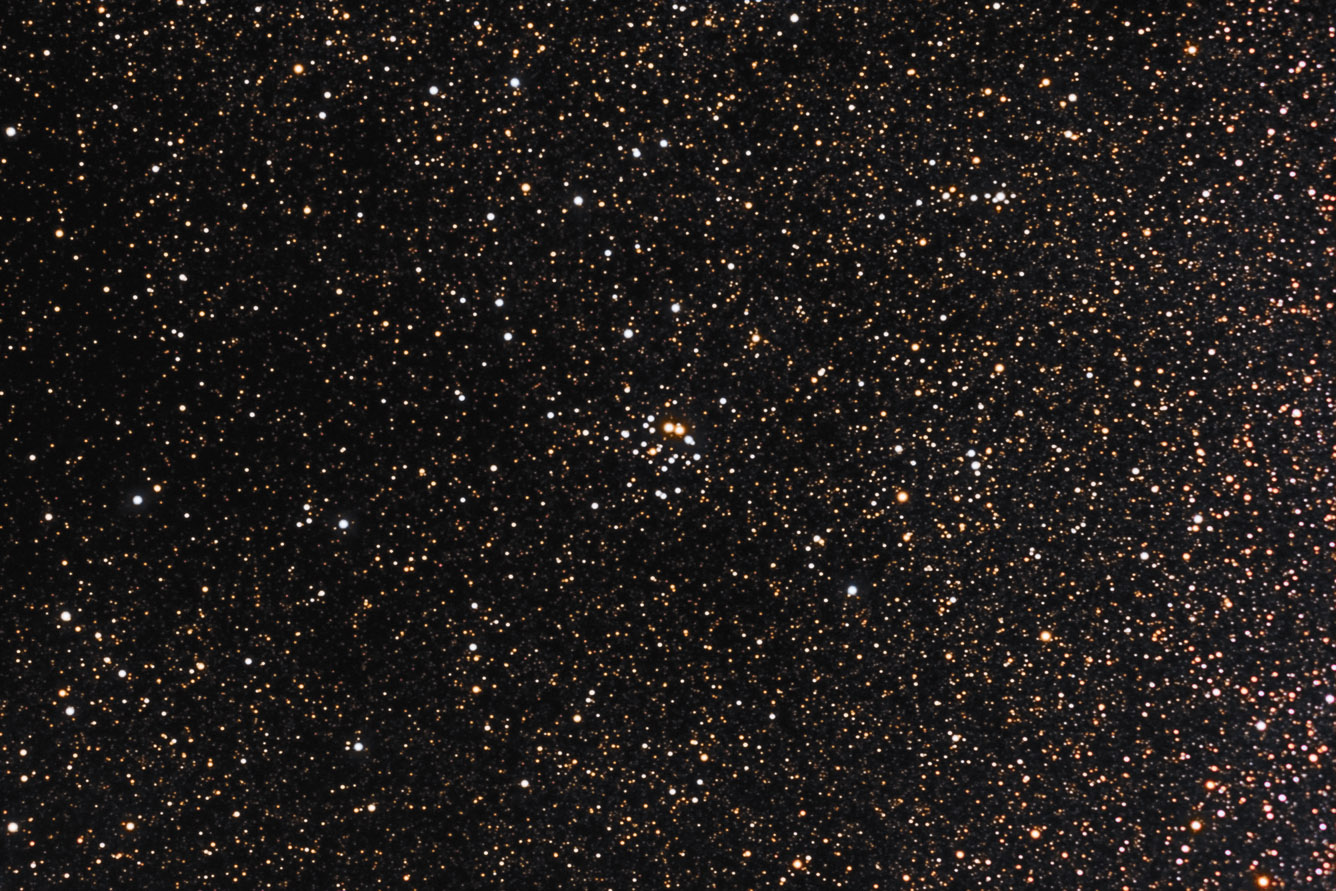
BERK82L3X10RGB2X10-67.JPG
| In late October of 2006, my observatory was just getting up and running when Comet Swan M4 came by the earth in the early evening sky. I had little experience with imaging a comet and none in trying to get a "movie" of it. I had beginner's luck. Not having but a glimmer of how to do it I succeeded beyond my expectations. The comet turned out to be very active on the evening of October 29th UT. It was still a rather bright sky but it was setting in the west so I gave it a try before it set behind my roof. I took 30 one minute shots which I then stitched together into a 4+ megabyte animated GIF. I was hoping to get its motion through the stars. I got far more.
I did succeed in showing that the tail of a comet doesn't necessarily point behind its direction of travel as many believe including some textbooks used in public schools. Instead, it is pushed back by the solar wind so, at least at first, points away from the sun. This is especially true of the ion tail which is made up of ionized gasses so also responds to the sun's magnetic field. Comet Swan had a very active ion tail. So active my animation caught the gasses flowing away from the head of the comet and down the tail. Even in 30 minutes, the motion was obvious. This came as a total surprise. Since then I've made movies of several other comets but none showed any motion in the tail.
Also, the tail responds to the sun's magnetic field. If a comet's orbital motion carries it across a strong field line and into another the ion tail can disconnect and flow away as a new one develops. This happened to Comet Swan a few hours after my animation stops. It stopped because it was right over my chimney and my wife not knowing I was pointed right there lit newspapers to start up the fireplace as we heat with wood in winter evenings after turning off the gas furnace. The sparks from the newspaper made further frames useless. Not that it mattered as the comet went behind the chimney a few minutes later.
Note however there are many short streamers coming from the head of the coma. In the first frames these are along a rather wide arc of the coma but by the end, they are narrowing down quite a bit. This likely was a precursor to the tail disconnect a couple hours later. If I was a few time zones west I might have caught the disconnect in the movie. No one did and as far as I know, no one caught any of the motion in the tail this one did.
I had been asked if I could make a movie of it to show the tail didn't flow behind the comet. I'd likely never have taken this without the request as I had no idea how to do it. The professional astronomer who asked me if I could do the movie was thrilled with the animation and said I should submit it to NASA's Astronomical picture Of the Day website. Not going through the right channels I was ineligible for an APOD but they did accept it for a link. You can see the short version I submitted at https://apod.nasa.gov/apod/ap061106.html then click on the text link "move outward" to see my animation. This short version skipping frames makes it easier to see the pinching of the streamers prior to the tail disconnect. The movie is used by many science teachers so is likely my most successful image and it was taken only by beginner's luck and in mostly ignorance rather than knowledge.
Note one frame is missing so it jumps slightly in the full version. My wife's first attempt to start the fire failed but not before sending up some nasty sparks. I didn't see the frame as it came in so didn't stop her from trying again a few minutes later. I had to pull that frame. Since my camera needs a few seconds to download each image and start another the movie covers about 33 minutes of time, not 30. Note two a few galaxies pass through the tail as the sky moves to the left due to the comet's orbital motion. It was too far west the next day so I couldn't try again.
14" LX200R @ f/10, 29x1' binned 3x3 (30 taken, one unusable), STL-11000XM, Paramount ME | 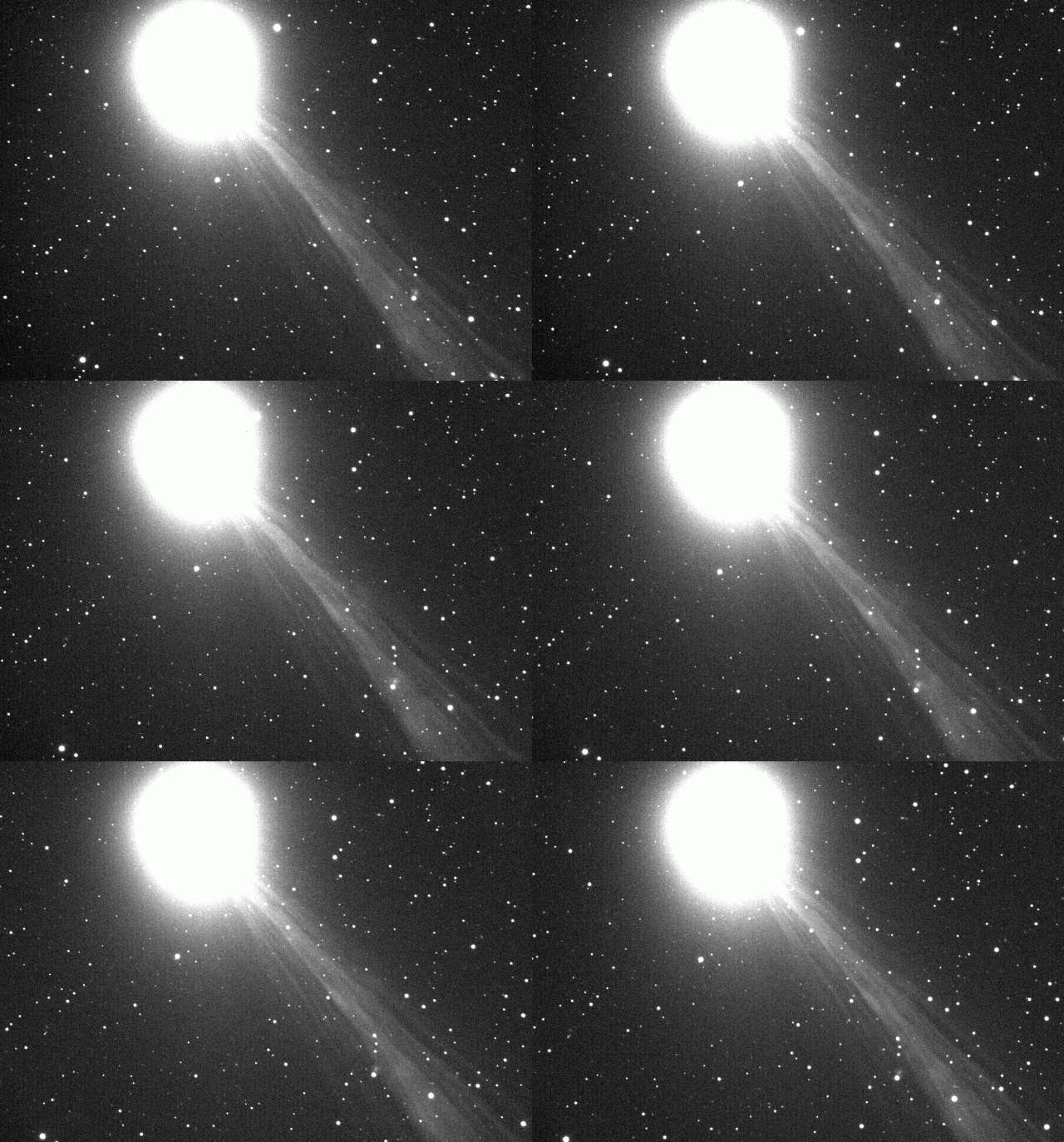
SWAN_10-28-06_0104UT_3X1_B3X3Large.gif
| Many comets are blue-green in color due to Swan band radiation. This was thought to be caused by cyanogen gas many comets emit. Today we know this isn't really true. The color is due to fluorescence of carbon particles rather than the cyanogen gas itself. But comets do emit cyanogen gas. When it was announced that in 1910 we'd pass through the tail of Halley's comet and it emitted cyanogen gas, same as used in gas chambers there was panic. My grandfather worked in a theater in NYC at the time. Suddenly in January the Great Comet of 1910 appeared and most thought it Halley and they were about to die. So he and my grandmother made sugar pills in their hotel room and sold them in the theater lobby for $10 each. Admission was only 75 cents so this was a small fortune. They were guaranteed to protect you from the gas. My grandmother worked 19 hours a day making pills and they sold some $300,000 worth -- after the theater and magic act he worked for got their cut. That was about 50,000 pills all handmade by my grandmother and a couple maids they hired. They then retired to a house full of servants in Omaha. In 1913 the Easter Sunday tornado lifted their 4 story mansion off its foundation and carried it a block setting it down on another mansion. Then a third was deposited on them. They were 10 days in the mess before rescue as no one was considered alive in the area. They were the only survivors from that 2 block area. Near death, they somehow survived. My mother was 2 at the time. She was apparently the result of their celebration over selling so many pills. Anyway, they rebuilt but being underinsured it cut into their fortune. My mom only had 3 servants after that to wait on her, not 6. Oh yes, those 6 died as they were in the basement. My mom and my grandparents were on the stairs between the third and second floor heading for the basement but luckily didn't make it. The basement was exposed when the mansion flew away and yet another house crushed those in it. My mom's luxury life suddenly ended with the '29 crash. My grandfather was sent back into the workforce leaving them with no servants and barely a roof over their head. Easy come easy go. Much like comets.
The comet is much larger in this photo than you'd have seen in a scope or binoculars. This was taken July 11, 2007. The photo has been reduced and cropped. Image scale is 2" of arc per pixel, half my normal scale. The nucleus of the comet is hidden in the bright spot in the center and is only a mile or so across. Just a microscopic dot at this scale.
The stars are lines because I had the mount tracking the comet rather than the stars. It is moving rapidly against the stars and rather close to us as well. The color frames show up as the stars are colored red green and blue. I used two of each after I took 20 luminosity images. Each is a one minute exposure. The gaps in the white trails are due to the time it takes to download a frame to the computer -- about 10 seconds. The bigger gap is because I took the shots in two 10 minute groups and wasn't around to restart it immediately. Then I had to set up for color making for other gaps in the stars. The comet is moving southwest so the stars appear to move up and to the right, northeast.
Image is at 2" per pixel.
14" LX200R @ f/10, L=20x1', RGB=2x1', STL-11000XM, Paramount ME | 
C2006VZ13_20X1RGB2X1_50%.jpg
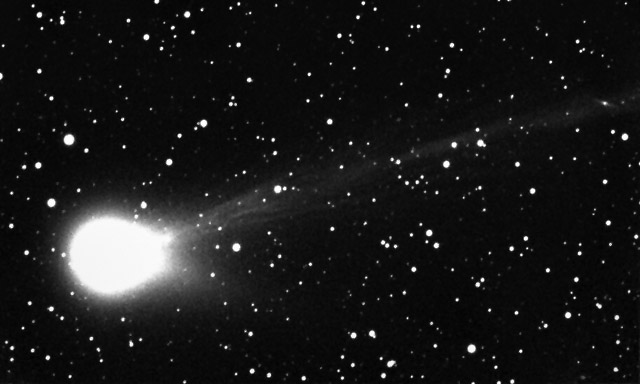
| 34 Minutes in the life of Comet C/2009 R1 McNaught. This was taken in a very bright dawn sky that got over three times brighter during the 34 minutes it was taken. Some frames were lost to clouds. A couple show space junk flying by as well. Due to the rapidly brightening skies it was very difficult to process this to hold the tail detail as the sun was trying to drown it out. As a result the head of the comet seems to grow in fits and starts over the 34 minutes. I processed for the tail and sky background and ignored the head for the most part. It took three days of trial and error just to get it to this point. With cloud haze varying with every exposure and the dawn sky giving a background count of 3000 to 10,000 (normal for 1 minute is 250) this was a processing nightmare.
Note that the comet has both a short, fuzzy, stubby dust tail pointing a bit down and to the right and a much longer gas tail pointing up and to the right. The dust tail does point away from the comet's motion but the gas tail points away from the sun. The motion of the stars shows this quite clearly for the dust tail. The gas tail changes quite a bit over the 32 minutes the movie covers. The very end of the gas tail passes over the galaxy UGC 01997 which is about 270 million light years beyond the comet.
Unfortunately, the comet, for me, is moving deeper into the dawn sky so there's no second chance on this one. Besides there's been a near constant mist falling since I took this movie. In fact a very light mist was falling while I imaged this. It was semi clear in the area of the comet. I spent 40 minutes holding an umbrella over the scope while this was taken. What we won't do for this hobby. Another new moon clouded out. I'm falling further behind in my Arp galaxy imaging.
The comet has an orbital eccentricity of 1.0003. If correct that would mean it is on a hyperbolic orbit and will never return. It was about .72 AU (67 million miles) from the sun and 1.16 AU (108 million miles) from the earth when I took this movie. It will be closest to the sun on July 2 at about 0.40 AU from the sun. Unfortunately it will be lost in the sun's glare at this time. It's closest approach to the earth is June 15, 2010 at 1.14 AU. So this was taken at nearly its closest approach to us.
Movie is about 4 meg so will take a while to load. Once loaded it will run more smoothly.
14" LX200R @ f/10, 28 one minute exposures binned 3x3, STL-11000XM, Paramount ME | 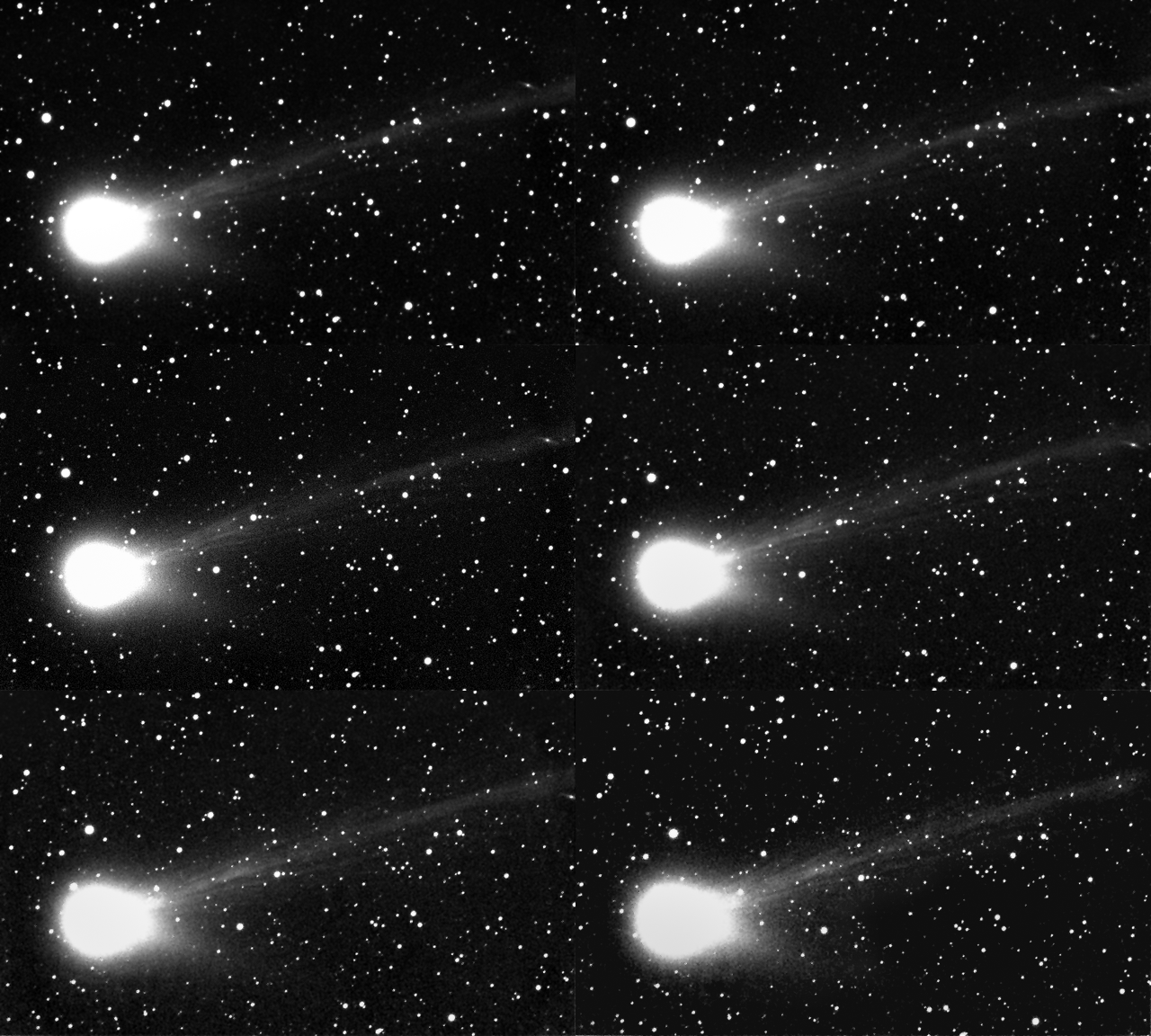
C2009R1a.gif
CA10.jpg
| C/2011 L4 (PANSTARRS) was a nice comet in the second week of March. Unfortunately, my lousy weather and neighbor's trees prevented me from imaging it until June 13, 2014 when it was far to the north. At just over 2 AU from both the Earth and the Sun I wasn't expecting much. But its anti-tail running almost due north was still there and is stronger and far more well defined than the dust tail to the southeast (upper right). I see no sign of a gas tail nor the typical green color from comets closer to the sun to get enough UV light to create it. It's rather white with a reddish tinge. I enhanced the comet's color way too far trying to find any color in it.
Putting together this composite was "fun". I now remember why I don't do this very often! The color data is made from three 5 minute frames each color taken tracking the comet. The luminance was made from 15 5 minute frames also taken tracking the comet. These are all unguided letting the Paramount and The Sky track the comet using the orbital elements of the comet to govern tracking using offsets on both axes added to the standard sidereal rate. Then two nights later when it was again clear I imaged exactly the same starfield this time tracking on the stars using 3 5 minute color frames per color and 3 10 minute luminance frames. Then the comet's color image (less the stars) was placed into the starfield using the comet's position at the start of the very first luminance frame. To set that I used that first frame as a layer which was then removed so it should be accurate to one second of arc which is my pixel size.
The reason for only 5 minute frames for the comet is that it was outside the dense portion of my T Point map that allows accurate tracking without guiding. I found it was still reliable for 5 minute frames so used those. The starfield luminance frames were 10 minutes each and guided. The reason for only three 5 minute frames of each color is dawn was fast approaching and I didn't have time for my usual 2 ten minute frames. My dark skies are very limited at this time of the year and I had to wait for it to clear eating up much of that time. This is why the starfield had to be done another night as well. Just no time for both the same night.
Removing the stars when there are only 3 frames to work with in the color data was an interesting exercise. Lots of trial and error in CCD-Stack finally found the right parameters. I used a Poisson rejection routine with a sigma of .2 then combined using the minimum mode. That completely removed the stars from the luminance and left only one small smudge to clone out of the color data. That was caused by the brightest star in the field (lower right).
I wish the weather had allowed me to try earlier when the anti-tail was much stronger. Also, I needed a wider field of view as it stretched some 6 or more degrees at one time. It went out of my very limited field. I should have rotated the camera to put it along the long axis I suppose. I'd hoped to catch more of the dust tail but that is just a blob on the southeastern side right now.
In any case, it is surprisingly bright even 3 months after it came by and worth a look. This is one time I wish I had a OSC camera. Simplifies color with a moving target like this. Also, a shorter focal length than the 14" LX200R offers would help as well!
The image is oriented with south at the top, the opposite of my normal orientation. It seemed more "natural" that way, looking "wrong" when rotated to my normal orientation. There appears to be some weak IFN in the image, especially to the lower left.
14" LX200R @ f/10, see text for exposure data, STL-11000XM, Paramount ME | 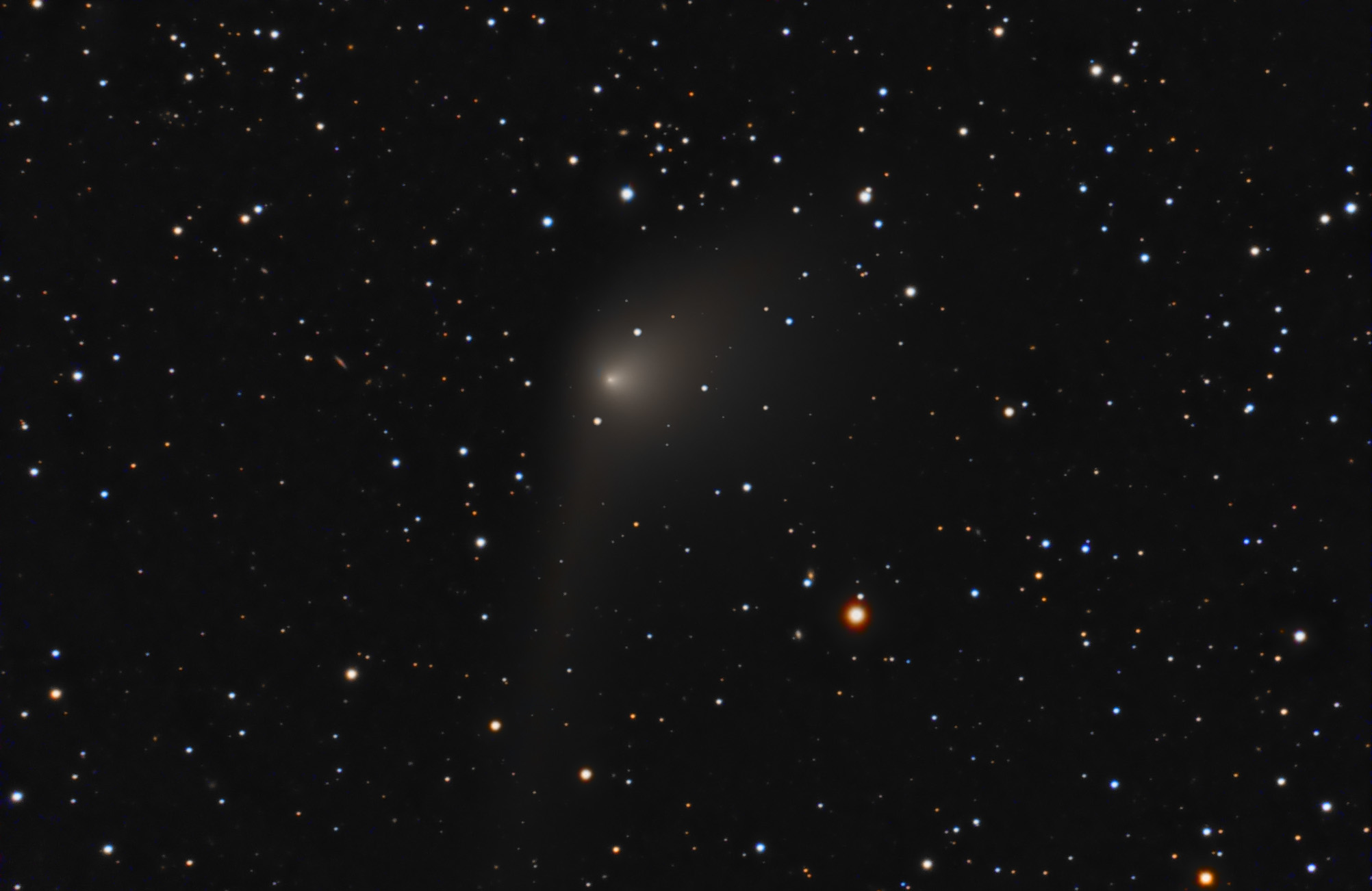
C2011L4COMBINE.JPG
| Comet C/2012 K1 (PANSTARRS) was putting on a pretty good show and was visible all night (though those are getting awfully short for me now) when this was taken June 4, 2014. At the time of the image, the comet was 2.069 AU from the sun and 1.472 AU from the earth. I took this data on May 4 about 8 hours UT when a hole opened in the clouds. I had less than an hour before dawn so didn't get as much data as I'd have liked. The comet was moving about 3" of arc per minute. I set the mount to track the comet which elongated the stars a bit. I started to "fix" them but it was slow going and I gave up so some are fixed and others show the motion. I shouldn't have started "fixing them".
With only one minute frames my read noise is rather high limiting how faint I could go. Also, I only had time to collect 20 one minute luminance frames. These were taken binned 2x2. Due to noise issues, I reduced the image to the equivalent of 3x3 binning (1.5" per pixel). Seeing the noise in the luminance I took the color data binned 3x3 using 5 two minute frames for each color. This caused the star colors to trail twice that of the luminance. I then used the simple trick of making a second layer, moving the top layer halfway in the direction of the star trails and combining using the darken mode. Quick and dirty way to match the star trails to that of the luminance frame. What error remained was covered by blurring the color data by a pixel. In the 50 minutes before dawn, this was all the data I had time to collect.
Still, the image came out better than I expected. The ion tail I thought I saw in my dawn hampered earlier image went straight down. In this image, there was an obvious short ion trail going to the southeast. While the comet has moved some in the sky I doubt the tail has rotated that much so suspect my hint of an ion trail in the earlier image was just noise. Though I don't see the curve in the dust trail I did in the first image and I'm sure that was real. Oddly the ion trail doesn't seem to point right back at the nucleus but at a point a bit behind it.
There's an obvious galaxy in the lower right corner. It is SDSS J131507.60+492030.1 (AKA ASK 286584.0, 2MASX J13150752+4920302, MAPS-NGP O_173_0046263) and has a look back distance of 750 million light-years. It appears to be an edge on spiral. Near the left edge below center is SDSS J131747.72+492651.2 at 1.72 billion light-years, another disk galaxy seen somewhat edge on. Between the end of the ion tail and the dust tail is SDSS J131634.18+492159.2, a face on spiral about 900 million light-years distant. There are others but I'll stop here.
14" LX200R @ f/10, L=20x1'x2 RGB=5x2'x3, STL-11000XM, Paramount ME Related Designations for C2012K1C2012K1, | 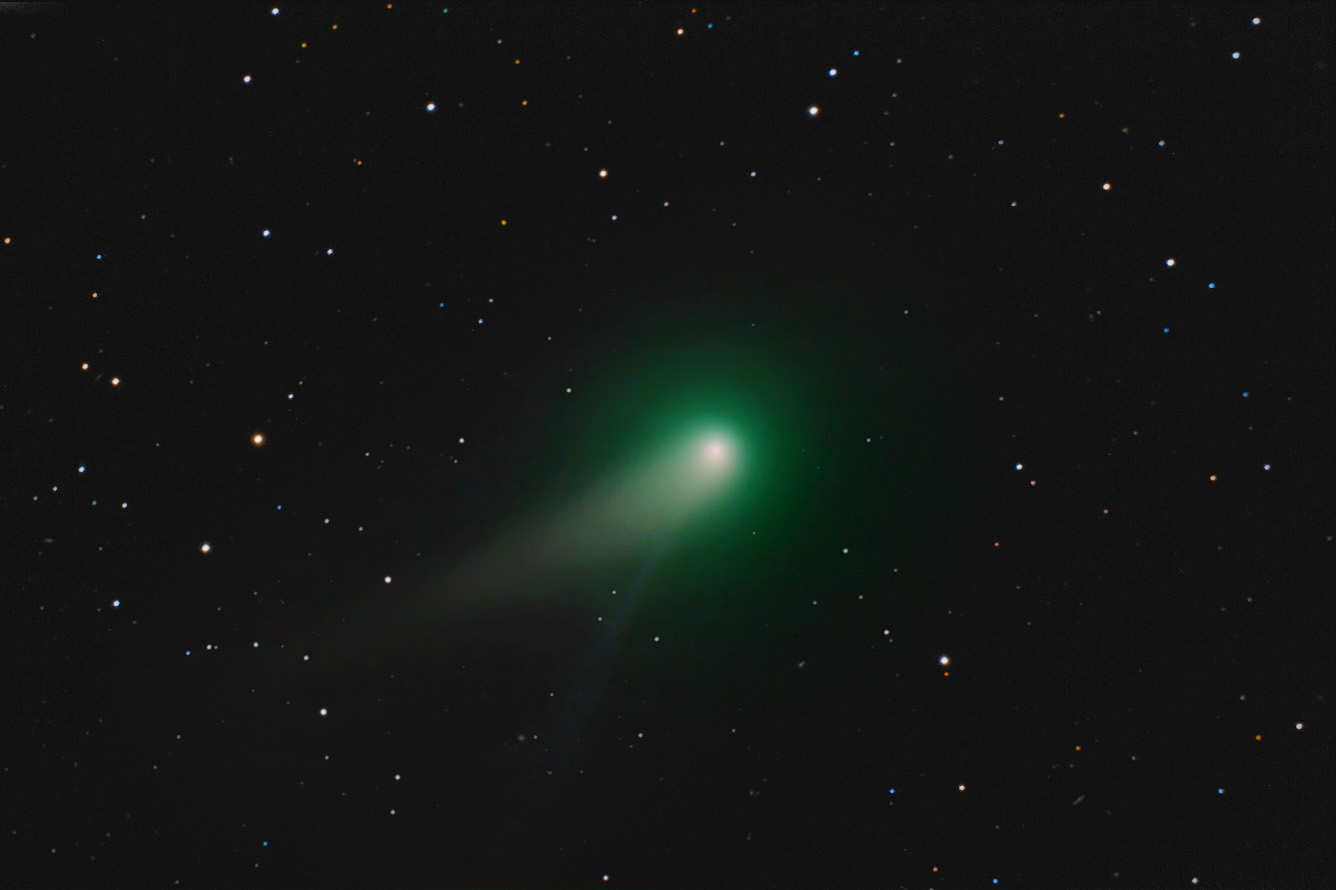
C2012K1L20X1X2RGB5X2X3.JPG
| On the morning of December 11, 2013 I finally had sort of clear skies to take data on the comet. As it was a nightmare to process due to the clouds so I kept putting it off. Now I wish I hadn't as I seem to have caught it ejecting a blob of material from the core. At least the images show a odd linear feature below and a bit west of the brightest part of the coma. It is rather red compared to the rest of the comet and has a dark area beyond it. Since the comet points toward the sun, I don't see how the darker area could be a shadow. Still, it is real. Though when I first processed the image I wondered if it was some background object but then I assembled the luminance data into a movie and the feature moves with the comet though seems to be moving very slightly away and behind the core. Dawn prevented a longer movie that might have shown this. I'd hoped to get detail of gas clouds moving down the tail. The tail had only very weak, indistinct detail. Still, if you look closely about halfway up the tail some motion can be detected. Set your viewer to repeat as the 30 minutes is compressed to 3 seconds of time for a time speed up of 600x. The color image was taken and is posted at 1.5" per pixel. Seeing this low didn't allow for any higher resolution.
Color image:
14" LX200R @ f/10, L=10x1'x3 RGB=7x1'x3, STL-11000XM, Paramount ME
The L frames used are every third frame used for the movie. This was needed to give time for enough motion between frames so stars moved enough they could be eliminated from the image of the comet when the frames were aligned on the comet's core. This gave a star free comet image to be pasted back into the starfield after the moving comet had been cloned out. The color frames were taken red, green, blue with the cycle repeated 7 times (all the oncoming dawn allowed). This moved each frame sufficiently that the same process could be used to create the color data used to make the final image. None of the color frames were used in the movie however. The movie used all 30 of the luminance frames, including two in which some space debris put in an appearance. I could have cloned them out but decided to leave them in as my cloning usually makes thing worse. | Video: https://images.mantrapskies.com//catalog/OTHER/C2013R1LOVEJOY/C2013CONTRAST.wmv 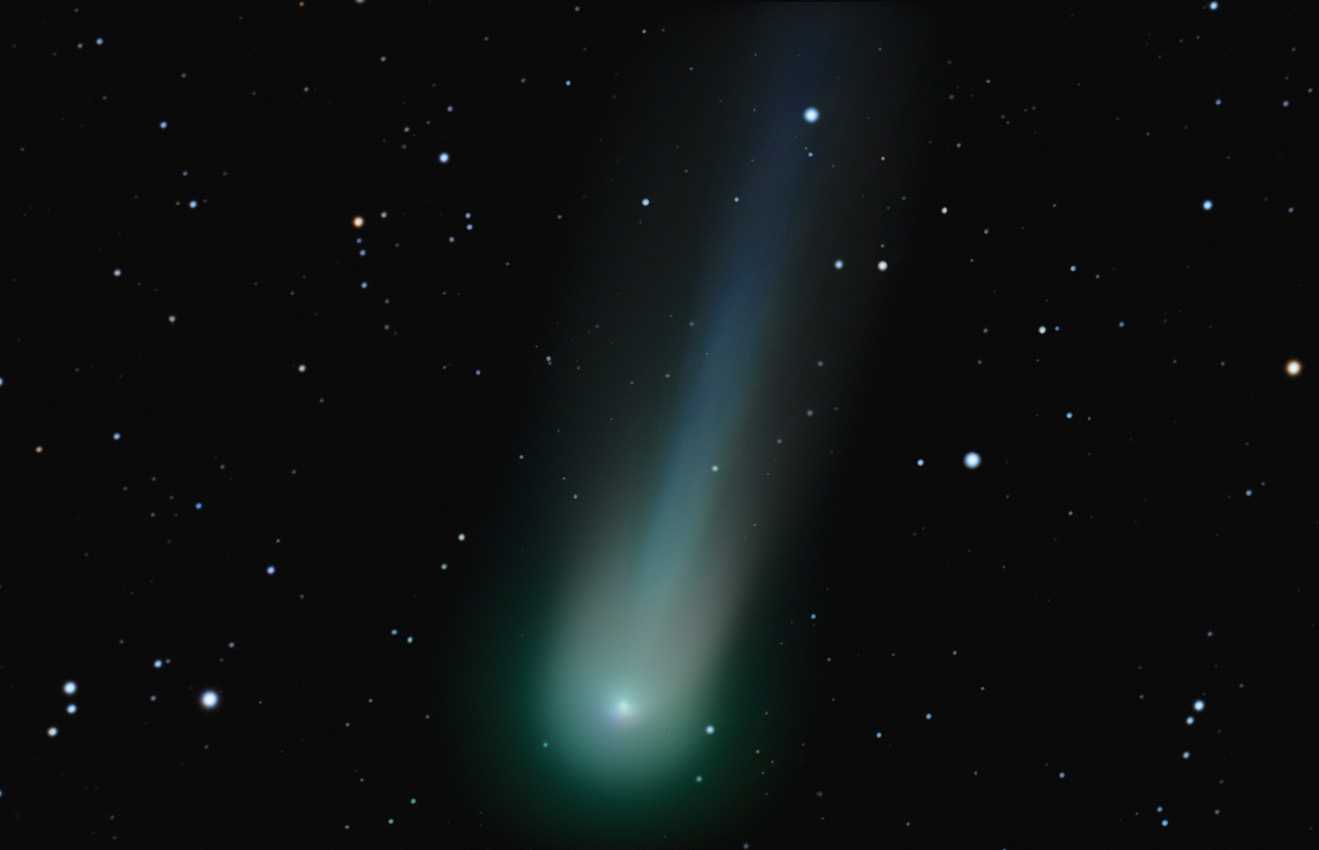
C2013R1L10X1RGB7X1R1.JPG
|