I'd wanted to retake this one this fall with my new filters that don't have the halo problem around stars my old filters had. But the weather conspired against me. I settled for reprocessing the old data. I think this is much better than before but you'll have to pretend the halos aren't there.
When I first got into astronomy and started building my first telescope it was announced that the 200" had finally imaged the long sought super nova remnant known as Cas A. The image was hardly exciting. I found the image I remember as figure three in this 1953 paper:
http://articles.adsabs.harvard.edu/cgi-bin/nph-iarticle_query?1954ApJ...119..206B&data_type=PDF_HIGH&whole_paper=YES&type=PRINTER&filetype=.pdf I've had reports this link sometimes fails. If so start here: http://simbad.u-strasbg.fr/simbad/sim-ref?bibcode=1954ApJ...119..206B
It was finally found when crude radio interferometry gave a better location but the image sure wasn't much. I certainly never expected I'd ever be imaging what was at the very limit of the 200" scopes ability in 1953. It cost millions of dollars and the scope I was building back then ended up costing me about $35 for a 6" f/12 on a pipe mount using homemade eyepieces (Coke bottle bottoms worked better I'm sure).
For those who say I never put much time into an image, your right but at least this one used 4 hours 50 minutes of data rather than the 1:40 I normally use. I wanted 6 hours of L data and 1 hour of each color but never had enough clear nights to even start it in which transparency would hold for the time needed.
Image was cropped to reduce bandwidth and some of those nasty stars but not reduced. This is still at 1" per pixel, my normal image scale.
14" LX200R @ f/10, L=14x10' RGB=5x10'x3, STL-11000XM, Paramount ME Related Designations for CAS ACassiopeia A, 3C 461, 3C 461 ID, 4C +58.40, 87GB[BWE91] 2321+5832, 8C 2321+585, NRAO 0711, 1RXS J232325.4+584838, 2PBC J2323.3+5849, PBC J2323.3+5849, SAXWFC J2323.5+5848.1, 4U 2321+58, 1H 2321+585, 1ES 2321+585, SWIFT J2323.3+5849, [VE75] CL 2321+58, [KRL2007] 402, CAS A, SNR G111.7-02.1, TeV J2323+588, | 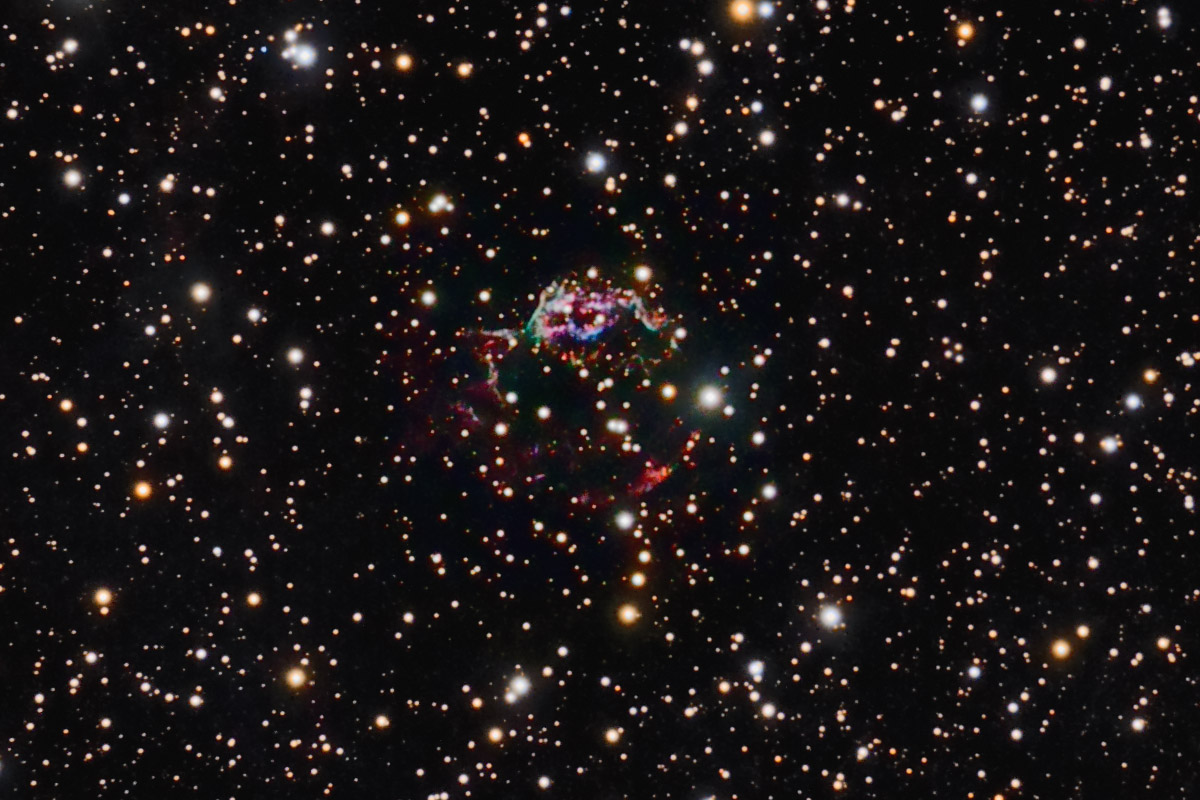
CAS_A_LUM-AV14X10RGB5X10X3R1-1200.jpg
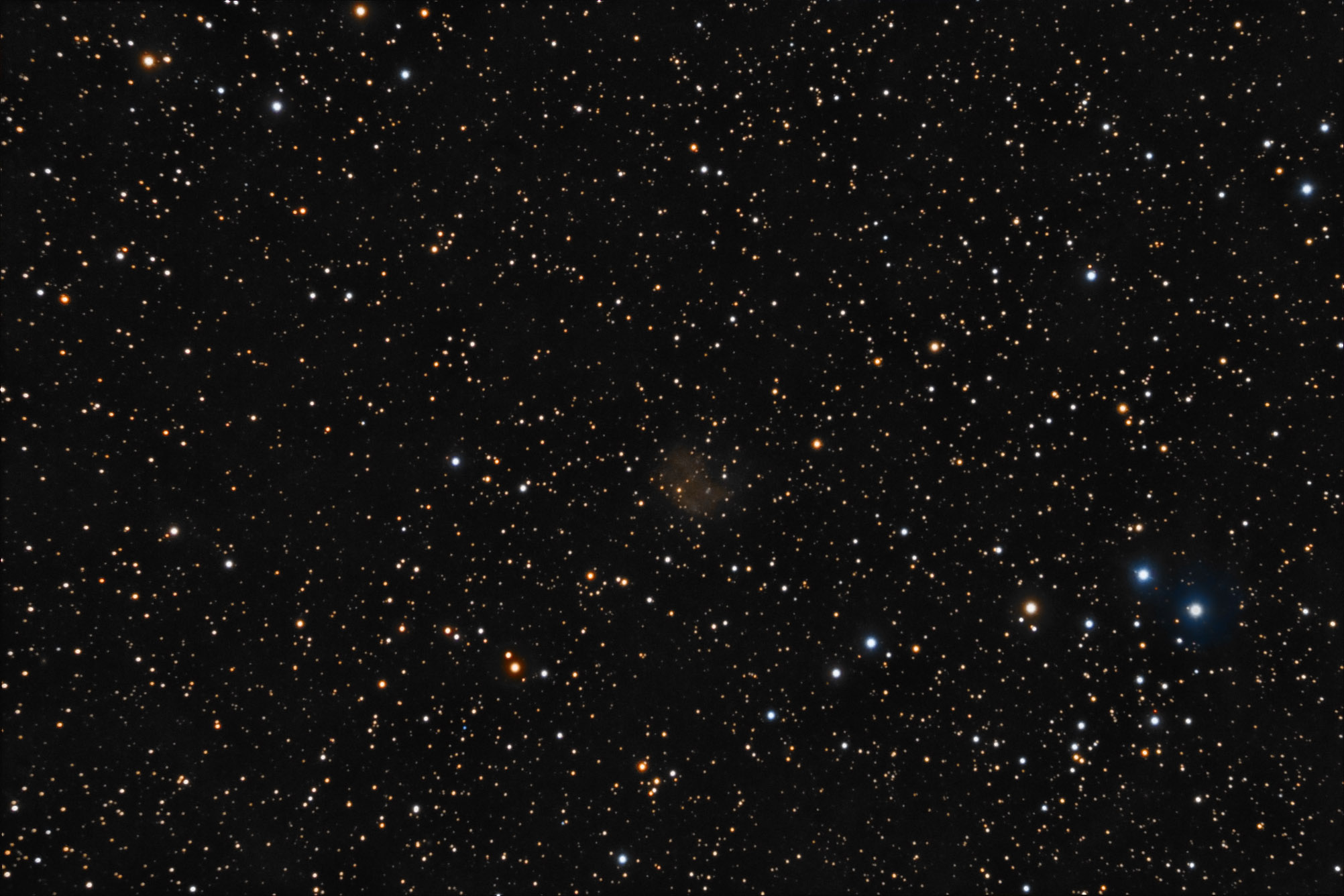
| Cas 1 (not to be confused with Cas A a supernova remnant) is a heavily obscured irregular dwarf galaxy in Cassiopeia about 8 degrees north of the Heart and Soul Nebulae. It is considered part of the Maffei group of obscured galaxies. The distance to obscured galaxies is hard to determine. There was only one estimate at NED but its determination is purely by judging the size of a single HII region. Thus it is highly suspect. It gives a distance of 16 million light-years which is likely too far. The generally accepted distance to the Maffei group is more like 6 to 10 million light-years. In any case, it is nearby, just nearly invisible as it lies behind the gunk of the disk of our galaxy. Its color is likely reddened by the dust. Most dwarf irregular galaxies are quite blue. Cas 1 is likely no exception if we could see it without the dust.
This one is so dim I spent 3 times my usual time for the luminance channel and twice normal for the color channels. It didn't seem to help much.
14" LX200R @ f/10, L=12x10' RGB=4x10', STL-11000XM, Paramount ME Related Designations for CAS1Cas 1, IRAS 02019+6845, ZOAG G129.56+07.09, ZOAG G129.57+07.11, LEDA 100169, NVSS J020558+685955, [W95] 1, [KK98] 019, [KK98] 020202.4+684557, CAS1, | 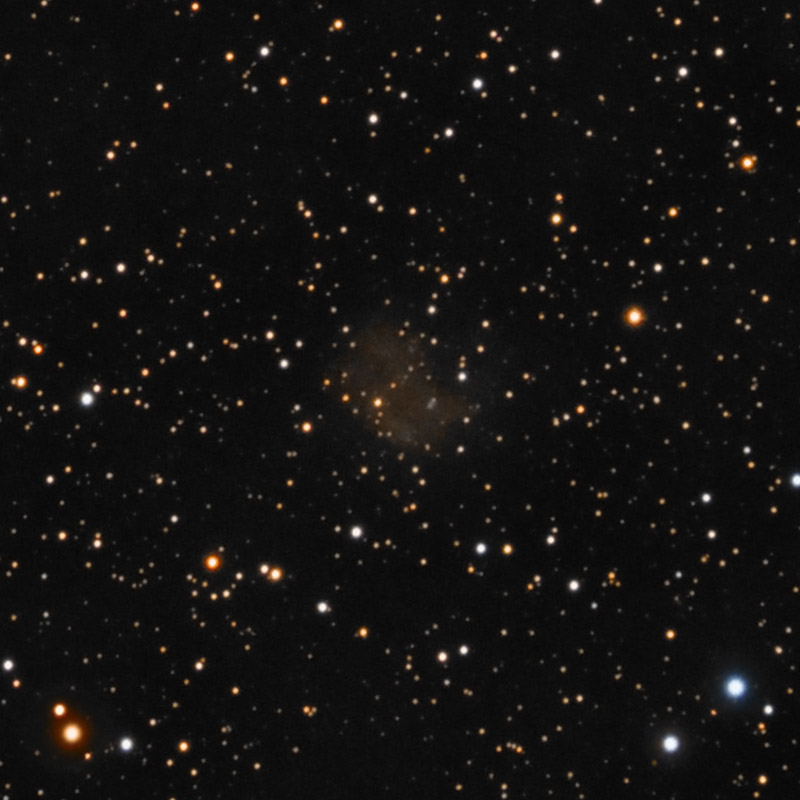
CAS1LUM12X10RGB4X10R-CROP125.JPG
CAS1LUM12X10RGB4X10R.JPG
| This nebula, mostly emission (red) with some reflection characteristics as well (blue) is located in Cepheus. It is part of the Cepheus B molecular cloud. The illuminating stars are considered to be HD 217086 at the top of my image, an O7 star and HD 217061 above center, a B1 star (very slightly smaller and cooler). IR images show a tremendous amount of star formation going on in the cloud (darker portions of my image). These are thought to be triggered by HD 217086. It is outside the cloud itself. Radiation from the star is thought to drive a compression wave into the cloud triggering star formation in the interior while blowing away the cloud's outer layers. Chandra/Spitzer observation in X-ray and IR light show this is happening. The region is thought to be about 2400 light years from us.
This is a reshoot of this object. I did it very poorly early in my digital career. It was time for a better effort. Still not what I wanted. I wanted a lot more color data but after two months of something preventing it I apparently gave up. Maybe I can get the needed data later this fall. For now, I put together what I had. I used the RGB data to try and bring out the reflection parts of the nebula and H alpha data to bring out the ionized hydrogen in the area (red). With too little RGB the hydrogen is dominating more than I wanted. Still, the reflection regions are sort of there.
14" LX200R @ f/10, L=4x10'+2x30'Ha (Ha blend at 40%), R=2x10'+40% Ha (to allow reflection nebula to show), G=2x10' and B=2x10'+10% Ha, STL-11000XM, Paramount ME | 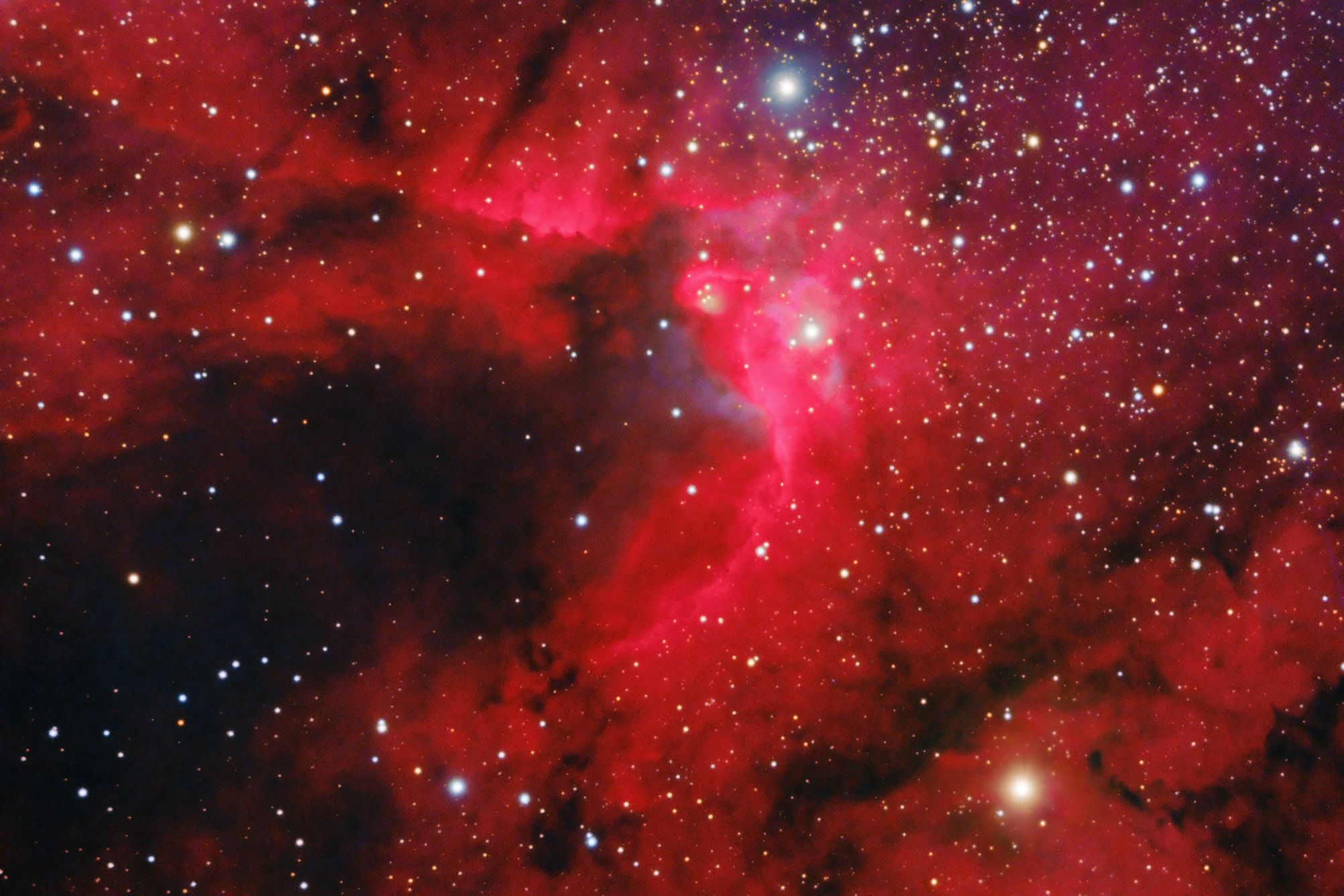
SH2-155CAVE_L4X10HA2X30RGB2X10R1.JPG
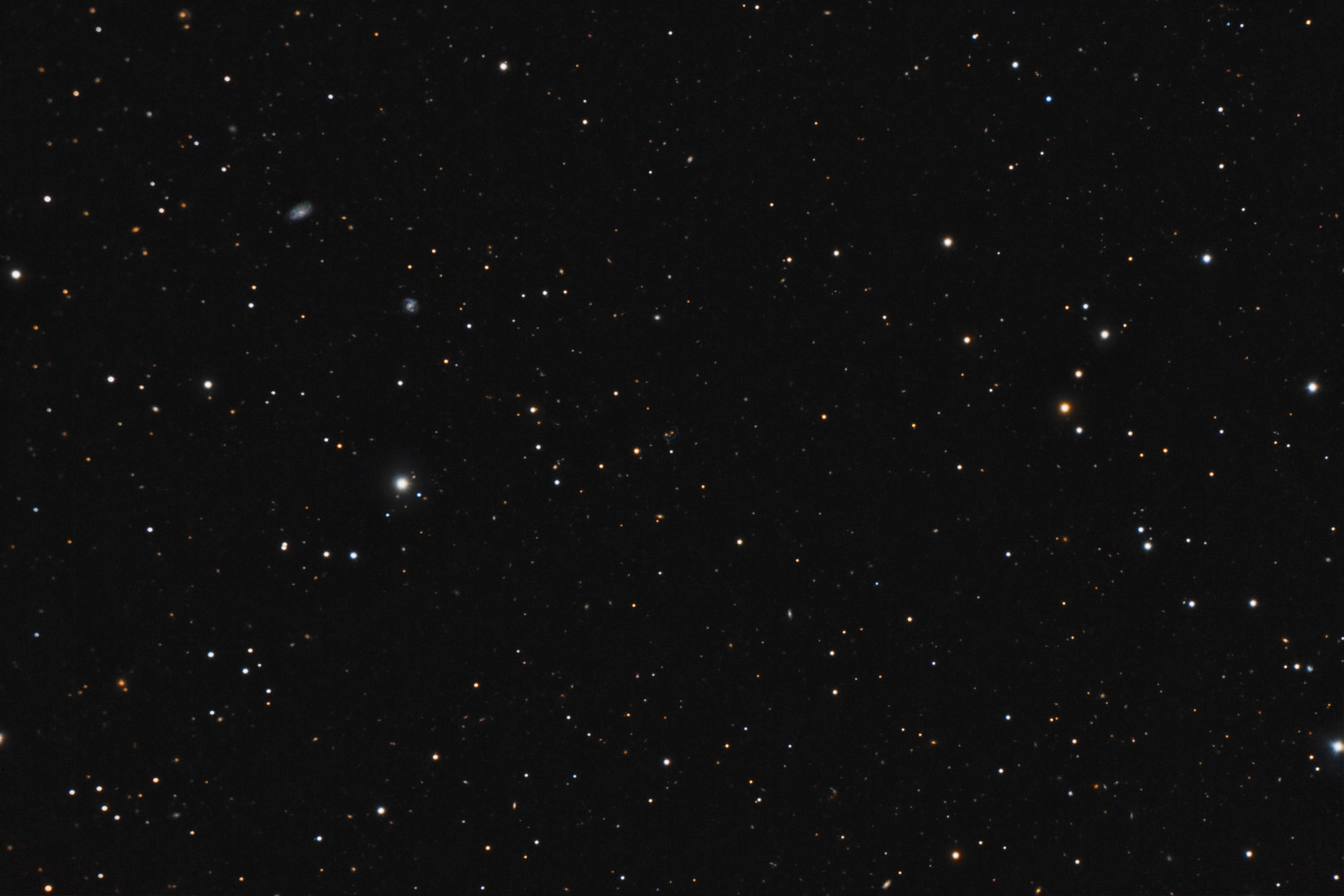
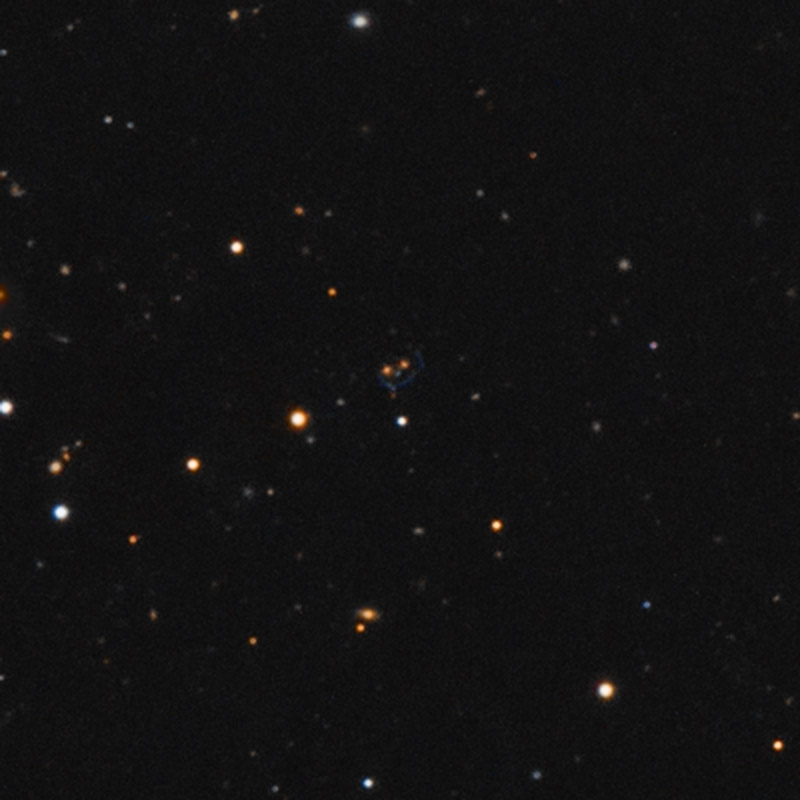
| This Smiley Face or Happy Face is the result of gravitational lensing of distant galaxies beyond the lensing galaxies. NED gives it the name Cheshire Cat if you are looking it up. An alternate name is Cassowary 02L1. A bird and its hunter. Though I suspect most house cats would end up very dead if they took on a Cassowary. When I was in Australia we were cautioned not to get near one as they were "The most dangerous bird in the world" or something like that. True or not we stayed very clear of the two we saw. They are quite rare so seeing one isn't common. Habitat loss is the problem.
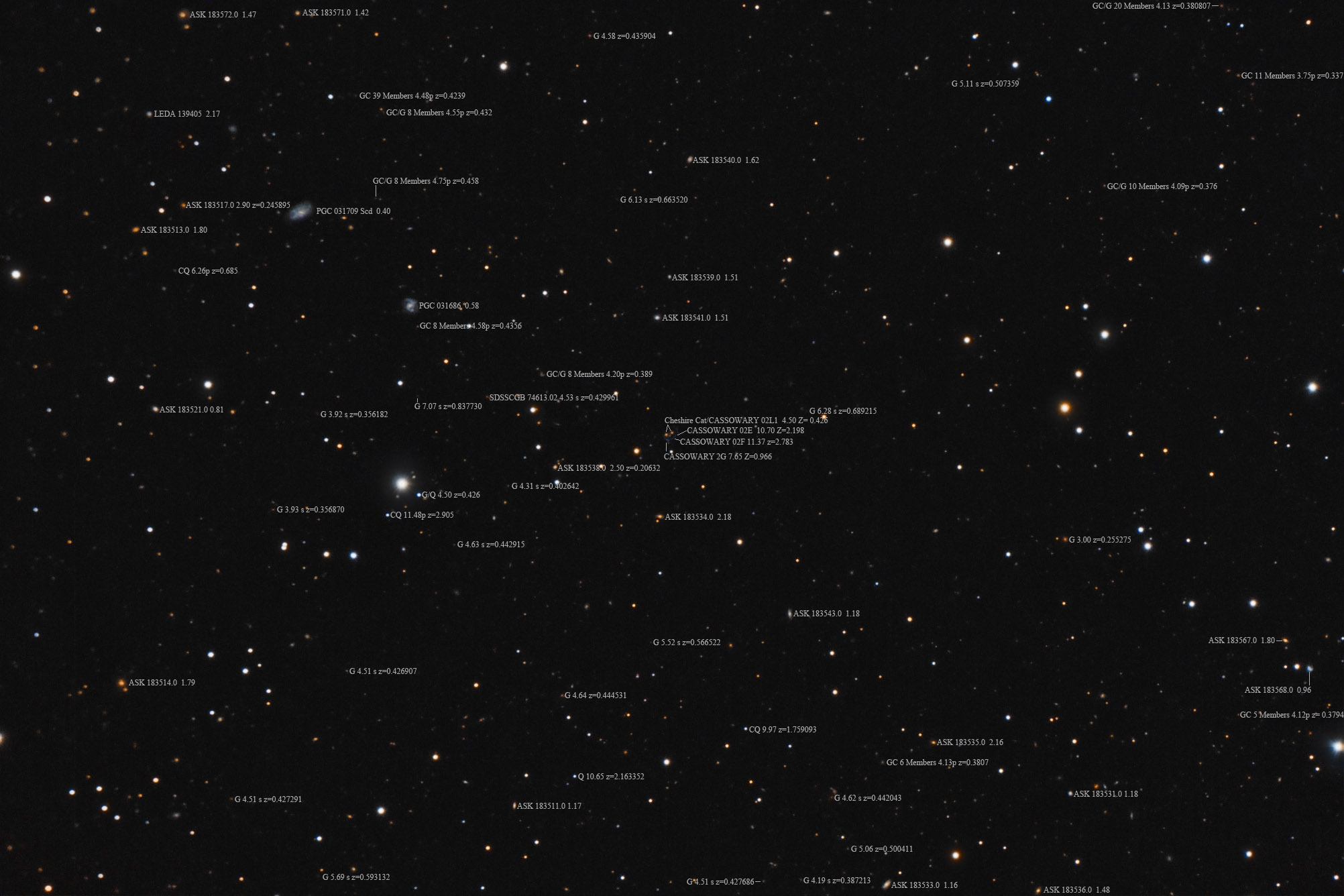
Back to astronomy. NED puts it about 4.5 billion light-years away with a redshift of 0.426. Is that the distance to the lensing galaxies or the lensed galaxies? I think that is the distance to the lensing galaxies. NED has an entry centered on part of the blue arc, CASSOWARY 02G with a distance of 7.65 billion light-years with a redshift of 0.966. NED points two other at 11.37 billion light-years. So the cat is made up of many unrelated galaxies that have the proper geometry when seen from earth to make a smiling face. It is the lens that brightens these very distant galaxies sufficiently that I can see them. I doubt any would be visible in my 14" scope without the foreground lensing galaxies. The CASSOWARY name is an acronym for CAmbridge Sloan Survey Of Wide ARcs in the skY. Someone had to really stretch for that one! Anyone know why the Australian tie?
Using the diameters of the two "eyes" at NED and a distance of 4.5 billion light-years I get a size for these two galaxies of about 110,000 to 120,000 light-years. Not as big as I expected for how bright they are. Their brightness isn't enhanced by the gravitational lens they create for the background galaxies. NED says they are magnitude 20.2 and 20.5 left to right. Normally I find galaxies at this distance to be at least a magnitude dimmer, often 2 magnitudes fainter. Though ASK 186534.0 is magnitude 18.3, 2.18 billion light-years distant and 145,000 light-years across making the two lensing galaxies somewhat smaller and dimmer by comparison.
I've had this one on my to-do list since February 2015 when it was first announced. The complex passes less than 2 degrees of my zenith so I expected it easy to get good enough seeing for long enough that I could catch it. I figured on a minimum of 2 hours of luminance, three times my typical exposure time. But seeing has never cooperated. Finally this March the night met my specifications and I started in with near 0.5" resolution for one frame. After 4 (each 10 minutes) seeing had deteriorated so much I had to stop. Since color data can survive such seeing I started in on that and got one round of 2 frames each before seeing then said no way and besides clouds moved in. I had to throw out one green frame as it was too cloud hit to be used. I had several more clear nights but seeing just wasn't good enough. Ditto for April. Now it is too far west and low for the seeing I need for this super tough object. Even though I had no more data than I use for most of my imaging I went ahead and processed it. The better than normal transparency for the first 3 frames allowed me to get something, just not what I wanted. It doesn't compare to Josh Smith's fantastic image using over 32 hours of luminance. https://www.astrobin.com/286097/0/ Adjusting for aperture that's 5 hours at 14 inches or 7.5 times the photons I was able to grab. Josh send me your seeing and clear skies. I was surprised I got as much as I did though the resolution was poor due to the low signal to noise ratio and deteriorating seeing. After I picked up the smile and the arc on the west I noticed the eastern side of the arc was missing. But it is pretty well lost in Josh's image as well. If I get needed skys next year I'll try and add more photons. In the meantime Josh's image is a good example that small aperture can do as well as larger if you put in the additional time to catch enough photons.
Since the image didn't do what I wanted I did annotate everything with redshift data at NED. Also, here's the link to the Hubble version https://www.nasa.gov/content/hubble-sees-a-smiling-lens . It's a bit better than mine but is it billions of dollars better?
14" LX200R @ f/10, L=4x10' RB=2x10' G=1x10', STL-11000XM, Paramount ME
| 
HAPPYFACEL4X10RB2X10G1X10.JPG
HAPPYFACEL4X10RB2X10G1X10CROP200.JPG
HAPPYFACEL4X10RB2X10G1X10ID.JPG
| Collinder 21, located in Triangulum, is a group of rather bright stars that make a good "cluster" for small telescopes. Most sources, however, say it is just an asterism rather than a true star cluster. That is, it is just some bright, unrelated stars that happen to appear close together due to our perspective. Viewed from a different angle the appearance of a cluster would vanish. But since it has a couple interesting galaxies I decided to put it on my to-do list. Being bright I took it on a very poor night with lots of clouds. This caused some nasty halos of various colors around the bright stars. Instead of a quick and easy object to process, it was quite difficult. While I initially balanced the star colors with eXcalibrator by the time I got done dealing with the halos I'll only claim the colors to be in the ballpark of correct. The bright star at the south end of the group is SAO 74965 a double star with a separation of only 0.32". Thus, it appears as a single F5 star of 8.15 magnitude in my image according to TheSky. I saturated the star so can't measure it. I'll have to take TheSky's word for it. It places it at a distance of 562 light-years. The distance to the lower of the pair of stars on the right side of the group is 1553 light-years according to TheSky. TheSky places the red star at the top of the group at only 105 light-years. It doesn't have distance data on any others in the group. Still, this is sufficient to show it isn't a true cluster. After going though this I found this paper doing a complete analysis of the group, and two others, thinking they were clusters being torn apart but found they are all just asterisms. https://arxiv.org/abs/astro-ph/0407605
Only two galaxies in the image had redshift data. IC 1731 at the top is about 150 million light-years distant by redshift and 130 million by other methods. NSA 130512 at 640 million light-years by redshift is at the very top of my image with its upper part out of the frame. Being near the Zone of Avoidance there's little on the field. Everything NED had is noted in the annotated image -- not much. I was disappointed that the apparent rather large, distant galaxy cluster left of IC 1731 wasn't listed. It sure looks interesting. IC 1731 was discovered by Isaac Roberts on November 29, 1896.
Just NW of this image is the pair of galaxies, NGC 0672 and IC 1727 which I've already taken. My field is just too small. The two images don't quite overlap so I couldn't make a mosaic. They are far more interesting than those in this image but there's no bright asterism in their image.
14" LX200R @ f/10, L=4x10' RGB=2x10', STL-11000XM, Paramount ME | 
COLLINDER21L4X10RGB2X10.JPG

COLLINDER21L4X10RGB2X10ID.JPG
| After months of nothing but clouds in the early morning, I finally was able to again image Comet Garradd (C/2009 P1). Though I missed it passing M92 due to the weather both wouldn't have fit my small field of view. Though then the two tails were at an odd obtuse angle. On the 18th of February when I took this image they were almost exactly 180 degrees apart with the dusty anti-tail fading rapidly as we are no longer looking at it in plane. I wanted to catch that on the 15th but clouds prevailed!
Oddly the anti-tail came out rather reddish in color in my image. Usually, they are pretty colorless. The blue gas tail to the west does have the right color. The green is due to carbon compounds commonly found in comet's coma.
I sort of cheated for this image. I used 30 one minute luminance images and 10 one minute images in each color. This didn't result in a very good star-field. Just too much read noise in all those images. So the 19th I revisited the star-field centering on the same position as the previous night. I took my usual 40 minutes of L and 20 of each color but come morning I found the sky went to pot. Fortunately, I took the images 2 L then 1 of each color then repeated the process. That meant I had half the data at least as it went bad someplace in the second round's first luminance frame. This was deeper than the one minute shots of the previous night with better color even if the time for the L channel was less and color the same. I then processed the comet after removing the stars and pasted the starless comet into the star-field carefully placing it where it was when the first L image was started on the 18th.
At the time the comet was imaged Garradd was 1.343 AU (125 million miles) from the earth and 1.734 AU (161 million miles) from the sun. To show this big at that distance it is one big comet. Odd the lunatic fringe decided far fainter and smaller Elenin would do us great harm yet totally ignored this comet which was even more well known at the time. Anyway, it is still "big and bright" though I needed 8x20 binoculars to see it. It is heading northwest west of the head of Draco. By month's end it will be moving in Ursa Minor below the bowl of the "Little Dipper."
While quite a few galaxies are visible in my image, NED had redshift data on only one. It is the largest in the field seen below the gas tail on the right side of the image. It is UGC 10493 with a redshift of z=0.030114. This puts it a bit over 400 million light-years from us.
14" LX200R @ f/10, comet: L=30x1' RGB=10x1', Stars: L=2x10' RGB=1x10', STL-11000XM, Paramount ME | 
GARRADD_L2X10RGB1X10_L30X1RGB10X1R-67.JPG
| I'm late with this one. Processing it gave me fits. Normally I find it easy to remove the stars with a data rejection stacking once the images are aligned on the comet's core. I found that impossible due to the dense star background. Getting rid of the comet is easy with a gradient tool and a bit of cloning out what little remains. I finally got rid of the stars in the luminance frame but the color frame was far more difficult. I lost a lot of the tail doing so. It went into M71. After days of much swearing, I finally managed something.
I debated on how to handle the ton of stars seen through the comet's tail. I ended up blocking the vast majority of the faint ones. Just detracted too much from the comet. So only the brighter were allowed to show with the fainter ones masked out in the star field image.
This one seems to be a case of too much aperture picking up too many stars.
Comet's color wasn't nearly as strong as on some other posted images. Probably needed more color but the clouds had other ideas, unfortunately.
14" LX200R @ f/10, L=30x1' RGB=10x1', STL-11000XM, Paramount ME | 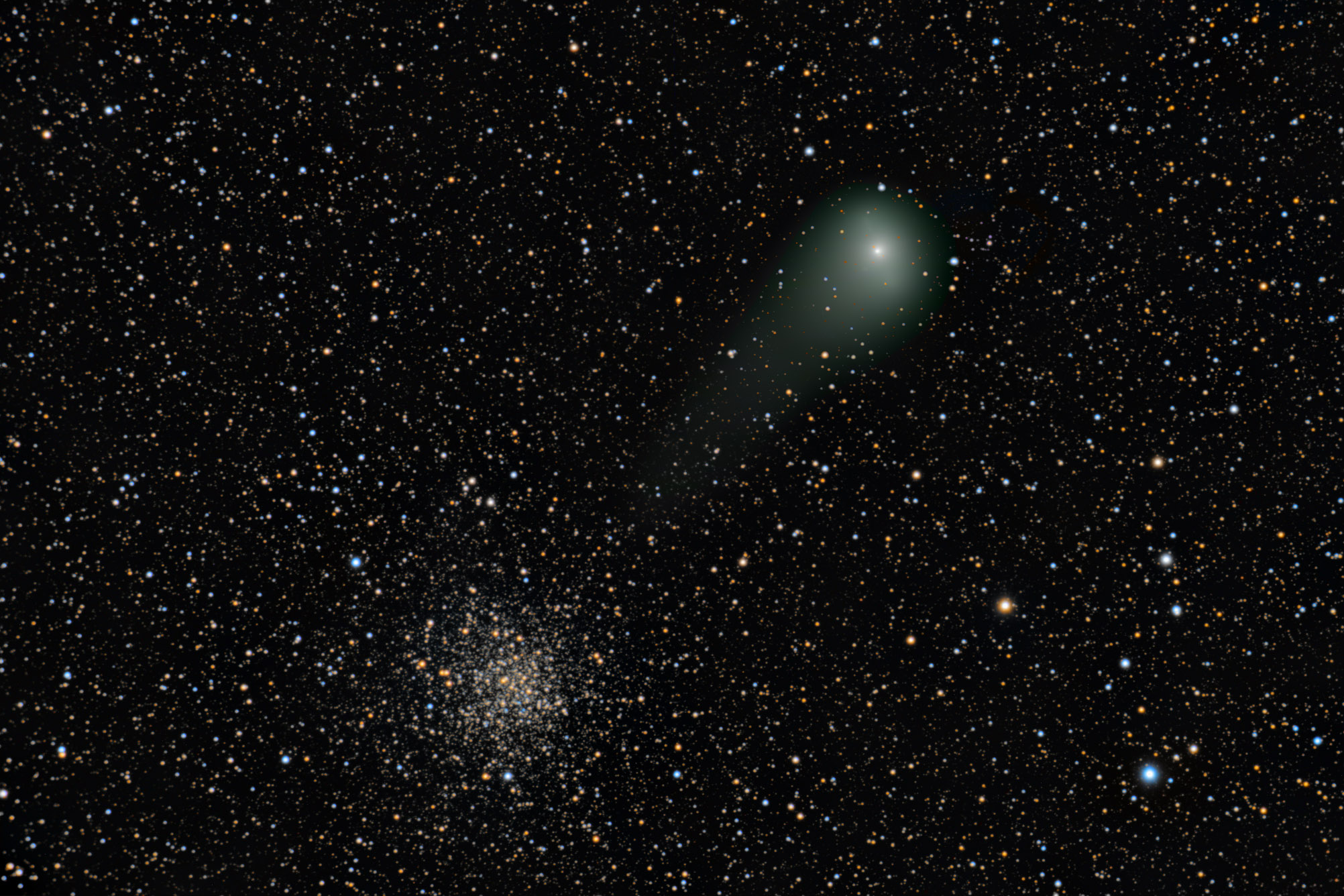
GARRADD-L30X1RGB10X1r.jpg
| This is a retake of an image taken in the fall of 2011. Conditions were very poor then so I wanted to retry it. I took data over three nights in December 2012 but conditions stayed very poor. At -11 degrees this one isn't easy even on a good night. Seeing was much better though again sky brightness was very high due to haze and nasty airglow. Again the fainter details escaped me. But thanks to better seeing it is a noticeable improvement over the previous year. Most of the text below is from the original post which is at: http://www.spacebanter.com/attachment.php?attachmentid=4373&stc=1 .
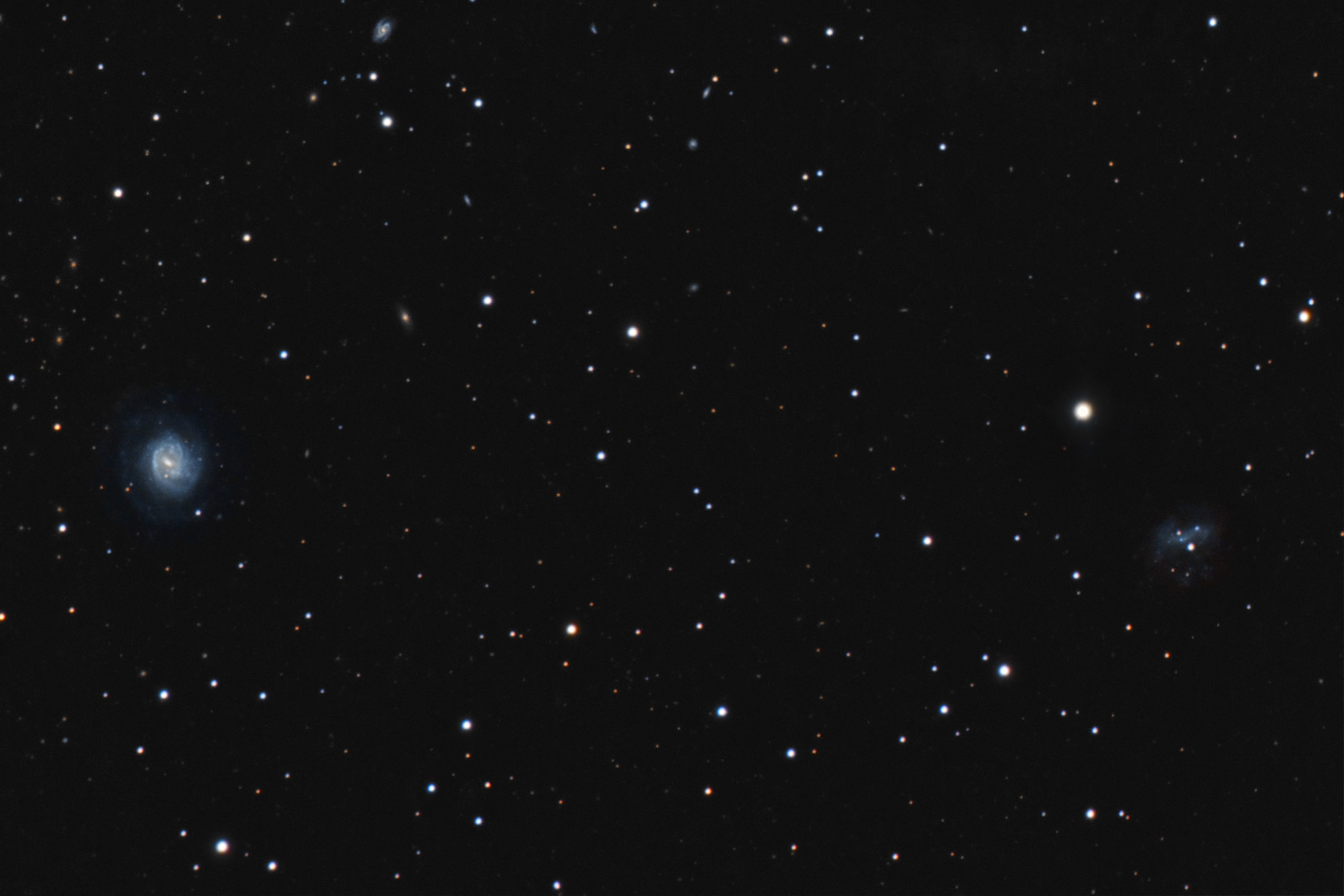
DDO 005/PGC 2689 is a strange galaxy near the right edge of my image. A note at NED shows lots of confusion about this galaxy in the MCG catalog (it is MCG -02-03-009). It reads: "Interacting? Perturbed SB? -- On the arm is a nucleus or a star, and also a compact E or star [16 mag] is found in it." The 16th magnitude object appears to be a star in my image judging by its PSF (Point Spread Function). The 18th magnitude object to the upper right, however, is not a star nor is the blue object below the 16th magnitude star. To me, both are star knots in a very disturbed looking galaxy. They are very common in such galaxies. I had expected it to be classed as an irregular galaxy but NED say it is a barred spiral classing it as SAB(s)m but of the Magellanic type (named for the Magellanic Clouds.) The DDO is the David Dunlop Observatory Catalogue of dwarf galaxies, most of which have low surface brightness.
The other main galaxy in this field is NGC 255 on the far left. Tully-Fisher measurements of the distances to these galaxies say both are about 65 million light-years away. Redshift measurements are in close agreement at 60 million light-years. Thus, while widely separated in my image, their projected separation is only about 500,000 light-years. It is quite possible they have interacted in the past. This could explain their appearance. NGC 255 is listed as SAB(rs)bc by NED and the NGC Project. It has a bright core region and widely spread very low surface brightness outer arms. It was discovered by William Herschel on November 27, 1785. It isn't in either H400 observing program.
This pair is located less than a half degree north of NGC 246, the Skull Nebula. So you've likely had it in your field of view when looking at this rather famous planetary nebula at low power.
There's another pair of probably related galaxies in the image. The spiral MCG -02-03-013 at the top of my image and LEDA 966142, the disk galaxy well below it. They have a redshift light travel time distance of 750 and 710 million light-years respectively. I found no other estimates of their distances. While a 40 million light-year difference may seem big this may be more to do with their relative velocities than a true distance difference. Or they just happen to be line of sight.
An apparent galaxy cluster is seen to the upper left of NGC 255. NED lists the 2MASS galaxies in the area but gives no indication that this is a cataloged group nor are there any distance estimates for them. Unfortunately, this is a very poorly researched area of the sky.
As mentioned I didn't begin to get the data I wanted and after a month of trying I gave up on it. I had to throw out about 70% of the frames as they hurt more than they helped. Satellites were nasty as well. Some frames had up to 3. One of the two usable red frames had three. With so few frames and some going right through detail in galaxies I had a lot of work removing them since I had to preserve the detail in NGC 255 and DDO 005 meaning cloning was not an option. I had to do a manual version of a rejection stack in Photoshop with only 2 color frames to work with. Lots of "fun" for a not so hot image.
14" LX200R @ f/10, L=5x10' RG=2x10' B=3x10', STL-11000XM, Paramount ME Related Designations for DDO005DDO 005, MCG -02-03-009, [RC2] A0043-11, APMUKS(BJ) B004331.99-114640.0, HIPASS J0046-11, PGC 002689, NGC 0255, MCG -02-03-017, 2MASX J00474730-1128073, 2MASS J00474726-1128077, GALEXASC J004747.22-112806.7 , IRAS 00452-1144, IRAS F00452-1144, AKARI J0047471-112807, CGS 131, 6dF J0047472-112807, 6dF J0047473-112807, LDCE 0041 NED004, APMUKS(BJ) B004516.60-114424.4, HIPASS J0047-11, PGC 002802, NVSS J004747-112803, DDO005, NGC0255, | 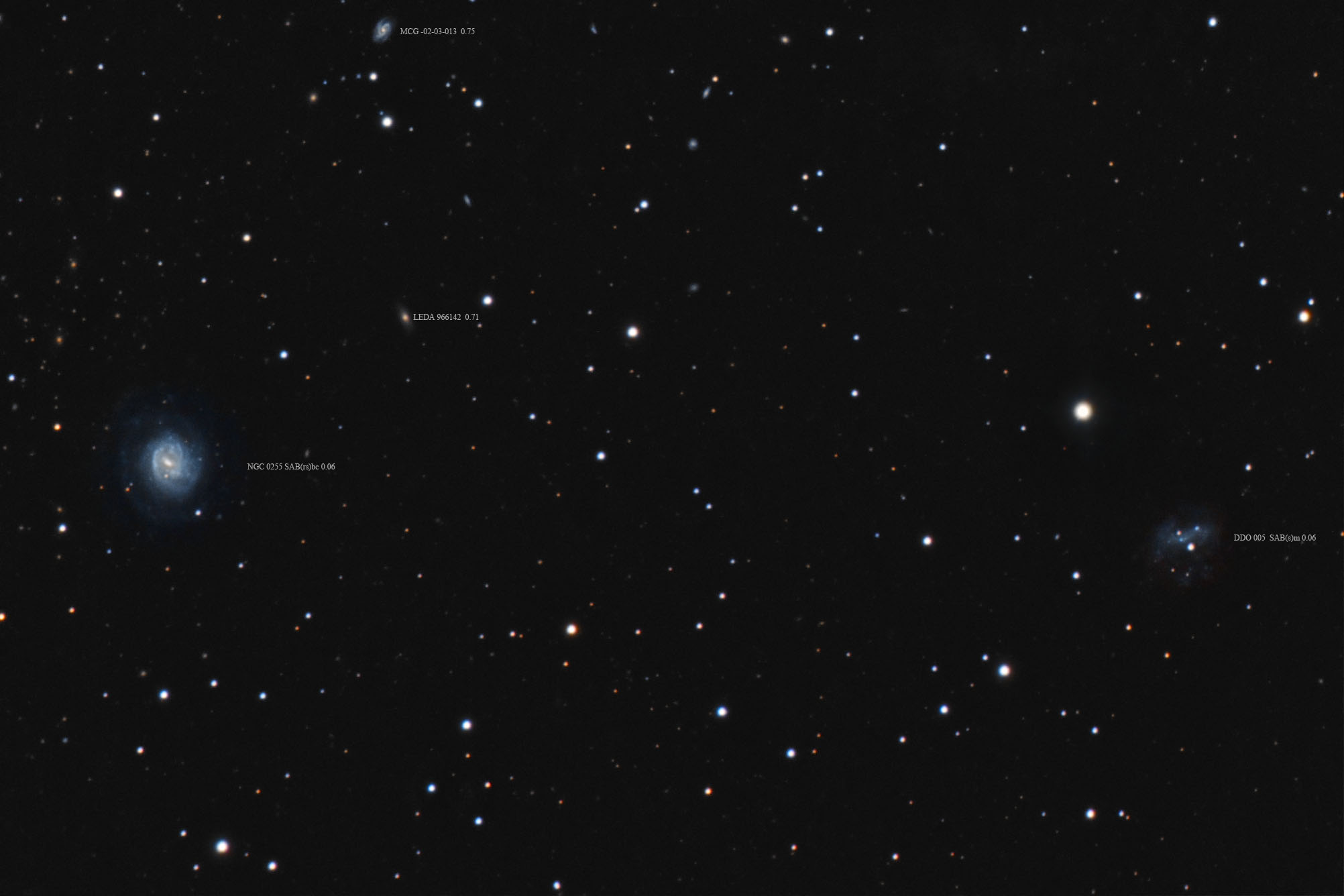
PGC02689L5X10RG2X10B3X10-ID.JPG
PGC02689L5X10RG2X10B3X10.JPG
| The Fath is a small cluster of galaxies, near the center of the larger cluster Abell 262. Located in Andromeda, it is at a distance of about 210 million light-years and includes many NGC galaxies. See my annotated image for details. The elliptical galaxy, NGC 708, anchors the cluster. I found this explanation for why it is named The Fath.
"The Fath is named after astronomer Edward Arthur Fath, 1880-1959. There does not seem to be any historical connection between Dr. Fath and the cluster. This suggests that it is named as such, simply because the cluster looks like the letter 'F'." I asked Dr. Pete Schultz (he punched holes in a comet and the moon), who did his undergrad work at Carlton College where Dr. Fath did much of his later work, what he knew about the group being named for him. While Fath was something of a legend at the college this was the first he'd heard of the cluster being named for him. So far he's turned up nothing. If he finds anything I'll update this.
"Dr. Fath did groundbreaking research that led to determining that spiral nebulae are actually distant galaxies." http://bf-astro.com/fath.htm
NGC 708 is the cD elliptical galaxy that anchors the Abell cluster. The cluster, in turn, is part of the Pisces-Perseus supercluster. Many papers speak of it having a dust lane across the nucleus at right angles to the radio axis of the galaxy. I don't see the dust lane in my image. It is likely too narrow for my resolution.
The annotated image notes the catalog name for apparent cluster members. I considered any with a redshift of 150 to 270 million light-years to be a member with the difference due to orbital velocities. Those outside this range are noted only by their redshift distance.
All sources agree NGC 704 is a galaxy pair. The problem is NED and SIMBAD can't agree on who is who. NED lists the northern galaxy as NGC 704B and the southern galaxy isn't listed at all. NED lists the faint galaxy to the southeast of the pair as NGC 704A which makes no sense. SIMBAD lists the northern as NGC 704A and the southern star-like galaxy as NGC 704B. Adding to the confusion the NGC project points to the lower galaxy to be NGC 704 making no mention of the upper galaxy yet in the text calls it the second brightest of the group. That might apply to the upper galaxy but not the lower. Also, they call it round while the brighter NGC 704B is oval. My head is spinning. Since I use NED as my "authority" I've gone with their designations though I consider that wrong in this case. That is A and B galaxies are reverse labeled.
Adding to the mistakes associated with this image is NGC 700 which some sources incorrectly attribute to PGC 6924 to the north. They are correctly labeled on my annotated image.
NGC 700, 709, 710, 714 and 717 were discovered by Bindon Stoney on October 28, 1850. NGC 703, 704 705 and 708 were discovered by William Herschel on September 21, 1786. None are in either of the Herschel 400 programs.
VI Zw 088 and VI Zw 095 are described in notes as "neutral fuzzy spherical compact" galaxies.
PGC 006974 seems to have some tidal sprays off the east and west sides.
IC 1737 appears to be just a double star. The position given is between two blue stars.
UGC 01319 has star clouds in its arms that are brighter than its core. Weird.
14" LX200R @ f/10, L=4X10' RGB=2X10', STL-11000XM, Paramount ME Related Designations for FATHNGC 0708, UGC 01348, CGCG 522-039, CGCG 0149.9+3555, MCG +06-05-031, GIN 105, B2 0149+35, 2MASX J01524648+3609065, 2MASXi J0152464+360906, 2MASS J01524644+3609065, GALEX J015246.3+360906, GALEXASC J015246.38+360906.7 , GALEXMSC J015246.35+360906.6 , WBL 054-015, LDCE 0115 NED019, HDCE 0099 NED018, CAN 014 NED01, USGC U081 NED55, HOLM 049A, MAPS-PP O_1225_0368467A, NFP J015246.5+360907, PGC 006962, SSTSL2 J015246.47+360906.7, UZC J015246.3+360906, [WB92] 0149+3552, NVSS J015246+360908, VLSS J0152.7+3609, 6C B014949.6+355432, TXS 0149+359, 73W 149, 1RXS J015244.7+360855, 1WGA J0152.7+3609, 2XMM J015246.2+360905, 2XMMp J015246.2+360906, ABELL 0262:[FD77] 01, ABELL 0262:[MS77] 01, ABELL 0262:[L84] G1, ABELL 0262:[BO85] 004, ABELL 0262:[ZBO89] O3, ABELL 0262:[ZBO89] R3, ABELL 0262:[CBW93] A, LGG 037:[G93] 011, ABELL 0262:[PL95] BCG, [SLH97] A01069, ABELL 0262:[BTM97] 1, ABELL 0262:[CAE99], [MO2001] J015246.5+360907.1, [LVO2003] J015245.0+360930, [MB2007] J028.1935+36.1523, [LPP2009] 0149+359(1), ABELL 0262:[ZAC2011] BCG, FATH, NGC708, | 
FATHL4X10RGB2X10X3-ID.JPG

FATHL4X10RGB2X10X3CROPr.JPG

FATHL4X10RGB2X10X3r.JPG
| This image was an opportunity to catch two objects on my to-do list at the same time. In the upper right, we have the 3 galaxy group WBL 142 comprised of three NGC galaxies, NGC 2385, 2388 and 2389 all about 200 million light-years distant. Also in the image in the lower left is the flat galaxy FGC 633 also known as UGC 03879 among 13 other designations at NED. It has a pair of faint round galaxies off its northwest ansa but like many of the galaxies in the image aren't listed at NED. FGC 0633 has about the same redshift as the 3 NGC galaxies so is likely related. In fact, the group of 4 is known as HDCE 0444. The field is located in northern Gemini north-northwest of Castor.
All four of these galaxies are quite different. Two appear rather red with little new star formation going on. NGC 2389 is a nice barred spiral with many short arm segments built up of star clusters. While it obviously has lots of HII regions they may be below my resolution limit as none showed up. It was spotted by IRAS indicating strong IR emission. With its blue color, it isn't all that surprising it is found in a UV catalog as well. Blue stars are new and formed in dust clouds that emit lots of IR light due to being heated by the young hot stars they contain. So oddly, blue galaxies can be strong in infrared light as well as ultraviolet light. NGC 2388 is considered a luminous infrared galaxy and is listed has having HII emission. That would indicate it isn't as dead as its red color would indicate. LIRG galaxies usually have intense star formation going on, just hidden behind a curtain of dust glowing brightly in IR light from the heat of all the newly formed stars hidden behind the dust cloud. NGC 2385 is an edge-on galaxy with a large halo around it. It too is red but also listed in both an IR and UV catalog. It too has HII emission. So it too likely has star formation hidden from us by dust. FGC 0633 is so edge-on we can't say much about it other than it certainly is thin. But it too is listed in IR and UV catalogs so is apparently rather active. It might be quite interesting if we could see it face on. I wonder if it might not look something like NGC 2389. I do find its irregular nature rather odd. Probably due to a very irregular arm structure when seen face on. My wife describes it as kinky.
While the 9th data release of the Sloan Digital Sky Survey covers this field only a few of its galaxies have been entered into NED, none with redshift data. The data I used comes from older measurements. In fact, only these 4 galaxies have redshift data at NED. I wouldn't have made an annotated image with so few to annotate but the field also turned up 5 asteroids. All with very short trails. Then there are some galaxies not listed at NED that look exactly like the short asteroid trails in the image. I decided I needed to point out the real asteroids. See the annotated image for details.
There's what appears to be a "sloshed" galaxy south of NGC 2385 which I've noted on the annotated image without redshift data. While the core appears located somewhat off center to the east side of the galaxy at first glance a closer look shows a faint arm making a complete, very faint loop to the northeast. If this is included the core is off-center to the west, exactly the opposite of my first impression. I needed more time to bring out this feature.
On the east side of the image is another galaxy that at first blush appears "sloshed" but in this case, the bright core is really a field star in our galaxy and the real galaxy core is where it belongs in the center of the galaxy. Though its two arms are very unsymmetrical with the eastern one drawn out giving the galaxy a somewhat oval appearance.
14" LX200R @ f/10, L=4x10' RGB=2x10' STL-11000XM, Paramount ME Related Designations for FGC0633UGC 03879, KUG 0726+337, CGCG 177-025, CGCG 0726.5+3347, MCG +06-17-012, FGC 0633, RFGC 1220, LCSB S1039O, 2MASX J07294395+3341242, 2MASXi J0729439+334124, 2MASS J07294398+3341238, GALEXASC J072943.91+334124.5 , GALEXMSC J072943.99+334124.4 , IRAS F07264+3347, NSA 134529, PGC 021136, UZC J072944.0+334124, NVSS J072945+334129, NGC 2388E, NGC 2389, UGC 03872, KUG 0725+339, CGCG 177-024, CGCG 0725.8+3357, MCG +06-17-011, 2MASX J07290464+3351395, 2MASXi J0729046+335138, 2MASS J07290459+3351361, 2MASS J07290465+3351394, GALEXASC J072904.48+335140.0 , GALEXMSC J072904.38+335139.0 , IRAS F07258+3357, AKARI J0729048+335133, WBL 142-003, LDCE 0504 NED007, HDCE 0444 NED004, NSA 134524, PGC 021109, SSTSL2 J072904.62+335138.2, UZC J072904.7+335139, NVSS J072904+335137, [WZX98] 07256+3355B, [VFK2015] J112.26954+33.86027 , NGC 2388, NGC 2388W, UGC 03870, CGCG 177-022, CGCG 0725.6+3355, MCG +06-17-010, FBQS J072853.4+334908, 2MASX J07285341+3349084, 2MASXi J0728534+334908, 2MASS J07285345+3349085, GALEXASC J072853.50+334907.5 , GALEXMSC J072853.42+334907.0 , IRAS 07256+3355, IRAS F07256+3355, AKARI J0728533+334905, WBL 142-002, LDCE 0504 NED006, HDCE 0444 NED003, NSA 134523, PGC 021099, SSTSL2 J072853.44+334908.5, UZC J072853.5+334908, [WB92] 0725+3355, NVSS J072853+334908, GB6 J0728+3349, [WZX98] 07256+3355A, [DJ2011] 07, NGC 2385, CGCG 177-020, CGCG 0725.2+3356, MCG +06-17-008, 2MASX J07282802+3350159, 2MASXi J0728281+335015, 2MASS J07282789+3350134, 2MASS J07282789+3350149, 2MASS J07282814+3350167, GALEXASC J072828.34+335016.6 , GALEXMSC J072828.18+335015.5 , WBL 142-001, LDCE 0504 NED005, HDCE 0444 NED002, AGC 170193, NSA 134517, PGC 021080, UZC J072828.2+335016, [WZX98] 07256+3355C, FGC0633, FGC0633, NGC2389, NGC2388, NGC2385, | 
FGC0633L4X10RGB2X10.JPG

FGC0633L4X10RGB2X10CROP125.JPG

FGC0633L4X10RGB2X10ID.JPG
|