M 106 is a large spiral galaxy about 20 to 25 million light-years away. A lot seems uncertain about such a major nearby galaxy. There is debate about its distance, about which galaxy group it is in and even as to its classification. Some say it is a peculiar Sb or Sc spiral. others say it is a cross between a spiral and a barred spiral and others add more oddities to its classification. It does seem to have an inner section and faint outer arms.
The large galaxy to the right (west) of M106 is NGC 4248. I've been asked to tell you where in the sky these objects are. This one is in the constellation Canes Venatici -- the Hunting Dogs. A rather obscure constellation high overhead during the middle of the night in the spring.
You can read more about it and see photos from many others at:
http://messier.seds.org/m/m106.html
Though the photo on the main page shows only the very center of the galaxy at very high contrast so is impossible to recognize as being the same as the one shown below. Even the others in the links in the article often don't look much like mine as they show only the inner core region of the galaxy.
M106 was discovered by Pierre Méchain in July of 1781 and never actually seen or recorded by Messier but was added to his list by others anyway. NGC 4248 was discovered by William Herschel on February 9, 1788. It is in the second Herschel 400 observing program. My notes from which got lost in the move to the lake 12 years ago.
Later I added H alpha data to show the regions of star formation and the odd jet coming up out of the galaxy. My skills were very limited when this was done. I made a few tweaks but really need to retake it correctly. This will have to do for now.
14" LX200R @ f/10, L=6x10' Ha (if used) 2x20', RGB=2x10' for Ha image 3x5' for original image, STL-11000XM, Paramount ME Related Designations for M106MESSIER 106, NGC 4258, UGC 07353, VV 448, CGCG 243-067, CGCG 244-003, CGCG 1216.5+4735, MCG +08-22-104, B3 1216+475, 2MASX J12185761+4718133, 2MASXi J1218574+471814, 2MASS J12185749+4718143, SDSS J121857.50+471814.2, GALEXMSC J121857.72+471813.6 , AKARI J1218583+471830, LDCE 0867 NED099, HDCE 0706 NED056, USGC U480 NED23, LQAC 184+047 010, HOLM 363A, NSA 141119, PGC 039600, UZC J121857.7+471820, 11HUGS 266, 87GB 121625.0+473537, 87GB[BWE91] 1216+4735, [WB92] 1216+4735, VLSS J1218.9+4718, 6C B121624.5+473456, GB1 1216+475, RX J121857.8+471813, RX J1219.0+4717, 1RXS J121900.4+471747, 1RXP J121856.4+471755, 2PBC J1218.9+4718, PBC J1218.9+4718, 2XMM J121857.5+471814, 2XMMp J121857.5+471814, 1AXG J121856+4718, XSS J12190+4715, CXO J121857.50+471814.3, SWIFT J1219.0+4715, SWIFT J1219.4+4720, LGG 290:[G93] 004, NGC 4258:[CPH93] 50C, NGC 4258:[TH94] 10, [M98j] 170 NED52, RX J1219.0+4717:[BEV98] 001, NGC 4258:[VP99a] X18, NGC 4258:[RW2000] X-06, [VCV2001] J121857.5+471814, [CHP2004] J121857.4+471812, RX J1219.0+4717:[ZEH2003] 01 , [VCV2006] J121857.5+471814, [KRL2007] 111, NGC 4258:[L2011a] X0001, [AHG2014] B172, M106, | 
M106&NGC4248LUM6X10RGB3X5.jpg

M106LUM6X10HA2X20RGB3X10R1.JPG
| M107/NGC 6171 is a globular cluster one of dozens of globular star clusters in Ophiuchus. While discovered Mechain who contributed many to the Messier list this one never made the list until modern times when this oversight was corrected by adding to the original list.
M107 is unusual in that has regions obscured by dust. The most obvious area is north of center in my image. I couldn't find out if the dust clouds are in the cluster or just foreground objects. The cluster is more scattered than most. Some sources put it about 21 thousand light years away.
This has been a jinx object for me. Seeing this low in my sky has been a major issue every time I tried. This time clouds and severe extinction was a problem. Atmospheric dispersion this low is another problem so I went with a pure RGB image to tighten up the stars. I used these to make a pseudo luminosity image after aligning them to remove the prism displacement by our atmosphere. Unfortunately, severe clouds got in the way, especially with the blue frames. Even though taken highest in the sky the blue and green signals were damaged by clouds. Blue far more than green. I was able to salvage 2 of 5 frames of each color. While the green frames used were not through clouds the two blue ones were rather badly obscured. The color data is rather suspect because of this. I used 4 blue frames to make the pseudo luminosity image but only two in the color data. Thus adding the color frames comes up two short of the pseudo luminance frame. I used them as they were taken the highest with the best seeing. Cost me some faint stars but the ones I got were sharper because of it.
Due to it being so low in my skies I'd not imaged it since going digital. Thanks to the Meridian Tree I can't catch it at its highest and have to do most of it to the east. Because of this, I had to wait years for a good enough night to go that low with usable seeing. Extinction was bad but the air steady. So severe were extinction and cloud issues, even 10 minute subs didn't come close to burning out the core. The image is several magnitudes fainter than my normal images due to how low it is and lack of luminance data. For more on it see: http://messier.seds.org/m/m107.html
14" LX200R @ f10, Pseudo L=11x10', R=5x10' GB=2x10', STL-11000XM, Paramount ME | 
M107PSEUDOL11X10R5X10G2X10B2X10C.JPG
| M108 is a near edge on spiral galaxy just off the bottom of the bowl of the big dipper. It can be put in the same low power field of view with M97, which was one of my first successful shots with the 6" f/4 when I was first getting starting with the observatory. Quite a few more distant galaxies can be seen in the background. The distance to this guy is thought to be 45,000 light years. Visually the bright star near the center makes it difficult to view all the detail that would otherwise be seen. Toward the left and right along the bottom is part of a distant, uncataloged galaxy cluster. Least, I can't find it in any such catalog I have. You can read more on this guy at: http://messier.seds.org/m/m108.html
This one is in dire need of retaking as it was a very early image before I knew what I was doing. Someday I'll get to it.
14" LX200R @ f/10, L=9x5' RGB=3x5', STL-11000XM, Paramount ME Related Designations for M108MESSIER 108, NGC 3556, UGC 06225, CGCG 267-048, CGCG 268-001, CGCG 1108.5+5556, MCG +09-18-098, 2MFGC 08733, 2MASX J11113096+5540268, 2MASS J11113091+5540275, SDSS J111131.06+554027.4, IRAS 11085+5556, IRAS F11085+5556, AKARI J1111311+554024, ISOSS J11116+5540, KIG 0469, LDCE 0867 NED008, NSA 034605, NSA 138917, PGC 034030, UZC J111131.2+554025, 11HUGS 224, 87GB 110837.4+555624, 87GB[BWE91] 1108+5556, [WB92] 1108+5556, NVSS J111130+554027, 6C B110835.2+555638, 1AXG J111128+5540, [SLK2004] 0604, [RHM2006] SFGs 047, [LG2007] 31, M108, NVGRC J111130.8+554027, | 
M108LUM9X5RGB3X5.jpg
| A more normal barred spiral and one much more like our own galaxy is M109. It is located about 50,000 light years away. Again that is only an approximate distance. The other bright galaxies in the field have about the same radial velocity so they are probably associated with M109 gravitationally. The bright one at the bottom right is UGC 6923. The one under M109 is UGC 6940 and the one to the left is UGC 6969. Oddly, the smudge directly below UGC 6969 and above a bright star wasn't in the Aladin database I checked. The dimmer one right of it was, it is LEDA 2832098. For more see: http://messier.seds.org/m/m109.html
This was one of my very first digital images and shows it. I do need to retake this one as I lost star color and faint features to my ignorance at the time.
14" LX200R @ f/10, L=10x5' RGB=3x5', STL-11000XM, Paramount ME Related Designations for M109MESSIER 109, NGC 3992, UGC 06937, CGCG 269-023, CGCG 1155.0+5339, MCG +09-20-044, 2MASX J11573598+5322282, 2MASS J11573596+5322290, SDSS J115735.96+532228.9, IRAS 11549+5339, IRAS F11549+5339, LDCE 0867 NED054, HDCE 0706 NED020, NSA 140498, PGC 037617, SSTSL2 J115735.95+532228.9, UZC J115736.0+532229, LGG 258:[G93] 006, [M98j] 170 NED26, UMa Cluster:[PRL2014] U082, M109, | 
M109LUM10X5RGB3X5.jpg
| NGC 205 is also known as Messier 110 though the latter designation is debatable as it was never part of a listing Messier ever made. He discovered it on August 10, 1773. But he never put it on his list. It was added to the listing in 1966, 149 years after his death. It, like M32, is a satellite of M31, the Great Andromeda Galaxy, and is classified as E5 pec. Most elliptical galaxies are red in color but NGC 205 is unusual in that its core region is blue and full of faint dust pockets. A tidal tail connects it to the outskirts of M32 seen in the lower left corner of my image.
This is a complete reprocessing of my 2007 data. While my original processing in early 2008 is very good for the time I reprocessed it hoping to better show the tidal tail and the dust in the core region. Also, I'd not processed it for an annotated image other than to point out long known globular clusters in a mono version. With better database data I decided it needed to be revisited, especially after I found many errors in the globular catalog when doing Andromeda IV on the other side of M32. As with that image, it turns out many of the globulars listed in the Bol catalog (Bologna Globular Cluster catalog) are, well, baloney. While all the classic globulars were correct (I've included their G number for cross-reference) many of the Bol objects had redshifts that put them over a billion light-years distant meaning they were really spherical distant galaxies. I've preceded the catalog name with *Cl for globular clusters and G for galaxies when redshifts were given. Unfortunately a few had no redshift data. For those, just the Bol number is listed with no attempt to classify them either way. That will take redshift data which was unavailable.
The improved processing also allowed me to bring out several planetary nebulae. Considering how close the field is to the edge of M31 it is hard to say if those more distant from NGC 205 belong to it or to M31 itself. I didn't try to make any distinction and doubt that is possible in any case. A couple of the planetaries were so faint or close to other objects I drew a line to them even when the label was on the right side of the object. For those, you may want to enlarge the image as they are only about 2 pixels across so too small to be seen on most screens without enlargement. Losses from JPG compression makes them even harder to see than they were in the uncompressed TIF images which at 15 megabytes are too large for posting.
For those wondering where the old G numbers came from they date to 1977 when Sargent, Kowal, Hartwick and van den Bergh did a search for globulars related to M31. This is listed at NED as the SKHV catalog. All with redshifts I checked are valid globulars, unlike the Bologna catalog that apparently expanded on the 1977 study only to be fooled into including some background spherical galaxies.
There are other late additions to the Messier list, none as late as M110 however. See http://messier.seds.org/addition.html for details. Then there's the issue with M102 which is still not resolved. Also, 4 others have been lost and "recovered" though also not without debate. http://messier.seds.org/missing.html
For SEDS general coverage see: http://messier.seds.org/m/m110.html
14" LX200R @ f/10, L=4x10' RGB=2x10', STL-11000XM, Paramount ME Related Designations for M110MESSIER 110, NGC 0205, UGC 00426, CGCG 535-014, CGCG 0037.6+4125, MCG +07-02-014, 2MASX J00402207+4141070, 2MASS J00402205+4141074, IRAS 00376+4124, ISOSS J00403+4140, KTG 01A, LDCE 0031 NED005, HDCE 0029 NED001, HOLM 017C, NSA 127447, PGC 002429, SSTSL2 J004022.06+414107.5, UZC J004022.0+414107, [SPB93] 008, LGG 011:[G93] 006, [SLK2004] 0093, KIG 0031:[VOV2007] 001, M110, | 
M110L4X10RGB2X10R4-ID.JPG

M110L4X10RGB2X10R4.JPG
| A galaxy of a different color --
Maffei 1 was originally cataloged as a nebula. It is SH2-191 in the Sharpless catalog of emission nebula for instance. It was recognized as a huge elliptical galaxy by Paolo Maffei in 1968 along with a nearby giant spiral Maffei 2. It lies only 0.6 degrees from our galactic plane. If in clear skies it would be a naked eye galaxy like the much closer M31 and M33. Some claim it would be brighter than M31 to the naked eye. I find that overly optimistic. Maffei 1 is thought to be about 10 million light-years away in the constellation of Cassiopeia. The error bar for that is about +/- 1 million light-years. http://iopscience.iop.org/article/10.1086/368339
Normally I see galaxies of this color only when they are several billion light-years distant and thus reddened by that billions of light-years of intergalactic gas and dust. Here I got the same color from only the dust along the plane of our galaxy. I believe it is varying levels of dust in our galaxy that makes the apparent dust lane in Maffei 1 and is responsible for its very lopsided shape. Seen by the 2MASS survey at 2 microns which penetrates the dust in our galaxy it looks very different.
Paper:
http://www.aanda.org/index.php?option=com_article&access=standard&Itemid=129&url=/articles/aa/full/2005/06/aa1566/aa1566.right.html
Image:
http://www.aanda.org/index.php?option=com_image&format=raw&url=/articles/aa/full/2005/06/aa1566/img32.gif
While Maffei 1 was thought to be an emission nebula, ironically, the blue reflection nebula northeast of the galaxy in my picture, ZOAG G135.91-00.47 was listed in the Zone of Avoidance Galaxy catalog, as a galaxy, about the same time Maffei was discovering the galaxy wasn't a nebula. It wasn't until 2003, thanks to the Midcourse Space Experiment it was determined to be a nebula forming new stars. That put it in the MSE catalog as [KSP2003] J023709.98+594231.0. To the north-northwest of the emission nebula less than 2 minutes away is another nebulous patch. This one isn't as blue. The only thing I find in Simbad in the area is centered a few seconds of arc below the star that seems embedded in it. Simbad classes it as an HII source though it is mostly listed in catalogs for CO masers and other IR catalogs. It also made the Midcourse Space Experiment catalog as MSX6C G135.8914-00.4580. For an HII region, it is an odd bluish color rather than HII pink.
14" LX200R @ f/10, L=8x10' RGB=4x10'x3, STL-11000XM, Paramount ME Related Designations for MAFFEI1Maffei 1, UGCA 034, WEIN 019, 2MASX J02363546+5939165, 2MASXi J0236354+593917, 2MASS J02363546+5939177, ZOAG G135.83-00.57, ZOAG G135.87-00.55, LDCE 0264 NED001, HDCE 0173 NED001, [RC2] A0232+59, HFLLZOA C027, HFLLZOA G135.86-00.55, PGC 009892, NVSS J023635+593921, [SPB93] 032, MAFFEI1, | 
MAFFEI_I_L8X10RGB4X10X3.JPG
| Sh2-197 is a very unusual entry in the Sharpless catalog of Nebula. The catalog was compiled in 1959 from the Palomar Observatory Sky Survey plates. #197 fooled Sharpless and nearly everyone else into thinking it was an emission nebula. In 1968 Paolo Maffei looking at IR sources discovered it was really a galaxy so obscured by dust it is only faintly visible in visible light. I see no hint of it in my blue filtered data, it is weak in green light and stronger in red though still quite weak. Sharpless can be excused for his error on account that such galaxies weren't even dreamed of at the time he compiled his catalog. Also its location, just below the Heart and Soul emission nebulae would strongly favor it being a bit of related nebulosity. Thanks to Maffei's discovery it is now known as Maffei 2. Maffei 1 I posted a while back is also incorrectly listed in the Sharpless catalog as Sh2-191.
WISE, the very deep IR survey satellite took a great image of the Heart and Soul Nebula that shows both Maffei 1 and 2 at the very bottom. http://www.nasa.gov/mission_pages/WISE/multimedia/wiseimage20100524.html Maffei 2 is seen at the very bottom just left of center. In the full size image it is seen to be a nice barred spiral with a drawn out arm. Likely it would have made Arp's list had it not been hidden from earthly eyes. To the right beyond a pair of "blue" stars is Maffei 1 which is very "blue" in the false color image. It has to be false color since all of the light is far too red for our eyes to see even if it could get through our atmosphere. The WISE image caption makes no mention of these galaxies which I find strange.
The two are thought to be about 10 million light-years distant and are in the constellation of Cassiopeia. Due to the highly variable obscuring dust and gas in our galaxy what visible light that gets through results in a very distorted image. In a comparison image I've placed the WISE image at the same orientation and image scale to the right of my image. Some of the stars can be identified in both images which cover the same region of the sky. Some of the bright regions at either end of the bar can be identified in my image, especially the "hook" going up from the bottom of the bar. A hint of the drawn out arm is visible below the "hook" region. To see it at these wavelengths Wise was cooled to within a 8ºK of absolute zero by a block of frozen hydrogen. The satellite was decommissioned after the last of the hydrogen was gone.
My fall weather last year (this fall is even worse) created havoc trying to get this image. I tried on many nights but only three were usable for the luminance channel and two for the color channels. Still I managed 12 luminance frames and 4 each for each color. I probably could have used more. Still I found amateur images up to 22 hours long that didn't show any more than mine does.
In processing I removed most of the nebulosity from the Heart and Soul Nebulae as they detracted greatly from even seeing Maffei 2. This is one tough object!
14" LX200R @ f/10, L=12x10' RGB=4x10', STL-11000XM, Paramount ME Related Designations for MAFFIE2MAFFIE2, | 
MAFFEI2L12X10RGB4X10.JPG

MAFFEI_2_COMPARED.JPG
| Minkowski's Butterfly, M2-9, is an interesting bipolar planetary nebula whose form is the result of two tubular jets created by interaction with its companion star. Most central stars are blue and that is likely the case here but the companion is a much brighter reddish star and that's what dominates. This one is too low in my skies for good seeing at my latitude. At least with the seeing, I had most of 2012. So other images posted on the net are far better as they were taken from more southern latitudes and also areas known for better seeing on average. See: http://www.cloudynights.com/ubbthreads/showflat.php/Cat/1,2,3,4,5,8,10/Number/3996507/Main/3985609 and http://www.pbase.com/jshuder/image/146351218/original for narrowband images without the seeing bloated LRGB stars in mine.
For more info see the HST image at: http://www.spacetelescope.org/images/opo9738a/
The jet is precessing as shown in the Wikipedia image at: http://en.wikipedia.org/wiki/File:M2-9motivo_corradi.gif
Only one galaxy with redshift data is in the image. It is a small round galaxy partly hiding behind a star near the southern edge of my image near the centerline. It is a bit over a half billion light-years distant by redshift light travel time measurement. Southeast of the planetary is the flat disk galaxy 2MFGC 13673. These galaxies from the 2 micron survey don't have to be as flat as those from the optical Flat Galaxy Catalog. There are a few other 2 micron survey galaxies in the field but none even have a magnitude estimate let alone a distance one so I didn't prepare an annotated image.
Conditions were so poor in June I tried many different nights and still only captured one usable blue frame so my color is suspect as even that night was poor compared to some of the other nights I got red and green data. They were only rather bad by comparison. I took over 30 frames to get the 9 barely usable ones.
14" LX200R @ f/10, L=4x10', RG=2x10' B=1x10', STL-11000XM, Paramount ME Related Designations for MINKOWSKISSDSS J012547.03-012218.4, APMUKS(BJ) B012314.23-013754.6, LEDA 073957, SSTSL2 J012547.34-012220.9, ABELL 0194:[D80] 037, ABELL 0194:[NFS85] 104, ABELL 0194:[LGC91] 0116, [BDG98] J012547.4-012221, MINKOWSKIS, BUTTERFLY, SDSS J012547.39-012221.0, | 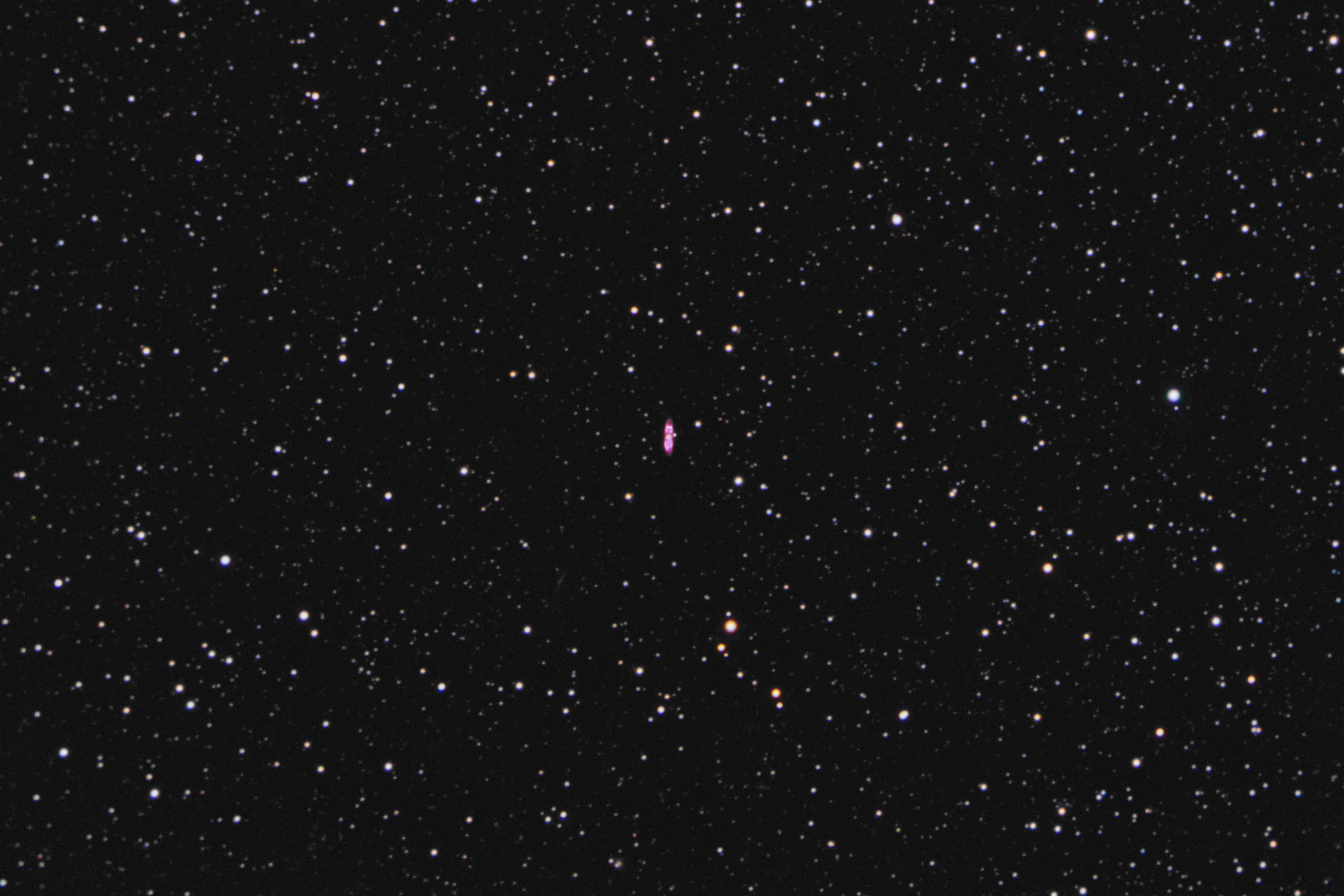
M2-9L4X10RG2X10B1X10.JPG
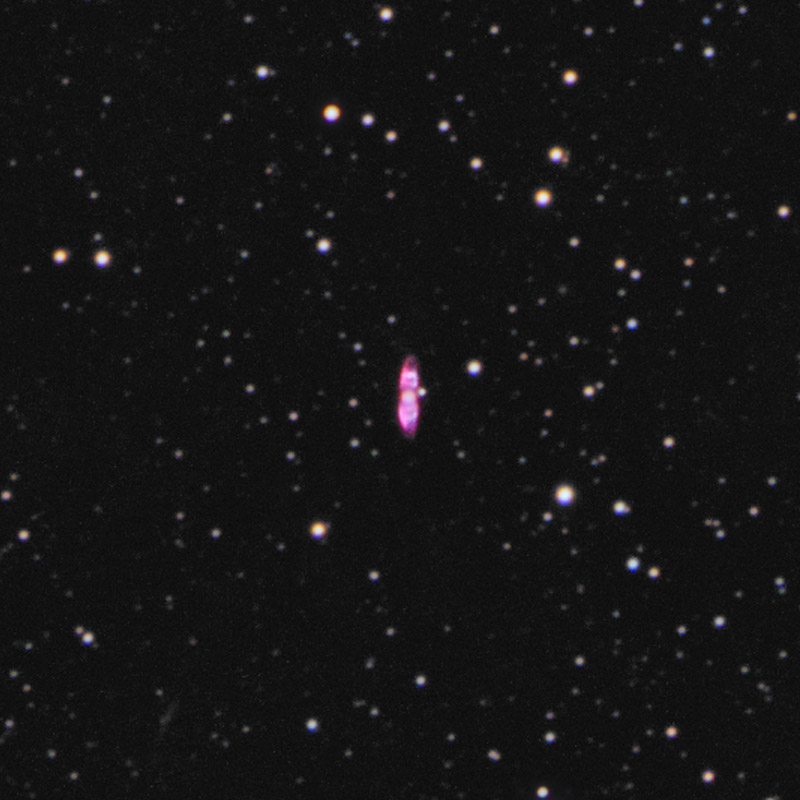
M2-9L4X10RG2X10B1X10CROP150.JPG
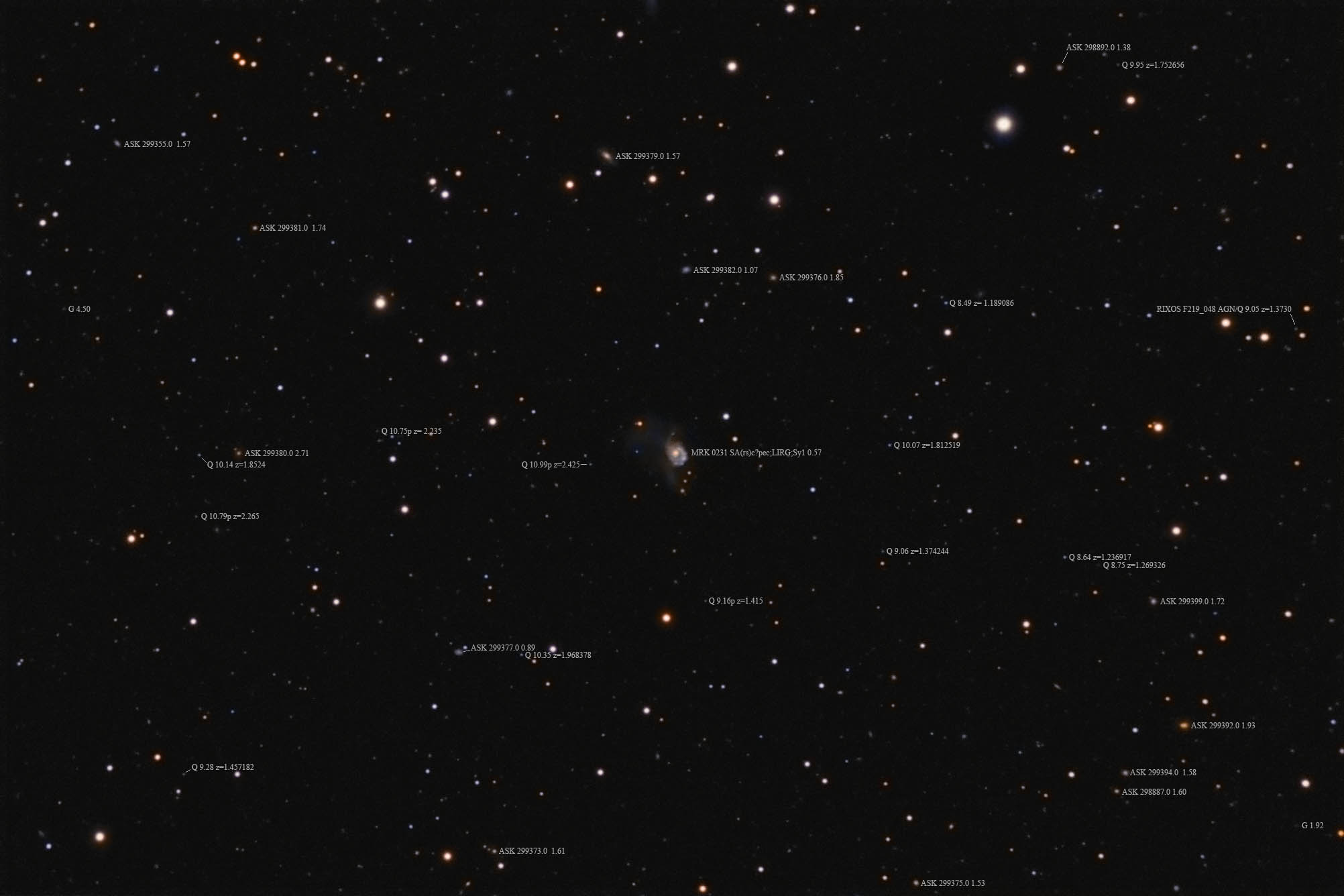
| MRK 0231 is a very active galaxy in Ursa Major a bit less than a degree north of Alioth the star in the handle of the Big Dipper before the bowl. NED classifies it as SA(rs)c? pec; LIRG; SY1 Which says it is a luminous infrared galaxy with a Seyfert 1 nucleus. This is one step down from a quasar. Some papers call it a BAL quasar. BAL stands for Broad Absorption Line. Some say it is a starburst galaxy due to its strong IR emission others say this is just a characteristic of the very well fed black hole at its core. In any case, this has to be the result of a nearly complete merger of two equal sized spiral galaxies. The AGN gives it a star-like core. So star-like the core appears to be a bright star. It gave me fits to process it in fact. The core is 10 times brighter than the disk of the galaxy just one second of arc away. I've never encountered a galaxy with such a powerful star-like core, especially one over a half billion light-years away.
This is a very well studied galaxy. Most major galaxies will have up to a dozen notes at NED. This one has 29 nearly all quite lengthy. I can't begin to recap them. If interested look this galaxy up at NED then click on the notes link, put on your hip waders and wade in. Many of the papers can be downloaded in their entirety. For a more readable article including an image of it by the Hubble space telescope (south up so rotated 180 degrees from my north up image) see: http://www.skyandtelescope.com/astronomy-news/spotting-nearby-quasars-winds/
Outside the star-like core to the south is a bright arc of stars not quite centered on the core. This may be due to the merging of two cores to make this galaxy or it could be caused by the outflow mentioned in the article above. To the southwest is a much larger ring with 5 or 6 star clouds in it. Large, very faint plumes are seen to the south, east and a finely defined one to the north ending in a blob. It looks much like a distant galaxy but is not listed at NED at all, not even as part of a galaxy. I didn't really know what to make of it until I saw the HST image at the Sky and Telescope link above. It is a distant edge on galaxy, just not one listed at NED. The HST image is oriented south up so is upside down compared to mine with north at the top.
There are three absorption features between us and the galaxy listed at NED. These are intergalactic dust clouds that may be altering its color. They are at 220, 290 and 370 million light years so about midway between us and the galaxy.
The bright disk portion of the galaxy is about 85,000 light-years across. A rather good size galaxy. The plumes, while weak, give it a diameter of over 300,000 light-years. Much of the plume volume appears to be very weak in stars. Does this mean most have fallen back into the disk of the galaxy? I found nothing on why the plumes were so weak other than suggestions that it is due to the merger being virtually complete. So have all the bright stars in the plumes died leaving only faint ones? Unfortunately, the plumes are very weak and conditions were poor when I collected the color data. The plumes appear to be very red in some areas but slightly blue overall. This might fit with the age of the merger being long enough ago the hot bright blue stars have since died leaving mostly low luminance older stars. I just don't trust my color data enough to say. It was extremely weak and was pushed beyond reason.
How Arp missed including this one in his list I can't understand. Also, Arp was fascinated by quasars near disturbed galaxies. He didn't buy the generally held view that the redshifts of quasars were due to the distance and the expansion of the universe. He thought they were ejected from active galaxies. In this case, there are 14 quasars (one a bit iffy) in the image. I didn't list the quasar candidates in the frame. That would have brought the total to nearly 30. I have my doubts many of these will prove to be real quasars so didn't include them. In any case, NED had only 17 galaxies in the field with redshift and 14 quasars. I've never had a field with a ratio like that and the total quasar count is a record for my images I believe. I have to wonder what Arp would have made of their abundance around such an active peculiar galaxy! Did he know about it? Wish I knew.
14" LX200R @ f/10, L=4x10' RGB=2x10', STL-11000XM, Paramount ME Related Designations for MRK0231MRK 0231, UGC 08058, SBS 1254+571, VII Zw 490, CGCG 293-045, CGCG 294-004, CGCG 1254.0+5709, CGPG 1254.0+5709, MCG +10-19-004, 2MASX J12561432+5652244, 2MASS J12561422+5652252, SDSS J125614.23+565225.3, IRAS 12540+5708, IRAS F12540+5708, AKARI J1256145+565223, ISOSS J12562+5652, LQAC 194+056 001, [RC2] A1254+57, C-GOALS 18, NSA 142553, PGC 044117, SSTSL2 J125614.23+565225.1, UZC J125614.3+565225, 87GB 125405.2+570847, 87GB[BWE91] 1254+5708, [WB92] 1254+5708, NVSS J125614+565223, VLSS J1256.2+5652, CRATES J1256+5652, CRATES J125614.23+565225.2, TXS 1254+571, CJ2 1254+571, GB6 J1256+5652, ICRF J125614.2+565225, IERS B1254+571, JVAS J1256+5652, VIPS 0613, VIPS J12562+5652, CXO J125614.2+565225, 2XMM J125614.2+565224, 2XMMp J125614.2+565224, 1XMM J125614.3+565224, 1AXG J125611+5652, 1AXG J125612+5652, [dML87] 663, [MBI96] 1254+571, [A2001] J125614.2+565225, [VCV2001] J125614.2+565225, [SLK2004] 0753, [VCV2006] J125614.2+565225, [FBS2007] 49, [HRT2007] J125614+565220, [JBB2007] J125614.23+565225.2 , [FCC2009] 008, [RLH2011] J1256+5652, [UIY2014] 22, MRK0231, | 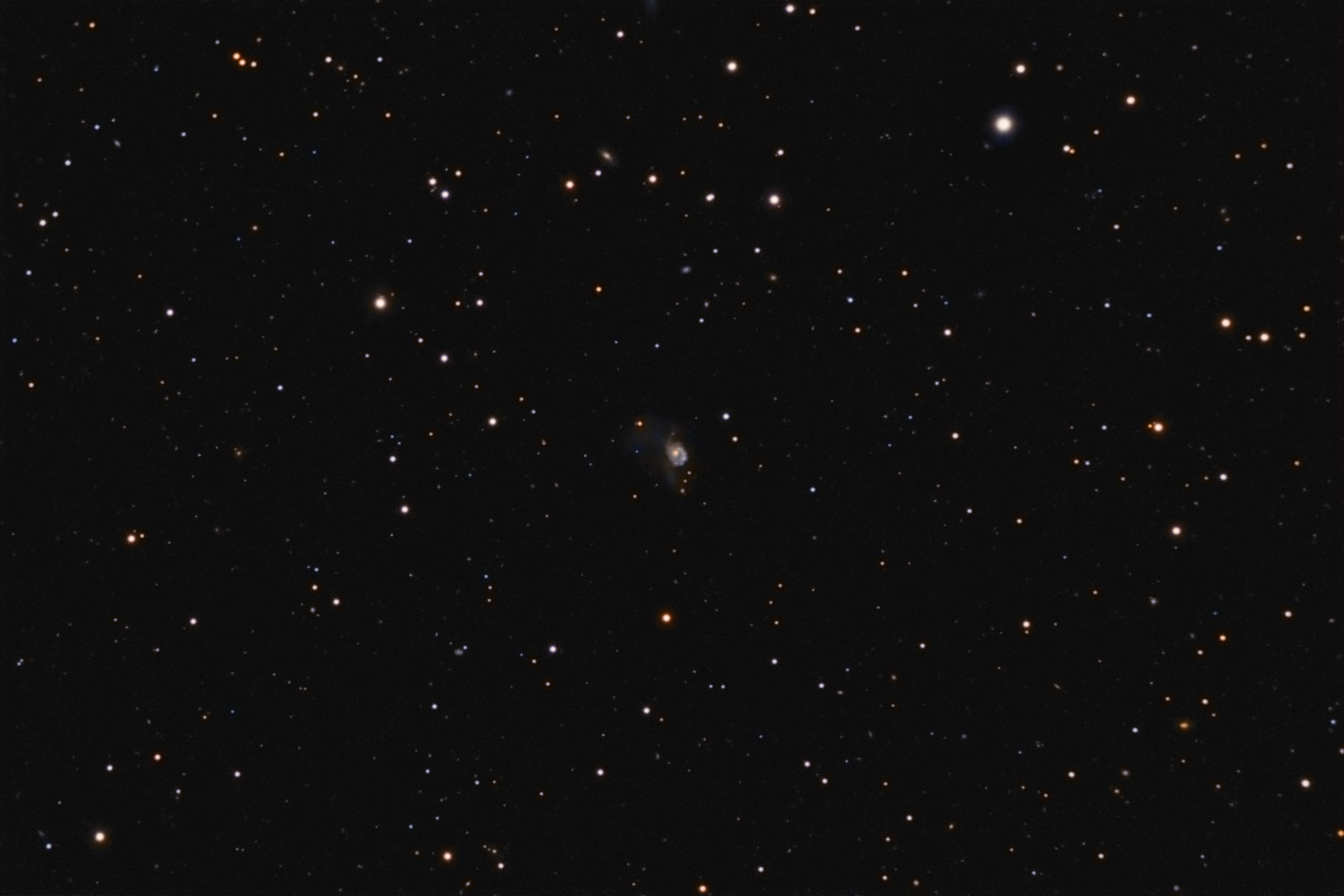
MRK231L4X10RGB2X10R.JPG
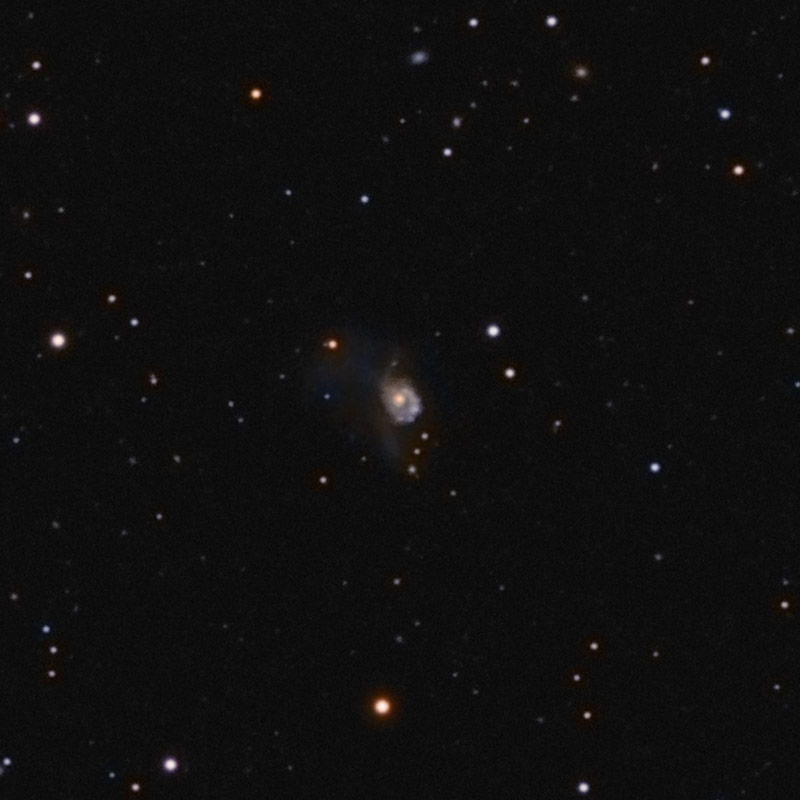
MRK231L4X10RGB2X10RCROP125.JPG
MRK231L4X10RGB2X10RID.JPG
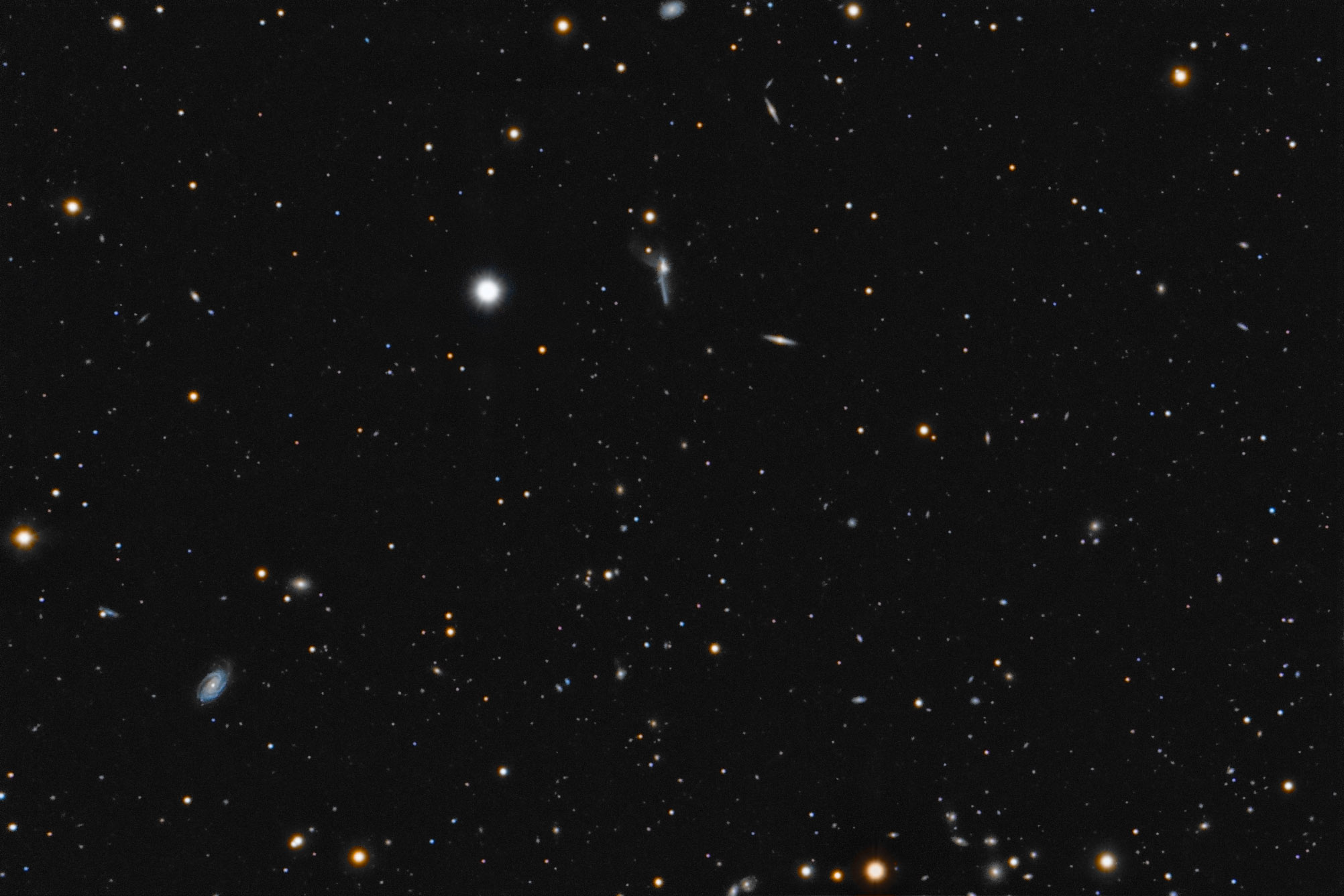
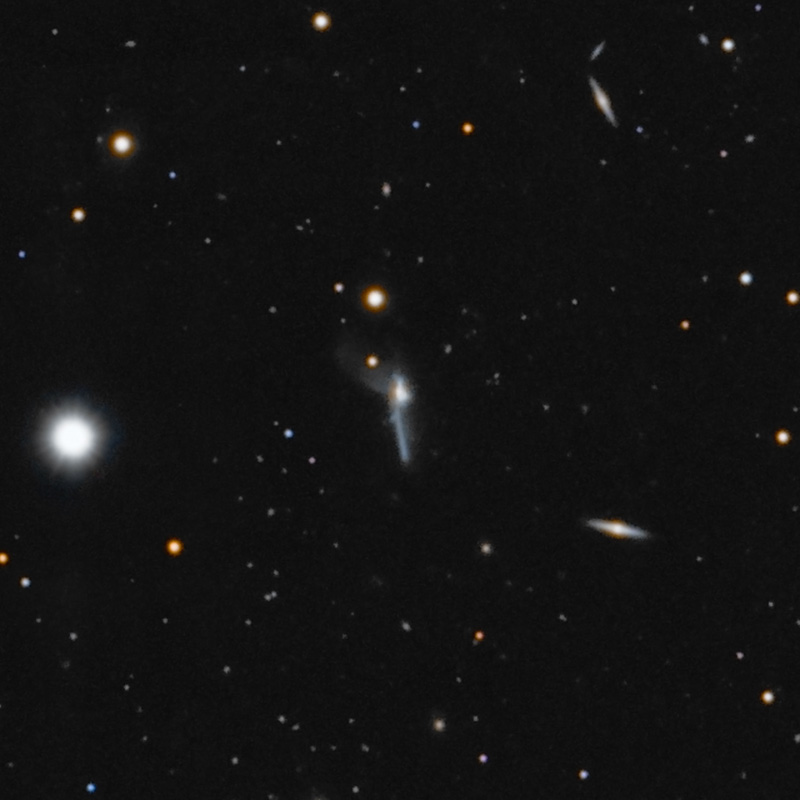
| Markaryan 273 is a well studied but mostly ignored by amateurs galactic merger in progress located in Ursa Major about 3 degrees northwest of M101. Redshift puts it about 516 million light-years distant. The core shows two nuclei one second apart. Far beyond my resolution this night. They consist of very different age stars. One of the merging galaxies is thought to have been unusually gas rich. A note at NED indicates there's a ring of star formation some 100 kpc (326,000 light-years) in diameter thanks to all the gas. I measure the southern plume as being some 144,000 light-years long though a note at NED puts it at 130,000. The difference may be due to the distance estimate used. As with all my redshift distances I used NED's 5 year WMAP calculator. I measure the northeastern fainter plume as being even longer at 165,000 light-years. Since they aren't 180 degrees apart I find the distance between their endpoints to be 103.7" of arc which works out to 259,000 light-years. The merging galaxies are considered very strong in all wavelengths from radio well into the ultraviolet. It is classed as an ultraviolet excess object, an IR source and a radio source. All but the gamma ray astronomers have put a lot of time into studying this object. There is a lot of information at NED on this galaxy, far too much for me to cover. Those interested can go to NED and look up MRK 273 and click on the notes link in the list of links at the upper right of the page. Several other galaxies with the same redshift as MRK 273 are in the area a few of which are in the frame.
I placed the galaxy well to the north of the center of the field to also pick up the core of the Abell 1783 galaxy cluster. This cluster's core consists of quite a few IC galaxies all of which are listed in NED as; "Identification as IC 0nnn is not certain." SEDS says of these; "Unidentified at the place given, or type unknown, in Ursa Major." Due to this, I've listed them with a question mark in the annotated image. The cluster's distance is about 920 million light-years. All the IC galaxies in this cluster were discovered in 1892 by Edward Barnard. He was a very careful observer so how these identifications became so questionable I don't know. With a radius of 35 minutes of arc MRK 273 is within the cluster but lies only about half as far away so the two are unrelated. All these IC galaxies were discovered by Edwin Barnard in June 1802. How such a careful observer came up with uncertain data I don't know. IC 936 may be a duplicate of IC 934 according to Seligman, if so what is the other one and which is the correct whatever IC number is used? It's all very confusing. Other IC galaxies credited to Barnard this night are just out of the image to the south. None of the identifications is certain, hence the question mark in the annotated image.
Well below MRK 0273 is the strange galaxy ASK 300802. Is that a plume going to the north-northeast or is it a separate galaxy? I consulted the Sloan image and couldn't tell. But according to NED, they say it is a star! Try as I may, I can't turn a fuzz patch into a star. So it is a mystery object, plume or separate galaxy but certainly not a star.
The frame contains several very blue star-like objects that appear to be quasars but aren't so listed at NED. Instead, they are listed as BLAGN (Broad Line Active Galactic Nuclei. Since they appear very quasar-like and are as bright as quasars I also show them as (Q?) in the annotated image. If a galaxy had a catalog designation that wasn't just its position I've shown that but if it is listed only by its coordinates I've just listed it as G followed by its distance. If a galaxy was in the IC but had no distance data it is listed with na where the distance would have been shown if it had been available. I've listed NED's classification of the object if given after its catalog name or "G" when available.
To show the faint northeastern plume of MRK 0273 I've stretched the image more than normal which also helps to show the noise in the image due to my short exposure time. I'd planned much more time but, as usual, this year, the weather conditions made that impossible. I had to fight for what little I got.
Also, the F7 star just east of MRK 273 sent horrid reflections all across the frame. The multitude of overlapping donuts it created was a major processing pain and cost me some faint detail. More time would have made those reflections even worse.
14" LX200R @ f/10, L=4x10' RGB=2x10', STL-11000XM, Paramount ME Related Designations for MRK273MRK 0273, UGC 08696, VV 851, Mrk 273, SBS 1342+561, I Zw 071, CGCG 271-060, CGCG 272-005, CGCG 1342.8+5608, CGPG 1342.8+5608, MCG +09-23-004, 2MASX J13444207+5553131, 2MASXi J1344420+555313, SDSS J134442.15+555313.8, SDSS J134442.16+555313.5, SDSS J134442.16+555313.6, IRAS 13428+5608, IRAS F13428+5608, AKARI J1344424+555316, ISOSS 058, ISOSS J13447+5553, LQAC 206+055 003, [RC2] A1342+56, ASK 300811.0, C-GOALS 22, NSA 052928, PGC 048711, UZC J134442.0+555312, 87GB 134253.6+560828, 87GB[BWE91] 1342+5608, [WB92] 1342+5608, NVSS J134442+555313, 6C B134252.4+560807, TXS 1342+561, GB6 J1344+5553, CXOMP J134442.0+555313, 2PBC J1344.2+5551, 2XMM J134442.1+555312, 2XMMp J134442.1+555312, 1AXG J134440+5553, [dML87] 678, [A2001] J134442.1+555313, [VCV2001] J134442.1+555313, [SLK2004] 0893, [RHM2006] ULIRGs 005, [VCV2006] J134442.1+555313, [FBS2007] 50, [HRT2007] J134444+555322, [JBB2007] J134442.12+555313.4 , [TCW2007] 149, [FCC2009] 009, [GMM2009] 0819603, [GMM2009b] 62, [TTL2012] 070237, [GMM2015] J134442.1+555313, [OYS2015] J206.17569+55.88711 , IC 0921, 2MASX J13430804+5539043, 2MASXi J1343080+553904, 2MASS J13430798+5539043, SDSS J134307.99+553904.3, SDSS J134308.00+553904.4, ASK 300906.0, LEDA 2509643, [BFW2006] J205.78325+55.65126 , Mr19:[BFW2006] 20347 NED02, Mr20:[BFW2006] 32589 NED03, [TTL2012] 081740, SDSS J134307.98+553904.5, IC 0926, 2MASX J13433923+5537534, 2MASXi J1343392+553753, 2MASS J13433925+5537535, SDSS J134339.26+553753.4, SDSS J134339.27+553753.5, GALEXASC J134339.06+553754.4 , SPIDER J205.91362+55.63152, [BFW2006] J205.91353+55.63157 , Mr20:[BFW2006] 32589 NED09, [TTL2012] 081741, SDSS J134339.24+553753.6, IC 0929, 2MASX J13434501+5538014, 2MASXi J1343450+553801, 2MASS J13434500+5538016, SDSS J134345.00+553801.8, SDSS J134345.01+553801.6, SDSS J134345.02+553801.6, ASK 300481.0, LEDA 2509027, [BFW2006] J205.93750+55.63384 , Mr20:[BFW2006] 32589 NED10, [GMM2009] 0817896, [TTL2012] 090687, IC 0930, 2MASX J13434549+5538474, 2MASXi J1343454+553846, 2MASS J13434553+5538473, SDSS J134345.54+553847.4, SDSS J134345.55+553847.4, SDSS J134345.55+553847.5, GALEXASC J134345.58+553848.1 , ASK 300910.0, [BFW2006] J205.93971+55.64657 , Mr20:[BFW2006] 32589 NED11, [TTL2012] 081744, SDSS J134345.53+553847.6, IC 0932, 2MASX J13435116+5538483, 2MASXi J1343511+553848, 2MASS J13435121+5538483, SDSS J134351.23+553848.5, GALEXASC J134351.79+553848.9 , LEDA 2509480, IC 0934, IC 0935, 2MASX J13435235+5539243, 2MASXi J1343523+553924, 2MASS J13435239+5539245, SDSS J134352.38+553924.5, SDSS J134352.39+553924.5, ASK 300441.0, [BFW2006] J205.96822+55.65687 , Mr20:[BFW2006] 32589 NED15, [TTL2012] 082501, SDSS J134352.37+553924.7, IC 0936, 2MASS J13440853+5542221, SDSS J134408.54+554221.9, SDSS J134408.55+554221.9, SDSS J134408.55+554222.0, GALEXASC J134408.51+554221.6 , ASK 301120.0, MAPS-NGP O_134_0024335, LEDA 2511548, [BFW2006] J206.03557+55.70616 , Mr20:[BFW2006] 32589 NED16, [TTL2012] 070297, SDSS J134408.53+554222.1, IC 0937, 2MASX J13442896+5537482, 2MASXi J1344289+553748, 2MASS J13442892+5537486, SDSS J134428.92+553748.6, SDSS J134428.92+553748.7, SDSS J134428.93+553748.7, ASK 300446.0, [BFW2006] J206.12045+55.63025 , Mr20:[BFW2006] 32589 NED17, [WLH2009] 0695 NED01, [TTL2012] 085651, SDSS J134428.90+553748.9, NGC 0507, UGC 00938, ARP 229 NED01, VV 207a, CGCG 502-067, CGCG 0120.8+3300, MCG +05-04-044, B2 0120+33, 2MASX J01233995+3315222, 2MASS J01233993+3315218, SDSS J012339.90+331519.2, GALEX J012340.03+331523.0, GALEX J012340.1+331522, GALEXASC J012339.79+331521.8 , WBL 038-015, LDCE 0074 NED071, HDCE 0070 NED021, USGC U059 NED36, NSA 129359, PGC 005098, SSTSL2 J012339.87+331522.2, UZC J012340.1+331520, [WB92] 0120+3257, 6C B012050.2+325930, 6C* 0120+329, RX J0123.6+3315, 1RXS J012337.2+331508, 2XMM J012339.9+331521, 2XMMp J012339.9+331521, 1XMM J012339.9+331521, LGG 026:[G93] 004, [SLH97] H01064, [BDG98] J012340.0+331520, RX J0123.6+3315:[BEV98] 002, RX J0123.6+3315:[CAE99], [MLO2002] J012340.0+331520, B2 0120+30:[MLO2002] NED45, NGC 0507:[PFP2003] 10, [FPK2009] 93747, NGC 0507 GROUP:[ZAC2011] BCG , RSCG 08:[WBJ2013] A, ABELL 1783, ZwCl 1341.9+5550, MCXC J1343.7+5538, SCL 133 NED02, RIXOS F254_524, RX J1343.7+5538, RX J134334.1+553644, [YSS2008] 045, MRK273, IC0921, IC926, IC929, IC930, ID931, IC932, IC934, IC936, IC937, UC938, ABELL1783, SAFIRES J134442.25+555314.1, | 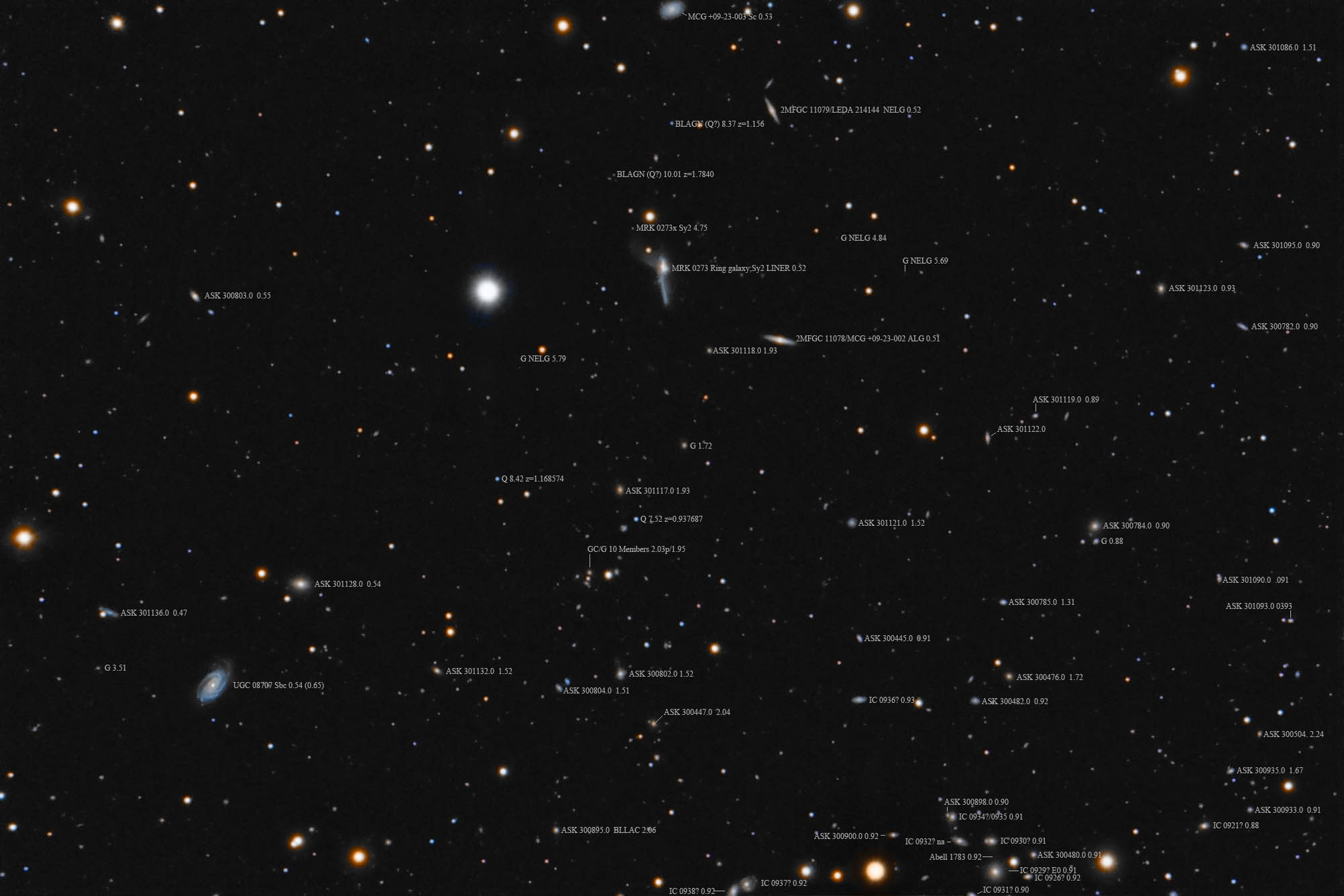
MRK273L4X10RGB2X10IDR.JPG
MRK273L4X10RGB2X10R.JPG
MRK273L4X10RGB2X10RCROP150.JPG
|