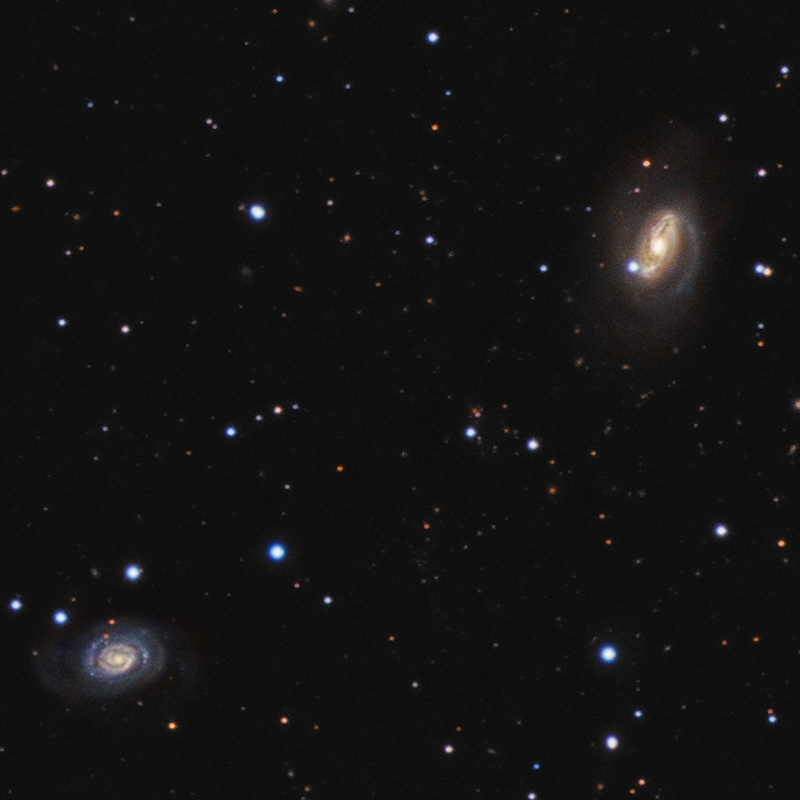
NGC 23 and NGC 26 are a pair of galaxies about 195 million light-years distant in the constellation of Pegasus about three degrees south of Alpheratz. NGC 23, the northwestern member, is classed by NED as SB(s)a; HII;LIRGSbrst while the NGC project says simply SB(s)a. HII means it has rather strong H alpha emission. This can be seen in the HST image at: http://commons.wikimedia.org/wiki/File:NGC23-hst-110-160-190.jpg which shows just the very core of the galaxy out less than 10" of arc. LIRGSbrst means it is a luminous infrared galaxy with starburst activity. This too is found in a region less than 10" from the galaxy's core. In any case, the galaxy appears somewhat disturbed so has likely interacted with some other galaxy, possibly NGC 26 10 minutes to the southeast which also appears disturbed. It is very non-symmetrical both as to the barred region which is much more organized to the north than to the south and the outer arms. The southern bar region seems to consist mostly of two bright star clouds. Off of each end are two the two faint arms. The one coming off the northern end and running down the western side is much brighter and condensed than the one coming off the disorganize southern end. The latter extends faintly well to the north more as a tidal plume than a spiral arm.
NGC 26 is classed by NED and the NGC project as SA(rs)ab. While a simple classification its structure is odd. Coming off the core on the eastern side is a bright arm arc that quickly ends. There seems to be no similar arm on the western side though one is hinted at in the DSS IR image. This is surrounded by a lopsided ring of rather white stars. Outside this is an arc of blue stars that circles about two thirds of the way around becoming a narrow dark lane to the south. Outside of these are faint spiral arms, the eastern one being very large and much brighter than the smaller western one. It is as if something pulled the entire structure but for the core to the east, the less dense the structure the more it was pulled off center. One very old paper indicated this might be due to a dwarf galaxy it ate sometime in the past.
NGC 23 was discovered by William Herschel on September 10, 1784. It is in the second Herschel 400 observing program. Unfortunately, my log from that was lost in the move to Minnesota. NGC 26 was found by Heinrich d'Arrest on September 14, 1865. Apparently, it was just a hair too faint for Herschel's speculum mirror telescope.
While there are many other galaxies in the image NED had little on them, not even a magnitude in most cases. Due to the lack of information, I didn't prepare an annotated image. Sure looks like it would have been interesting if the data had been available.
This is another field suggested to me by Sakib Rasool.
14" LX200R @ f/10, L=4x10' RGB=2x10' STL-11000XM, Paramount ME Related Designations for NGC0023NGC 0023, UGC 00089, MRK 0545, KUG 0007+256, CGCG 477-062, CGCG 478-034, CGCG 0007.3+2539, MCG +04-01-033, 2MASX J00095341+2555254, 2MASS J00095340+2555259, SDSS J000953.42+255525.6, GALEXASC J000953.40+255524.9 , GALEXMSC J000953.45+255523.4 , IRAS 00073+2538, IRAS F00073+2538, AKARI J0009533+255529, NSA 126309, PGC 000698, SSTSL2 J000953.37+255526.2, UZC J000953.4+255526, UZC-BGP 02A, 87GB 000717.6+253820, 87GB[BWE91] 0007+2538, NVSS J000953+255526, ALFALFA 4-220, GB6 J0009+2555, LGG 002:[G93] 003, [M98j] 001 NED01, [BTW2003] J0010+2557, [RHM2006] LIRGs 020, NGC 0026, UGC 00094, KUG 0007+255, CGCG 477-064, CGCG 478-036, CGCG 0007.8+2533, MCG +04-01-034, 2MASX J00102587+2549544, 2MASS J00102586+2549549, IRAS 00078+2533, IRAS F00078+2533, NSA 126323, PGC 000732, UZC J001025.8+254955, UZC-BGP 02B, NVSS J001025+254957, ALFALFA 4-221, LGG 002:[G93] 004, [M98j] 001 NED02, NGC0023, NGC0026, | 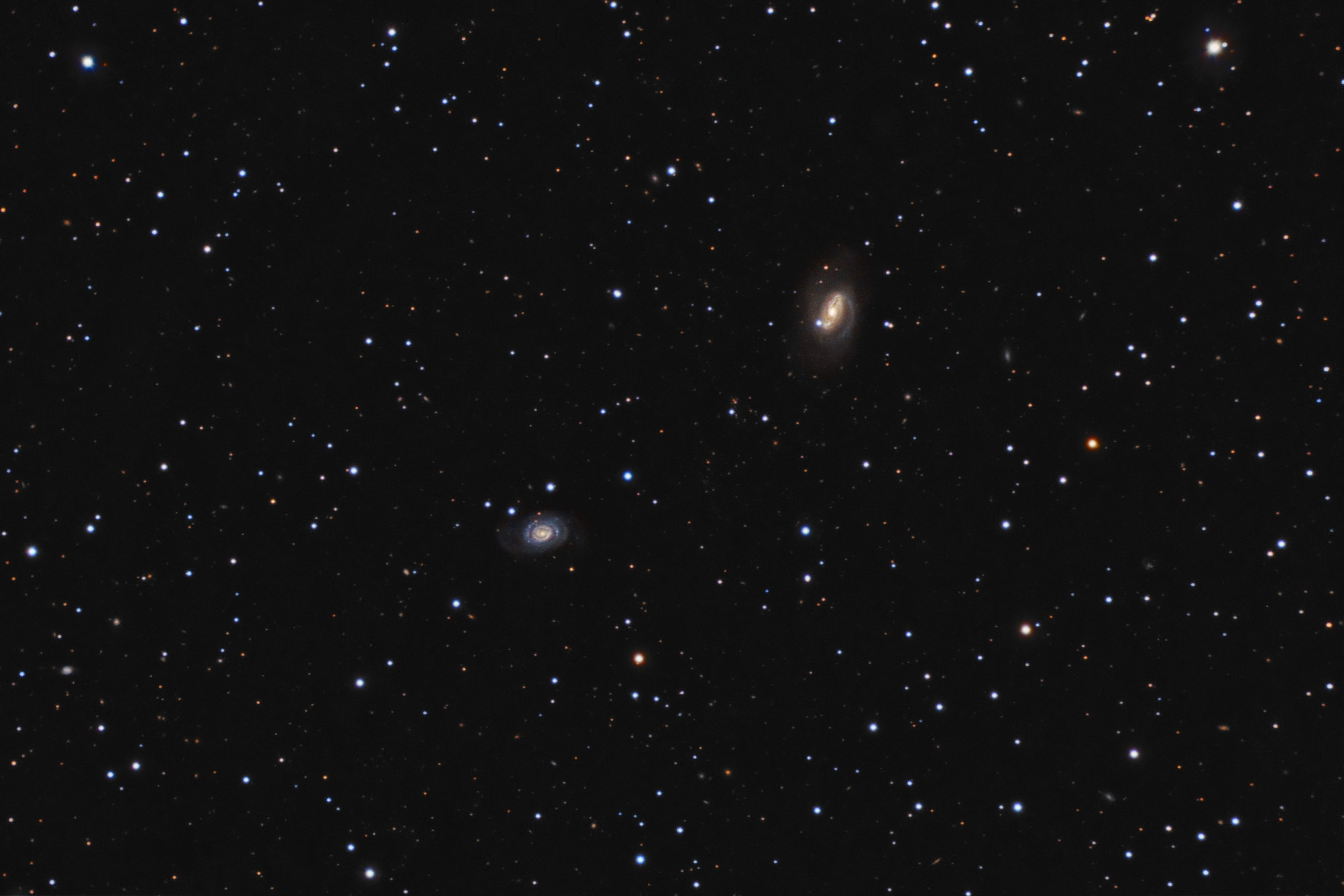
NGC0023-0026L4X10RGB2X10.JPG
NGC0023-0026L4X10RGB2X10CROP125.JPG
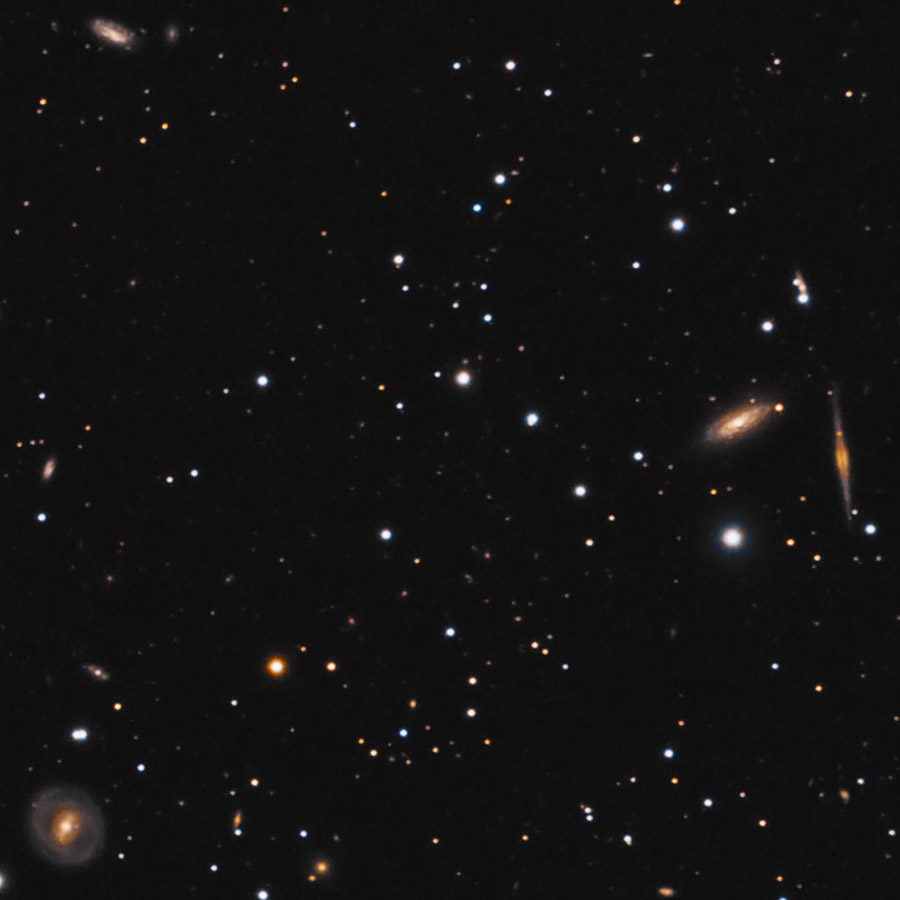
| KPG 3 is a pair of galaxies in Andromeda about a half degree east of Alpheratz a bit over 310 to 340 million light-years distant. The eastern member is NGC 27 a spiral galaxy that NED and the NGC Project classifies as S? while Seligman says Sbc?. I measure its size at nearly 120,000 light-years counting faint extensions seen in the FITs data and 90,000 for the bright region obvious in the JPG image. It was discovered by Lewis Swift on August 3, 1884. The companion was too faint to be seen in his telescope so was missed.
The companion is UGC 95, an edge on spiral. It qualifies as a flat galaxy and is FGC 16. NED lists it as being an Sc galaxy. Most distance measurements put it about 30 million light-years further than NGC 27. With that difference and lack of any distortion to either it is likely they are not interacting and thus close as seen only from our perspective. It is a very large spiral which I measure at about 190,000 light-years.
The other major galaxy in my image is UGC 105 which NED classifies as (R')SAB(S)0 and Seligman as (R')SAB0^+(s). It is an obvious ring galaxy with a very blue ring around a barred core. Redshift puts it at about the same distance as UGC 95, 350 million light-years. The ring is off center from the barred core extending further northeast than southwest. I measure the size of the galaxy at about 125,000 light-years.
Only two other galaxies in the image have redshift data. PGC 786 as an Sb spiral and LEDA 1856846 is an edge on disk galaxy not classified by NED. Both are about 350 million light-years distant same as UGC 105. I measure them at 83,000 and 54,000 light-years across respectively.
Several other PGC galaxies are in the image and are labeled but have no classification or redshift data.
14" LX200R @ f/10, L=4x10 RGB=2x10, STL-11000XM, Paramount ME Related Designations for NGC0027NGC 0027, UGC 00096, CGCG 499-063, CGCG 0007.9+2844, MCG +05-01-044, 2MASX J00103277+2859464, 2MASS J00103276+2859463, 2MASS J00103293+2859456, IRAS 00079+2843, IRAS F00079+2842, ISOSS J00104+2858, KPG 003B, LDCE 0012 NED001, MAPS-PP O_1257_0271300, NSA 126326, PGC 000742, UZC J001032.9+285946, NVSS J001032+285941, [SLK2004] 0017, KPG 003, NGC0027, KPG3, | 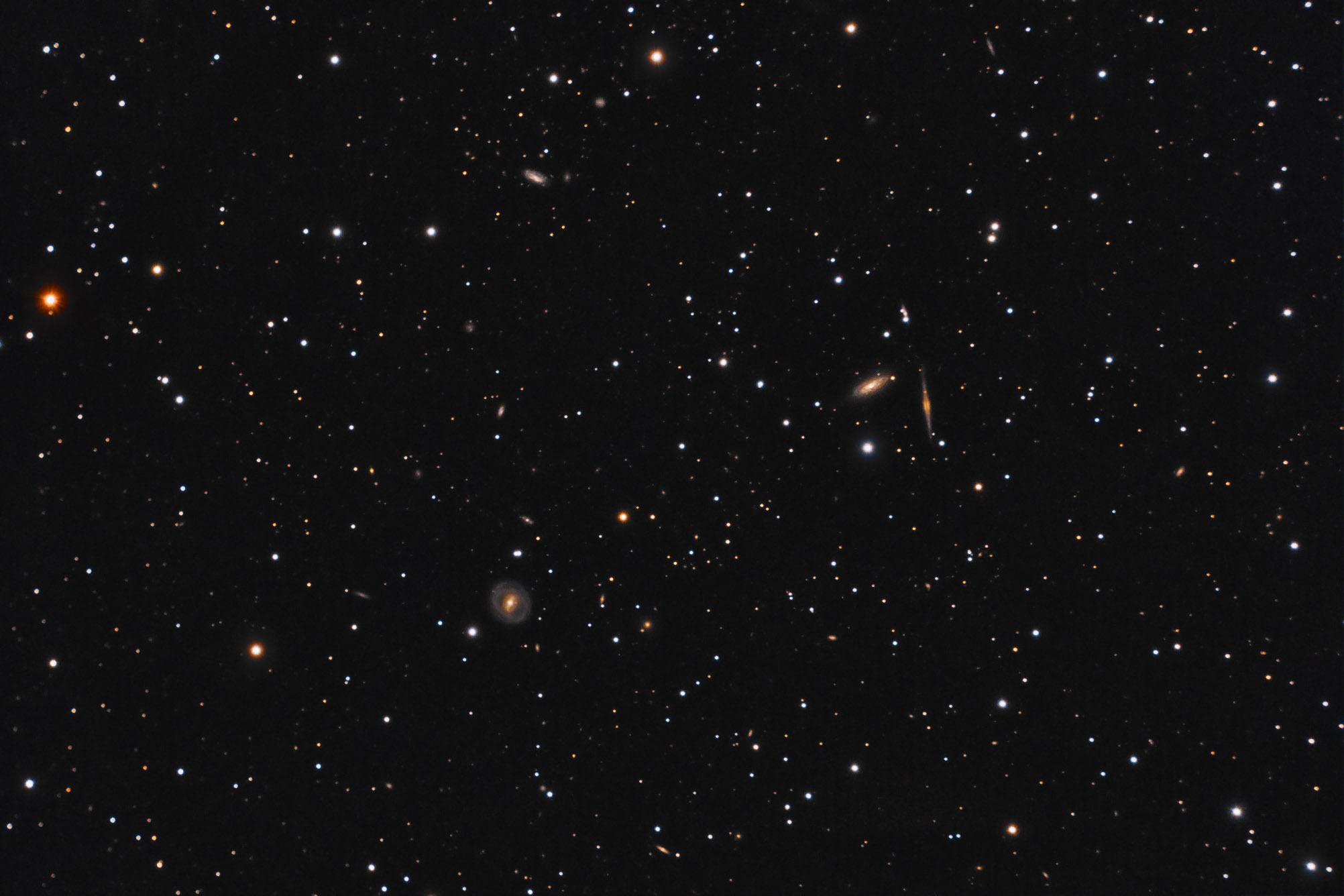
NGC27L4X10RGB2X10.JPG
NGC27L4X10RGB2X10CROP125.JPG
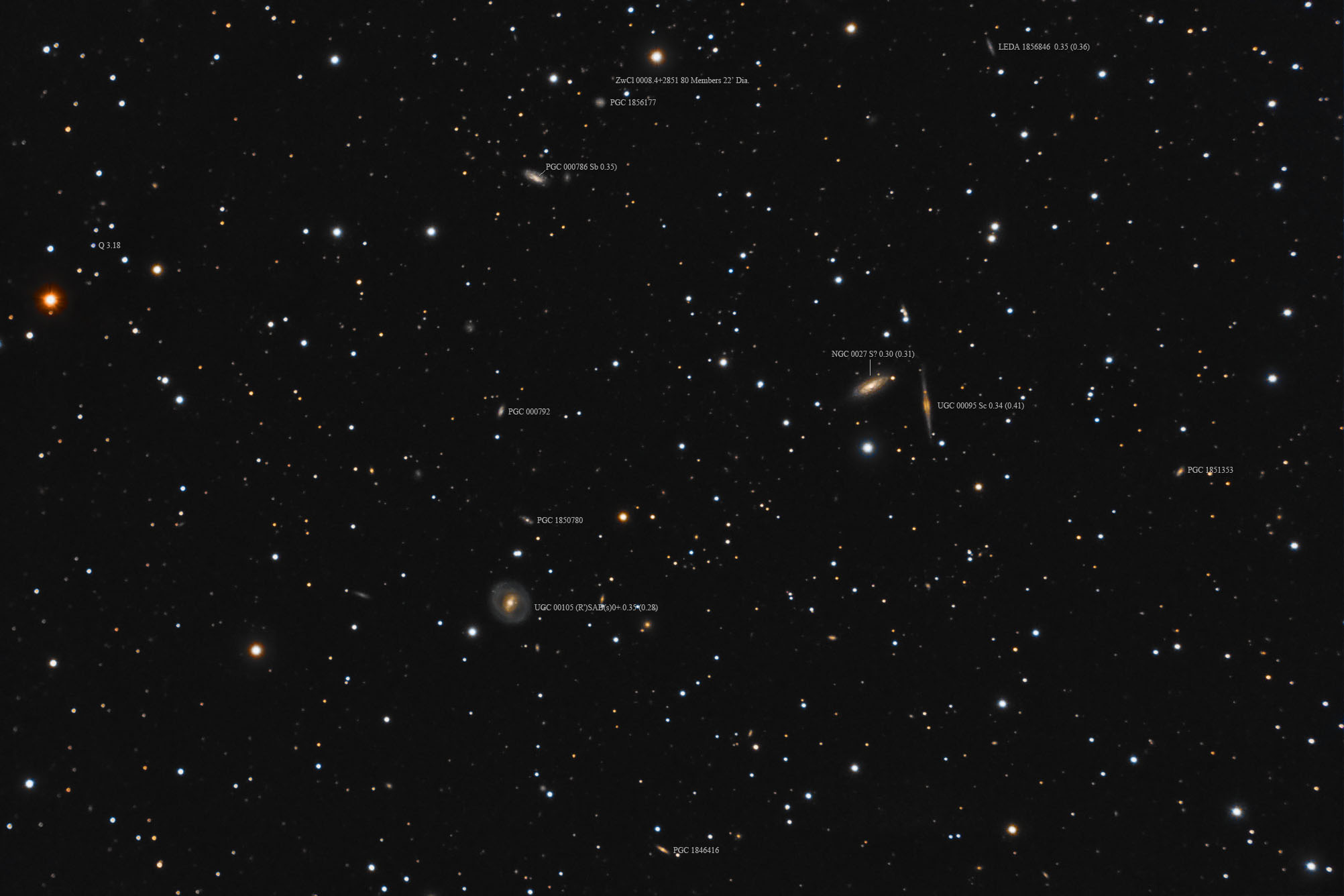
NGC27L4X10RGB2X10ID.JPG
| NGC 40 is a very red planetary nebula in Cepheus about 3000 to 3500 light-years away. The distance to these objects is hard to pin down. Papers indicate this nebula is interacting with the interstellar medium (ISM). It has two jets, a long one to the north and a fainter shorter one to the south. Many images on the net fail to pick these up which surprised me. The north arm is bent possibly due to the interaction with the ISM. See http://www.aanda.org/index.php?option=com_article&access=bibcode&Itemid=129&bibcode=2002A%2526A...391..689MFUL for more on this.
Conditions were horrible for this image. I was able to only use 2 of the 10 minute images and none of the 2 minute images of the bright regions were usable so they are rather burned in as is the central star. To better show the jet with limited luminance data I combined the two L images with one 5 minute one from long ago with the blue and red frames to make a pseudo luminance image. To show the weak nebulosity in the area I stretched it beyond reason. This hurt the stars but did allow some of the background nebulosity to be seen.
It was discovered by William Herschel on November 25, 1788. It is in the original Herschel 400 observing program. My entry from July 11, 1985 with my 10" f/5 at 180x on a good night reads: "Nearly 1', translucent ball of light around a 12th magnitude central star. UHC filter helped reduce the light of the star to make the nebula larger and brighter. Where did the 60"x8" size in the manual come from? It is nearly round to me, say 60" x 50" though I see Burnham's has it more oval. A good object."
14" LX200R f/10, PSEUDO L=6x10'+1x5' RGB=2x10', STL-11000XM, Paramount ME Related Designations for NGC0040NGC 0040, V0400 Cep, HD 000826, 2MASS J00130099+7231190, GALEXASC J001301.16+723119.7 , IRAS 00102+7214, IRAS 00102+7214 ID, SSTSL2 J001301.03+723119.1, 87GB 001015.0+721426, 87GB[BWE91] 0010+7214, NVSS J001301+723119, P-K 120+09 01, PN G120.0+09.8, GB6 J0012+7231, KNoWS J001302+723123, VERA J0013+7231, HIP 001041, [RCR2012] 01, [MGD2014] 0010.2+7214, NGC0040, UVQS J001301.23+723118.8, | 
NGC40PSEUDOL7X10RGB2X10.JPG

NGC40PSEUDOL7X10RGB2X10CROP150.JPG
| NGC 60/UGC 150 is a rather chaotic spiral possibly interacting with a high surface brightness companion on its arm. Why Arp didn't include it in his category for such galaxies I don't know. Seems more deserving than some he did include though at the time he didn't realize they were often at very different distances. That's not the case here. These two have virtually the same redshift that puts them about a half billion light years distant. It is located in southern Pisces between Aquarius and Cetus. NED and the NGC project classify it as SA(r)cd pec. Peculiar it certainly is with its very weird arm structure. NED makes no attempt to classify its companion, however. It was discovered by Édouard Stephan on November 2, 1882.
There's a third object to consider. It is northeast of the core of NGC 60. While its listed redshift is listed as about the same as the other two this is a friends of friends estimate (based on the other two) so of course, it agrees! Is it a star cloud in the disk of NGC 60 or a third galaxy. NED considers it a separate galaxy. If correct are they right to use a FoF estimate for redshift? To me, it looks like a distant unrelated galaxy. However, looks can be deceiving.
There are several other galaxies in the field, two near NGC 60, the others scattered through the image, that appear to be part of the same group at about a half billion light-years. All are listed by catalog identification not just my usual G label for galaxies. Several other groups appear to exist in the image. one at just under 2 billion light-years, another at just under one billion light-years and another at a bit over 800 million light-years.
The image contains many quasars (Q) and quasar candidates (UvES). Arp seemed enamored with the idea they are nearby objects, with anomalous redshift, ejected from disturbed galaxies like NGC 60. Another reason I find it odd he overlooked this object. It's quite possible they were unknown at the time.
Quasar LBQS 0013-0029 at 10.53 billion light-years is north of NGC 60. It is quite interesting not for itself but for what is between it and us. NED lists 9 absorption line sources between the quasar and us. With their redshift distances they are:
[HB89] 0013-004 ABS01 at 10.44 billion light years
[HB89] 0013-004 ABS02 at 10.38 billion light years
[HB89] 0013-004 ABS03 at 10.36 billion light years
[HB89] 0013-004 ABS04 at 10.35 billion light years
[HB89] 0013-004 ABS05 at 10.34 billion light years
[HB89] 0013-004 ABS06 at 9.95 billion light years
[HB89] 0013-004 ABS07 at 9.87 billion light years
[HB89] 0013-004 ABS08 at 9.53 billion light years
[HB89] 0013-004 ABS09 at 4.65 billion light years
Each is a cloud of gas and likely dust that have added their absorption lines to those of the quasar. It must be fun untangling such a mess.
There are 6 asteroids in the image. I've listed them with their magnitude estimate from the Minor Planet Center. One has the name Abstracta. I had to look that one up. Here's the naming citation.
(6805) Abstracta = 4600 P-L
Named for the astronomical bibliography Astronomy and Astrophysics Abstracts. Founded in 1969, the AAA present a comprehensive documentation of all aspects of astronomy, astrophysics and related fields. The AAA are prepared under the auspices of the IAU by a special department of the Astronomisches Rechen-Institut, Heidelberg. The department, headed by Lutz D. Schmadel for the last 20 years, has recorded, abstracted and indexed more than 500,000 documents. AAA is the direct successor of the Astronomischer Jahresbericht, which was founded in 1900. The AAA already amount to more than 60 volumes, occupying more than 3 meters of shelf space.
Since I use this source a lot in my research I find the asteroid more interesting than normal.
14" LX200R @ f/10, L=4x10' RGB=2x10', STL-11000XM, Paramount ME Related Designations for NGC0060NGC 0060, UGC 00150, CGCG 382-037, CGCG 0013.4-0034, MCG +00-01-048, 2MASX J00155824-0018130, 2MASS J00155824-0018126, SDSS J001558.24-001812.6, SDSS J001558.24-001812.7, SDSS J001558.25-001812.6, 6dF J0015582-001813, 6dFGSv 00132, LQAC 003-000 040, ASK 028709.0, APMUKS(BJ) B001324.76-003453.6, NSA 005769, PGC 001058, UZC J001558.2-001813, [ISI96] 0013-0034, [BFW2006] J003.99268-00.30351 , [GVI2006] LSB 004, Mr18:[BFW2006] 08854 NED02, Mr19:[BFW2006] 17868 NED02, KIG 0011:[VOV2007] 117, NGC0060, | 
NGC0060L4X10RGB2X10R-ID.JPG

NGC0060L4X10RGB2X10R.JPG

NGC0060L4X10RGB2X10RCROP150.JPG
| NGC 95 is a very peculiar galaxy in Pisces some 230 million light-years distant by redshift. Tully-Fisher estimates put it close at 190 million light-years using the mean value but they range from 170 to 230 million light-years. The galaxy has a very triangular shape with plumes to the east and west. My wife says it looks like it was flattened by someone stepping on it and spilling guts to the side. Something seems to have disturbed it but I doubt it was a big foot. The arm structure is very odd. It has mostly short faint arm segments coming from a very bright core that run rather directly to the edge which is ringed in HII star-forming regions. One arm coming around the west (right) side is stronger and rather red. As it reaches the edge it appears to turn blue and looping back along the edge until it meets another arm on the northeast which carries the illusion of a loop back to the core. Rather than being real, I think this an illusion due to the location of the HII regions but they could indicate something odd going on. The shape and plumes would indicate interaction with something, possibly something it is digesting. NED, The NGC project and Seligman all classify it as SAB(rs)c pec. Though Seligman adds a question mark after the "c". It was discovered by William Herschel on October 18, 1784. It isn't listed in either of the Herschel 400 observing programs. I measure its size at 120,000 light-years though Seligman says 125,000 but they put it slightly more distant (250 million light-years) which accounts for the size difference.
The only other galaxy with redshift data in the field is the flat galaxy FGC 036. It has virtually the same redshift as NGC 95 putting it at 230 million light-years though Tully Fisher measurements say 250 million. Since it is about half the angular size of NGC 95 it is half its size or about 60,000 light-years. NED says it is classified as an Sd galaxy.
One faint asteroid appears in the image halfway between NGC 95 and the lower right corner. It is (255371) 2005 WW111. It is estimated by the Minor Planet Center at magnitude 19.4 but appears much fainter in my image. This is likely due to the poor transparency and high sky brightness due to aurora the night I took this data. Due to the poor conditions, I tried another night but while transparency was better seeing was far worse so I went back and used the first night's data. There's a second 20.5 magnitude asteroid in the image but it is so faint it didn't survive my processing. I probably should have tried yet again but never did. The aurora played havoc with my color balance. I hope I compensated. I think it fairly close at least.
14" LX200R @ f/10, L=4x10' RGB=2x10', STL-11000XM, Paramount ME Related Designations for NGC0095NGC 0095, UGC 00214, CGCG 434-003, CGCG 0019.8+1013, MCG +02-02-003, 2MASX J00221352+1029297, 2MASS J00221353+1029298, IRAS 00196+1012, IRAS F00196+1012, AKARI J0022139+102931, LDCE 0015 NED003, NSA 126800, PGC 001426, UZC J002213.6+102931, NVSS J002213+102929, NGC0095, | 
NGC0095L4X10RGB2X10.JPG

NGC0095L4X10RGB2X10CROP125.JPG

NGC0095L4X10RGB2X10ID.JPG
| The NGC 128 galaxy group is located in southern Pisces along the border with Cetus and is about 200 million light-years distant give or take 30 million or so. Redshift distances range from 170 to 230 million light-years due to orbital velocity differences. I found no other distance estimates for the group.
The core galaxy appears to be the very strange edge on galaxy NGC 128 at about 180 million light-years by redshift. Its disk is rather warped and apparently covered by a dust band from nearby NGC 127. Its core region is very odd with a box-like structure with severe points at the corners. Many papers refer to the nucleus being peanut shaped. I guess this is the odd "X" shape. I sure don't see a peanut in any image including those in the papers. Most attribute this shape to perturbations caused by the two companions. Though the much smaller companions don't seem nearly as distorted. To distort the more massive core region with such small galaxies without tearing them to pieces seems rather hard to explain. I suspect the core is more likely due to a merger. Many years ago (like about 1985) I played with galaxy collision models by computer. Took days to run a simple simulation. Several times when a small galaxy was eaten by a tightly wound spiral I ended up with something seen edge on that looked like this, complete with warped disk and no other companions needed. Today simulations that include dust and gas (not possible with the computing power I had available) show they can be ejected leaving a dead, often elliptical galaxy. I have to wonder if that isn't what's going on here and the two companions are latecomers to the scene. It is classed as S0 pec by NED which seems reasonable.
To the west is NGC 127 at a redshift indicated distance of 170 million light-years. It appears to be interacting with NGC 128 but I can't see that as sufficient to cause NGC 128's odd core. Wish I could come back in a few million years to see what happens. NGC 127 is classed by NED as SA0^0^: by NED and SA0°by the NGC project.
On the eastern side of NGC 128 is NGC 130. It doesn't appear to be interacting so is likely at a somewhat different distance. Redshift would put it a bit behind NGC 128 but I doubt you can read it that accurately to know for sure. It shows no sign of distortion. The only one of the 5 NGC galaxies in the image to be "normal" looking. NED and the NGC project class it as SA0-:.
Southwest of NGC 128 is NGC 126. NED's classification is SB0^0^? while the NGC project says SB0°?. Except for the north and south side arms being unequal, it is rather normal looking.
Furthest west is the face on galaxy NGC 125. It has obviously interacted with some galaxy in the past; possibly NGC 128. It certainly has the mass to have inflicted damage on it and has plumes to indicate something major happened. Also, the core is "sloshed", meaning it is well off center. This can be caused by tidal forces some papers say. There's a broad plume on the south side partly hidden behind rather bright field stars in our galaxy. It has a talon-like claw coming out the west side. While faint it sure looks nasty! The NGC Project calls it (R)SA0+P: and NED says (R)SA0+ pec:. So they agree on this one.
NGC 125 and NGC 128 were discovered by William Herschel on December 25m 1790. NGC 126, NGC 127 and NGC 130 were found by Bindon Stoney on November 4, 1850.
Other group members that can be identified by redshift is MCG +00-02-045. It is also cataloged as 2MFGC 00328, a flat galaxy catalog of 2MASS IR galaxies. It isn't flat enough for the true flat galaxy catalog, however. NED says it is a Sbc: edge on galaxy. There are many other possible group members in the image but without any redshift data, it's impossible to know for sure. Some may be dwarfs closers than the group or large than average galaxies further away than the group. For those that seemed possible and were identified I labeled them with their catalog name, almost are from the 2MASS IR survey or from the British anonymous galaxy plate survey.
Many others are not listed in NED at all and are just noted with a question mark when they were either more interesting or brighter than many of the identified galaxies.
There are 6 asteroids in the image. They are listed by name and magnitude estimate by the Minor Planet Center on the annotated image. That saves me going over them here.
I've included an HST image of the core region of NGC 128 though it shows little detail. While it was labeled as color it appears to be a grayscale image.
14" LX200R @ f/10, L=4x10' RGB=2x10', STL-11000XM, Paramount ME Related Designations for NGC0128NGC 0128, UGC 00292, CGCG 383-029 NED02, CGCG 0026.7+0235 NED02, MCG +00-02-051, 2MFGC 00335, 2MASX J00291506+0251505, 2MASS J00291504+0251504, GALEXASC J002915.05+025150.7 , GALEXMSC J002915.05+025150.6 , USGC U017 NED01, NSA 127052, PGC 001791, UZC J002915.1+025150, UZC-CG 007 NED05, LGG 006:[G93] 002, [WGB2006] 002642+02350_a, v2MCG 03:[DMP2012] 1, NGC 0125, UGC 00286, CGCG 383-027, CGCG 0026.3+0233, MCG +00-02-048, 2MASX J00285020+0250200, 2MASS J00285018+0250196, GALEXASC J002850.25+025019.9 , GALEXMSC J002850.20+025018.7 , WBL 010-001, LDCE 0021 NED002, NSA 127036, PGC 001772, UZC J002850.2+025019, UZC-CG 007 NED03, NGC 0126, CGCG 383-028, CGCG 0026.6+0232, MCG +00-02-049, 2MASX J00290809+0248400, 2MASS J00290809+0248400, GALEXASC J002908.13+024840.8 , GALEXMSC J002908.07+024840.9 , WBL 010-002, USGC U017 NED02, NSA 127046, PGC 001784, UZC J002908.1+024840, UZC-CG 007 NED04, LGG 006:[G93] 009, [WGB2006] 002642+02350_d, v2MCG 03:[DMP2012] 3, NGC 0127, UGC 00292 NOTES01, CGCG 383-029 NED01, CGCG 0026.7+0235 NED01, MCG +00-02-050, 2MASX J00291239+0252215, 2MASS J00291239+0252213, GALEXASC J002912.35+025220.5 , GALEXMSC J002912.41+025221.3 , IRAS 00266+0235, IRAS F00266+0235, WBL 010-003, NPM1G +02.0013, NSA 127049, PGC 001787, NVSS J002912+025212, LGG 006:[G93] 010, [WGB2006] 002642+02350_c, v2MCG 03:[DMP2012] 5, NGC 0130, UGC 00292 NOTES02, CGCG 383-029 NED03, CGCG 0026.7+0235 NED03, MCG +00-02-052, 2MASX J00291854+0252135, 2MASS J00291854+0252136, GALEXASC J002918.43+025212.4 , GALEXMSC J002918.55+025214.0 , NSA 127054, PGC 001794, 1RXS J002917.0+025219, LGG 006:[G93] 011, [WGB2006] 002642+02350_b, v2MCG 03:[DMP2012] 4, NGC0128, NGC0125, NGC0126, NGC0127, NGC0130, | 
NGC0128L4X10RGB2X10CROPR125.JPG

NGC0128L4X10RGB2X10R-ID.JPG

NGC0128L4X10RGB2X10R.JPG
| NGC 129 is an open cluster in Cassiopeia about 5300 light-years distant. Distances to open clusters are often hard to come by. Not in this case. The cluster is one of the youngest known, about 77 million years old yet does contain the Cepheid variable DL Cassiopeia. It is the orange star just right of center in my cropped image. As an important rung on the distance ladder, this cluster and star have been very well studied allowing its distance to be pinned down rather accurately for a change.
Unlike NGC 7261 an even younger cluster, this one isn't as reddened by dust so appears much bluer. Also, eXcalibrator found more stars with good spectral data that were in the cluster itself that allowed me to adjust fully for what reddening there was, about half a magnitude.
The cluster was discovered by William Herschel on December 16, 1788 and is in the original Herschel 400 observing program. The preliminary notes from that program I was working from said it extended to 6th magnitude, very blue HD 2626 15 minutes to the south. I had to move the cluster south to move the star well out of my field as it was sending in some very nasty reflections and flares. My comments from July 11, 1985 took issue with that star being "in" the cluster. They read: "Large, rather bright, scattered cluster whose north edge blends into the background stars. Field star mentioned is a good 15 minutes south of the cluster and not 'within' it as the writer indicates. Also, the cluster is larger than the 11' cited (maybe 15'). Even so, it can't reach the field star." Today most sources say it is about 20 minutes across rather than the 15 I saw. That still won't reach HD 2626.
A few galaxies are seen in the background but they are nearly star-like and have no redshift data so I didn't bother with an annotated image.
14" LX200R @ f/10, L=4x10' RGB=2x10', STL-11000XM, Paramount ME | 
NGC0129L4X10RGB2X10.JPG
| When nothing pressing is within my imaging window which stretches no more than 1 or two hours either side of the meridian I will pick up a Herschel 400 (either the original or second list) object. The night of January 5th UT didn't look promising so I went for the rather meager original Herschel 400 object, the open star cluster NGC 136 in Cassiopeia, about 17,000 light-years according to WEBDA. That explains its small size. My visual notes from July 11, 1985 with my 10" f/5 reads: "Small ball of 15-20 stars inside a 10' cloud of stars." I don't really see that star cloud but the star count seems reasonable from my image. Herschel found it on November 26, 1788.
But I got quite a surprise when I processed this image. Processed normally for a star cluster I saw a "glitch" in my flat. Apparently, a dust mot was on the flat that wasn't on the camera. It was small so made a faint ring of light below an orange star. That was my initial take. I was about to process it out when I saw it wasn't quite round. Could it be real? I checked an image taken later that same night under worse conditions with no hint of a bright ring after flat calibration nor did the flat show a dust mot in that spot. So what the heck was it? A check of the blue POSS II plate showed a hint of the same feature. I'd just read a technique for bringing out galaxy plumes that was quick and dirty invented by Adam Block. Since it takes only seconds to try I put it to use and out popped an irregular ring. It is very noisy as I'm working severely underexposed for such a faint feature. Still, it looked like it could be a faint planetary nebula. A quick plate solve and check of SIMBAD showed that's what it was. It was discovered in 2012 by the French amateur astronomer Nicolas Outters when taking a deep shot in narrow band of nearby Sh2-173. I was two years late in taking the image! It is Ou2. He's discovered 4 such objects now. Not all are certain planetary nebulae, however. See: http://www.astroscu.unam.mx/rmaa/RMxAA..48-2/PDF/RMxAA..48-2_aacker.pdf for the initial announcement of Ou1 through 4 and two others found by other amateurs. If you read French or use a translation program Outters' website is at: http://www.outters.fr/ . Last I tried it it wasn't working properly for my browsers.
I processed this image expecting it to be quick and easy with little research needed for such an open cluster. Ou2 changed that! Took me several hours to track down the information on it. The central star is thought to be the sort of bright blue star a bit to the upper right of the dark core and below a rather bright blue star in the inner edge of the upper part of the ring. It shows faintly in the NB image in the PDF link above. Those out there taking many hour exposures in narrow band can likely show it a lot better than my 40 minutes of luminance data does.
So how many have imaged this cluster and either missed seeing or processed out the planetary that could have had their name on it?
14" LX200R @ f/10, L=4x10' RGB=2x10', STL-11000XM, Paramount ME | 
NGC0136-OU2L4X10RGB2X10R-CROP.JPG

NGC0136-OU2L4X10RGB2X10R.JPG
| NGC 140 is a rather strange spiral galaxy in western Andromeda about 280 million light-years distant judging by its redshift. NED and the NGC project classify it as Scd: The colon indicating some question about this classification. I classify it is strange. It seems to have only one main arm that comes out of the northern end of the galaxy which wraps around to the east then south and then back north making a three quarters ring around the galaxy. At this point, it seems to split in two. The shorter part continuing north-northwest then suddenly wrapping to the east-northeast where it ends. The longer half makes a sharp bend to the east-northeast to travel under the shorter branch. When it gets about as far east as the upper branch it suddenly bends south again. Other short arm segments can be seen off the three quarters ring at the south end going west. The ring portion of the one main arm has many knots of star formation which NED indicates are HII regions. I found no papers on this galaxy to shed light on how it got its strange arm structure. It was discovered by Truman Safford on October 8, 1866.
While there are a ton of background galaxies, not one has a listed redshift and only one has a magnitude listed. This is truly a "zone of avoidance" as far as information is concerned. A very odd spiral, hundreds of interesting background galaxies and nothing of use on any of it. Very frustrating.
I know I sound like a broken record but this one was severely hurt by conditions. I took a lot of data yet could use very little of it. Of the 4 red frames taken only 1 was at all usable. I used 2 of the 4 for the other two colors but they are highly suspect. 4 of the 8 luminance frames were unusable as well. I was surprised it came out as well as it did. I almost chucked the whole data set.
This is my first November 2013 image and was taken under very high winds with gusts to 70 kph according to my cloud sensor. I should have removed the dew shield as that extra length gave the wind leverage to move the scope elongating stars. High winds alone keep dew at bay so the shield wasn't needed. This is by far the highest winds I've tried imaging under due to the risk of branches flying into the observatory. Why I didn't shut down I don't recall. Guess I was desperate for finishing this one as I'd already spent several failed nights on it due to weather.
14" LX200R @ f/10, L=4x10' (one very poor), R=1x10', GB=2x10' (one green and one blue poor), STL-11000XM, Paramount ME Related Designations for NGC0140NGC 0140, UGC 00311, CGCG 500-038, CGCG 0028.7+3031, MCG +05-02-021, 2MASX J00312048+3047329, 2MASXi J0031204+304732, 2MASS J00312045+3047329, IRAS 00287+3031, IRAS F00287+3030, USGC U020 NED03, MAPS-PP O_1244_0344359, NSA 127120, PGC 001916, UZC J003120.5+304733, NVSS J003120+304727, NGC0140, | 
NGC140L4X10R1X10GB2X10.JPG

NGC140L4X10R1X10GB2X10CROP125.JPG
| NGC 147 is a low surface brightness dwarf elliptical galaxy and well-known satellite of M31. Oddly, I found a wide range of distance measurements to this one. Apparently, it doesn't have any Cepheids as all distance measurements used other methods including a relative of Cepheids, RR Lyra stars. The estimates ranged from 2.2 to 2.8 million light-years. The average is about 2.5 million light-years which is pretty much the accepted distance to M31. One paper said star formation ended over a billion years ago in NGC 147. Another said there's been little star formation for the last 3 billion years. I expected it to be more golden than it came out.
I noticed a nice "small" edge on disk galaxy on the NE edge of the galaxy. I then collected redshift data from NED on the field. Oddly that galaxy (marked with a question mark in the annotated image) wasn't in NED at all. NED identified less than 20 galaxies in the field even though I see far more in my image. Of those only 5 had redshift data. I'm not counting NGC 147 since it is bound to M31 which is heading our way. Thus NGC 147 has a blue shift, worthless for determining distance. One of the 5 is about 130 million light-years away and is southeast (lower left) of NGC 147. It is listed at NED as being a starburst galaxy though rather red in my image. Not unexpected as the new stars of such galaxies are often hidden near the core behind a dense dust cloud. Heating of the cloud by these stars is often the key to identifying them as being starburst galaxies. Still, it is nearly star-like and faint at magnitude 19.7 so a low surface brightness dwarf galaxy.
It was discovered by John Herschel on September 8, 1829.
14" LX200R @ f/10, L=4x10' RGB=2x10'x3, STL-11000XM, Paramount ME Related Designations for NGC0147NGC 0147, UGC 00326, DDO 003, CGCG 550-006, CGCG 0030.4+4814, MCG +08-02-005, 2MASX J00331212+4830314, LDCE 0031 NED003, PGC 002004, UZC J003312.7+483036, [SPB93] 005, LGG 011:[G93] 004, NGC0147, | 
NGC147L4X10RGB2X10X3R1.JPG

NGC147L4X10RGB2X10X3R1_ID.JPG
|