This field in southeastern Canes Venatici contains a large group of galaxies at a distance of about 350 million light-years. 6 of them are bright enough to have made the IC catalog. They are all quite red with the sixth IC imposter that redshift puts nearly 70 percent more distant. I'd have expected this group to have a designation but I couldn't find one. Three of them (ICs 4304, 4305 and 4306) form the WBL 457 group. Others, mostly fainter than the IC galaxies are lumped into other three and four galaxy groups but nothing I find encompasses the entire group. I find that odd. In any case, the IC galaxies are (starting in the center and working out), IC 4304, 4305, 4306, 4302, 4301 with IC 4300 being the outcast. There's another bright member of the group, UGC 08609 in the northeast corner that's a nice face on blue spiral finally adding a color other than red to the image. It appears there's been no work done on this group so I can't report further. Odd how such a nice group has been ignored like this. How far outside my frame the group continues I didn't look up.
All but one galaxy in the field are either members of this group at about 350 million light-years or more distant but for one exception. That is LEDA 214123, a blue S01 galaxy at 220 million light-years though it is smaller than most of the true members. Still being blue it adds some much needed color contrast.
One of the smallest members of the group is ASK 533588.0 on the western side of the frame. It has two companions that appear to be in its halo. They are likely far more distant galaxies in the same line of sight but without redshift data on them I can't say for certain they aren't colliding with the known member or with each other.
There are several distant galaxy clusters in the image. Some had an anchoring bright cluster galaxy others had none. If there was such a bright cluster galaxy it is noted in the annotated image. Often these have a spectroscopic redshift that's more accurate than the photographic one use for the cluster but in this case, all were photographic and identical to that of the cluster so aren't listed twice.
The IC galaxies were all discovered by Stephane Javelle. IC 4300 was not seen until June 16, 1903. The others were all seen on July 1, 1896.
As usual with my annotated images distances are in billions of light years and spectroscopically determined unless noted differently (p for photographic, Est for estimated etc.) Distances found by non-spectral means, often Tully Fisher, are the median of as many as NED has listed and are shown in parentheses.
14" LX200R @ f/10, L=4x10' RGB=2x10', STL-11000XM, Paramount ME Related Designations for IC4304IC 4304, UGC 08586, CGCG 190-032, CGCG 1333.7+3341, MCG +06-30-055, 2MASX J13355786+3325477, 2MASS J13355789+3325480, SDSS J133557.87+332548.0, SDSS J133557.88+332548.0, SDSS J133557.88+332548.1, GALEXASC J133558.00+332550.2 , WBL 457-001, LDCE 0983 NED021, HDCE 0806 NED010, ASK 533597.0, NSA 093479, PGC 047980, UZC J133557.9+332548, [SMB88] 0971, [TTL2012] 146309, [DZ2015] 738-01, IC 4300, MCG +06-30-048, 2MASX J13352519+3325116, 2MASS J13352520+3325114, SDSS J133525.19+332511.3, SDSS J133525.20+332511.3, ASK 533594.0, MAPS-NGP O_270_1279542, NGP9 F270-1279759, NSA 093477, NRGb 251.032, PGC 047912, [SMB88] 0941, [TTL2012] 146306, IC 4301, 2MFGC 10953, 2MASX J13353581+3322286, 2MASS J13353586+3322288, SDSS J133535.80+332228.1, GALEXASC J133535.97+332226.6 , MAPS-NGP O_270_1324473, NGP9 F270-1324690, NSA 163739, [SMB88] 0950, IC 4302, UGC 08580, MCG +06-30-051, FGC 1641, RFGC 2606, 2MFGC 10954, 2MASX J13353598+3328466, 2MASS J13353591+3328475, 2MASS J13353598+3328463, SDSS J133535.94+332846.4, SDSS J133535.94+332846.5, SDSS J133535.95+332846.5, ASK 504371.0, MAPS-NGP O_270_1279693, NGP9 F270-1279910, NSA 087667, NRGb 251.034, PGC 047935, SDSS-g-eon-0633, SDSS-i-eon-0661, SDSS-r-eon-0655, [SMB88] 0951, [TTL2012] 490371, [DZ2015] 738-04, IC 4305, CGCG 190-033, CGCG 1333.7+3344, MCG +06-30-054, 2MASX J13355834+3328257, 2MASS J13355837+3328260, SDSS J133558.37+332826.0, SDSS J133558.37+332826.1, GALEXASC J133558.40+332827.4 , WBL 457-002, LDCE 0983 NED022, HDCE 0806 NED011, ASK 533590.0, MAPS-NGP O_270_1280048, NSA 093473, NRGb 251.037, PGC 047981, UZC J133558.4+332826, [SMB88] 0972, [TTL2012] 146302, [DZ2015] 738-02, IC 4306, CGCG 190-035, CGCG 1334.0+3340, MCG +06-30-058, 2MASX J13361966+3325247, 2MASS J13361964+3325245, SDSS J133619.63+332524.3, SDSS J133619.64+332524.4, GALEXASC J133619.77+332525.1 , WBL 457-003, LDCE 0983 NED023, HDCE 0806 NED012, AGC 231140, ASK 533591.0, MAPS-NGP O_270_1280394, NGP9 F270-1280611, NSA 093474, PGC 048015, [SMB88] 0984, [TTL2012] 146303, [DZ2015] 738-03, IC4304, IC4300, IC4301, IC4302, IC4305, IC4306, ECO 04194, | 
IC4304L4X10RGB2X10ID-R.JPG

IC4304L4X10RGB2X10R.JPG
| IC 4630 was suggested to me by Sakib Rasool. It is a spiral starburst galaxy which is likely the result of a merger in progress -- SIMBAD considers it two galaxies while NED sees only one as I do. Though the plumes indicate it is the result of a merger. A merger some feel is still going on. It is a mostly white galaxy with two plumes. NED classes it as S? It is located in Hercules below the keystone at a distance of a bit under a half billion light-years. Besides the plumes, it has a nearly complete arc around a bright core. I find little on it other than it is included in many papers about mergers in progress. The annotated image shows a number of related galaxies at its redshift. Most are smaller galaxies. I've annotated them by catalog entry rather than the generic G or Q used for the rest. With so many in the immediate area, it's not much of a stretch to think this galaxy has been feeding on its dwarf neighbors for a long time. IC 4630 was discovered by Stephane Javelle on July 27, 1903.
I got a surprise when I looked at the first image as it came in as there was a bad reflection in the upper left corner. I moved the scope slightly but it was still there. Reflections move or vanish when the scope's aim is changed slightly. I let it go expecting to remove it during processing. That was last June. Before I took it out when processing the image I checked the Sloan image of the area and there was the "reflection" just as it appeared in my image. Like IC 4630 it was quite white in color on the Sloan image. So it is real. Real what I don't know. Neither NED nor SIMBAD shows anything in that position. It likely is a small piece of rather bright IFN. I see some hints of other pieces throughout the frame, just much fainter.
As happens rather often there was what appeared as a trio of interacting galaxies due east (left) of IC 4630 about two-thirds of the way to the edge. Neither NED nor SIMBAD shows anything at their location. The Sloan Survey image shows it is real and very blue. Could be either a single rather disrupted looking irregular galaxy or two or three superimposed blue galaxies. Two other faint fuzzies I was interested in are also missing from both NED and SIMBAD. All are noted with a question mark in the annotated image.
Also in the upper left corner and well within the mystery "reflection" is this entry "GC/C 4 or 6 Members 4.14p/3.58". NED shows two galaxy clusters at almost the exact same position with an error circle sufficient to include both. One has a photographic distance based on photometric data, the other uses spectroscopic data. Are they the same cluster or two different ones? Another much larger one at 3.67 billion light-years is in the area. Does it include the other two? NED lists no size for any other than galaxy count. It appears I'm not picking up but a very few of the cluster member other than the anchoring bright cluster galaxies.
14" LX200R @ f/10, L=4x10' RGB=2x10', STL=11000XM, Paramount ME Related Designations for IC4630IC 4630, UGC 10607, VV 852, MRK 1111, CGCG 139-020, CGCG 1653.1+2644, MCG +04-40-007, 2MASX J16550959+2639463, 2MASXi J1655095+263946, 2MASS J16550958+2639462, SDSS J165509.57+263946.4, SDSS J165509.58+263946.5, GALEXASC J165509.64+263945.3 , IRAS 16531+2644, IRAS F16531+2644, UCM 1653+2644, ASK 407805.0, NPM1G +26.0441, NSA 070026, PGC 059257, UZC J165509.6+263946, NVSS J165509+263947, [TTL2012] 021708, IC4630, PGC59257, | 
PGC059257L4X10RGB2X10-ID.JPG

PGC059257L4X10RGB2X10.JPG

PGC059257L4X10RGB2X10CROP150.JPG

SDSS-WHAT_IS_IT_165607.51+264645.83.jpg
| IC 5146 is commonly known as the Cocoon Nebula. It is located about 4000 light-years away and is seen against the Milky Way in Cygnus the swan. Nebulas can be either reflection nebula in which they shine because starlight is illuminating them same as the sun illuminates the Earth or because strong ultraviolet light excites the gasses it is made of to glow much like electricity causes a neon light to glow. There's a third possibility, the gasses and dust block and/or absorb light making a dark nebula. All three are going on here.
First off the gas and dust in this area is condensing into what will become a major open star cluster given enough time. Right now most of the stars are hidden behind the dust and gas creating them and can be seen mostly in infrared light which can penetrate the dust. But in the center, a very massive cluster star formed near the edge and blew a hole allowing us to look in a bit. This is the bright star in its center. I say bright but at magnitude 9.7 it is nearly 100 times fainter than a 5th magnitude star seen by the unaided eye. It is very massive however and is classed as a B1V star. It is known as BD+46 3474. B1V stars emit a lot of light, more in ultraviolet than visual light but still, the visual light is tremendous. The result is the UV light causes the hydrogen gas on the edges of the cloud to glow due to hydrogen-alpha emission. It also is illuminating the surface of the cloud but this light is mostly lost to the much stronger hydrogen-alpha emission. But at the edges, the UV light is too weak to ionize the hydrogen. There we see the blue of the reflection nebula where it doesn't have to compete with the hydrogen-alpha emission. Notice around the illuminating center star other stars are seen. These are likely seen through the hole the B1V star has created letting us see a very few of the more normal cluster stars.
Harder to see, due to my limited field of view, is that this nebula is actually much larger than the reflection and emission nebula. There not enough light exists so it is dark and seen only because of the background stars it hides. It is known as Barnard 168. It extends several degrees, mostly to the upper right of my image. Wide field images show it almost like a dark comet tail coming from this bright nebula.
Also, the dark bands are seen in the bright nebula, but for the center hole, are due to the hydrogen gas absorbing the UV light that would otherwise cause the nebula to glow. This is because the gas is too dense to glow with hydrogen-alpha emission. There's a lot going on in this object.
Unfortunately, I took this right after I started doing color imaging and before I knew what I was doing. I need to dig out the original FITS files and reprocess it with today's tools. Back in 2007 when this was taken I ended up processing it two ways, one too gentle and one too harsh. Also, I didn't know how to preserve star colors so most are too saturated to show color except around the edges. It is in need of correct processing but this old image will do for now. I've included 2 versions, neither what I would do if I had the original data handy to work with. It was discovered by Max Wolf on July 28, 1894.
Many images you see of this one use narrowband filters to isolate the hydrogen, oxygen and sulfur that cause this nebula to glow. Then RGB data is added to pick up the reflection parts. Only having a hydrogen filer this is a pure LRGB wideband image. The hydrogen emission seemed plenty strong without resorting to narrowband filters as those located under light polluted skies have to do. but I used 3 times more luminance data than I usually do. Not so much because it was needed but because I didn't know it wasn't really necessary. I did use my normal amount of color data however which is rather strange. Shows my state of ignorance all those years ago.
14" LX200R @ f/10, L=12x10' RGVB=2x10', STL-11000XM, Paramount ME Related Designations for IC5146IC 5146, B3 2151+470, 2MASS J21532885+4715595, MG4 J215328+4715, 87GB 215132.8+470148, 87GB[BWE91] 2151+4701, [WB92] 2151+4701, GB6 J2153+4716, NEWPS_5yr_5s 478, NEWPS_5yr_5s_15 461, [KC97] G094.4-05.5, IC5146, COCOON, | 
COCOON12X10LCRGB2X10R.jpg
| IC5337-IC5338-ABELL2626IC 5337 and 5338 form the core of the Abell 2626 galaxy cluster. The cluster is located almost dead center in the Great Square of Pegasus and is about 720 million light-years distant. The cluster is listed as richness class 0 meaning it has 30 to 49 members. Its diameter is listed as 79 arc minutes, so covers an area 8 times that of my frame yet I show well over 50 galaxies that appear to be members of the cluster that have distance estimates. Many more have no distance estimates but likely are also cluster members. That leaves me wondering how this count is arrived at.
The cluster's morphology class is I-II meaning it has an elliptical galaxy at its core but also at least one other major galaxy and other elliptical galaxies. IC 5338 is the cD-BrClG for the cluster while IC 5337 is the second major galaxy. Usually, these are also ellipticals but a large spiral will do.
IC 5338 is a strong radio source known as 3C 464. Also, several sources say it is "... two close galaxies separated by 3.4 arcsec embedded in an asymmetric halo extending to the SW component. Galaxy b (SW) has line emission and is associated with the radio source 3C 464." I agree the halo is asymmetric but to me, the other "galaxy" is just a field star superimposed in the galaxy. NED gives no galaxy or star at its position. At least I was going to say it was a field star until I looked at an HST image. It does indeed appear to be a galaxy in the HST image. I measure the size of the pair at about 350,000 light-years, probably larger than that as the edge is very hard to determine likely getting larger the longer the exposure time.
IC 5337 is an edge on spiral. NED classifies it as a spiral while Seligman says Sc? It too is huge, at least for a spiral, with a size of about 220,000 million light-years. That makes it twice the diameter of our galaxy. Their size becomes even more obvious when compared to all the other galaxies in the cluster. Many like the red S0-like galaxy to the upper right of IC 5337, are actually about the same size or larger than our own galaxy yet seem small compared to these two. They were discovered by Stephane Javelle sometime in 1897. I can't find an exact date. I would assume he saw them on the same night.
As usual of late seeing was below normal so details I'd normally pick up were lost. I was surprised the not one quasar is listed in the field. There is, however, one asteroid toward the right center of the image. See the annotated image for details.
14" LX200R @ f/10, L=4x10' RGB=2x10', STL-11000XM, Paramount ME Related Designations for IC5337IC 5337, KUG 2333+208, CGCG 455-025, CGCG 2333.9+2052, MCG +03-60-012, 2MASX J23362506+2109028, 2MASXi J2336250+210902, 2MASS J23362504+2109029, WBL 719-001, WINGS J233625.05+210902.5, WINGS J233625.06+210902.6, AGC 330572, NSA 152044, PGC 071875, SSTSL2 J233625.04+210902.5, UZC J233625.1+210901, 2XMM J233624.7+210902, ABELL 2626:[SPS89] 10, [WSB2008] 06, IC 5338, UGC 12703, CGCG 455-026, CGCG 2334.0+2052, MCG +03-60-013, 3C 464, 4C +20.57, 2MASX J23363057+2108498, 2MASXi J2336305+210849, GALEX J233630.6+210848, GALEXASC J233630.44+210846.8 , WBL 719-002, WINGS J233630.49+210847.3, WINGS J233630.50+210847.4, PGC 071884, SSTSL2 J233630.47+210846.6, UZC J233630.5+210842, NVSS J233630+210845, VLSS J2336.4+2108, TXS 2333+208, Cul 2334+208, 2XMM J233630.4+210846, 2XMMp J233630.4+210846, ABELL 2626:[SPS89] 11, ABELL 2626:[ZBO89] O1, ABELL 2626:[ZBO89] R1, ABELL 2626:[B90], [SRS94] 233359.32+205207.8, ABELL 2626:[CAE99] a, RX J2336.5+2108:[ZEH2003] 03 , [PMP2006] J233630.5+210847.1 , [MB2007] J354.1268+21.1459, [WSB2008] 08, [LPP2009] 2333+208(1), ABELL 2626A:[CAC2009] BCM, ABELL 2626:[AAV2011] BCG, IC 5336, ABELL 2626, WBL 719, ZwCl 2332.8+2027 NED02, MCXC J2336.5+2108, SCL 213 NED04, RBS 2028, 1RXS J233631.0+210848, RXC J2336.5+2108, EXSS 2333.9+2052, [LVO2003] J233631.1+210857, IC5337, IC5338, IC5336, ABELL2626, GCwM 272, | 
IC5337L4X10RGB2X10.JPG

IC5337L4X10RGB2X10CROP125.JPG

IC5337L4X10RGB2X10ID.JPG

cutout_hst_06967_2t_wfpc2_total_pc_sci.jpg
| IC 0568 is a huge barred spiral in western Leo about 2.5 degrees above the ecliptic. That usually means lots of asteroids but the night was so hazy only one was bright enough to be visible even in the original FITs luminance stack. Its trail is very short, only a few seconds long. It was at the end of its retrograde loop and starting to move back to the east. The motion was about equally to the north and east
I say huge as I measure it at 244,000 light-years across. If it is tilted, even a little bit, that will be too small. The other IC galaxy at a similar redshift is about 79,000. Has something drawn out the arms of IC 0568 to this unusual size? NED lists what appears to me to be just a bright area in the upper arm. I've labeled it in the annotated image. It has a similar redshift. That could mean it is just part of the galaxy or that it is now merging with the galaxy. I favor it being part of the galaxy. I needed a much better night to have pulled the extended arms out better than I did. I had nothing below magnitude 22 that was visible. So the annotated image is mostly barren of faint distant galaxies. Many nearby ones had no redshift data.
IC 0570 has a rather off-center core with faint arms to the west but not the eastern side. There's a flat edge on galaxy on the northwestern edge of the galaxy. I found it not in any catalog carried by NED or SIMBAD. How it was missed I don't know.
Both IC galaxies were discovered by Stephane Javelle on January 15, 1894.
14" LX200R @ f/10, L=4x10' RGB=2x10', STL-11000XM, Paramount ME Related Designations for IC568IC 0568, UGC 05285, CGCG 092-057, CGCG 0948.4+1558, MCG +03-25-031, 2MASX J09510833+1543497, 2MASXi J0951083+154348, 2MASS J09510834+1543493, SDSS J095108.32+154349.5, IRAS 09484+1557, IRAS F09484+1557, LDCE 0681 NED001, HDCE 0550 NED001, USGC U264 NED03, NSA 136128, PGC 028368, UZC J095108.3+154349, NVSS J095108+154347, IC 0570, CGCG 092-060, CGCG 0949.1+1600, MCG +03-25-032, 2MASX J09515095+1545203, 2MASXi J0951509+154520, 2MASS J09515096+1545205, SDSS J095150.98+154520.6, GALEXASC J095151.04+154520.4 , ASK 644573.0, NPM1G +15.0261, NSA 116515, PGC 028407, [TTL2012] 267280, IC568, IC570, | 
IC0568L4X10RGB2X10.JPG

IC0568L4X10RGB2X10CROP.JPG

IC0568L4X10RGB2X10ID.JPG
| II Hz 4 is a pair of empty ring galaxies. The only pair I'm aware of, at least in the part of the sky I can cover. If anyone knows of another please let me know. The second empty ring apparently is due to II Hz 4:[RMV2008] R2. They are located in southern Lynx about 590 million light-years away. The core of II Hz 4 is well off center. The second ring appears part of the companion I Hz 4:[RMV2008] R2 to the north. It has a rather normal looking disk shape with core and eastern side. Western side can't be seen. It has apparently been drawn into the faint ring that loops up and around. A nasty "bright" star makes seeing all this difficult as it casts a glare over the faint ring. Redshifts of both are virtually the same making it quite likely these are an interacting pair.
As you will see in the annotated image, these two are pretty much alone in their spot of the universe. I found no other galaxies within a couple hundred million light-years of them in my frame. Odd how two such galaxies managed to collide so violently with all that space to roam around in. None of the papers on these two addressed this issue.
There are several galaxy clusters in the image. Each is anchored by a Bright Cluster Galaxy (BrClG). I've noted the position of the anchor galaxy and its distance. They contain from 10 to 12 galaxies in an unknown radius. Oddly the cluster distance is slightly different than that of the anchoring galaxy. The difference was small so rather than clutter the annotated image I just used that of the anchor galaxy.
These appear to be part of a much larger cluster ZwCl 0856.6+3710. It is said to have a diameter of 19 minutes (almost the height of my image which is 22.5 minutes) so it covers a major part of the left side of the frame. It is listed as having 104 members but no distance or even distance class. Likely this is because it is just indicating this is a rich part of the sky for distant galaxies rather than they are all gravitationally bound to one center of mass. I've indicated the center position even though there's nothing at that location either in NED or my image.
The image contains several quasars out beyond 10 billion light years. When quasars were first discovered they were almost all blue. Thus they were called blue quasi-stellar objects. The hunt was on looking for very blue stars in hopes one was another blue quasi-stellar object. After a while, it was seen many were not blue and the search needed to be extended. Then they were just quasi-stellar objects which was shortened to QSO or quasar. Quasar also became a TV brand of Motorola solid state TVs during the switch from tube sets (but for the picture tube). It was later sold to Matsushita (now Panasonic) and renamed Quasar Electronics Incorporated. But I digress. In my images, some quasars are blue while others are white or even reddish. This is the first one I can recall that all are blue, even the very distant ones. Just a statistical fluke I find fascinating.
14" LX200R @ f/10, L=4x10' RGB=2x10'x3, STL-11000XM, Paramount ME Related Designations for IIHz4CGCG 180-023, CGCG 0855.3+3716, II Hz 4, 2MASX J08583307+3705112, 2MASXi J0858330+370511, 2MASS J08583305+3705115, SDSS J085833.03+370511.4, SDSS J085833.04+370511.4, SDSS J085833.05+370511.4, SDSS J085833.05+370511.5, ASK 206604.0, NSA 036200, PGC 025211, SIP 0327-1, [TTL2012] 051113, IIHz4, | 
IIHZ4L4X10RGB2X10X3R-ID.jpg

IIHZ4L4X10RGB2X10X3R.JPG

IIHZ4L4X10RGB2X10X3R1CROP150.JPG
| II Zw 073 is a very strange pair of galaxies in northeastern Bootes about a quarter billion light-years from us. Individually they are UGC 9796 and MCG +07-31-049. At that distance, you might not think there is much to see but the western galaxy UGC 9796 is a polar ring galaxy with a huge polar ring. While the galaxy itself is rather small with a diameter of its spiral disk being 28,000 light-years across the polar ring is about 115,000 light-years across. Its polar ring is 4 times the size of the galaxy. A very strange situation indeed. The UGC's original entry in 1973 reads: "Diffuse 'spindle' (dwarf?) with elongated 'core', probably superimposed companion". This was before polar ring galaxies were really known so the confusion isn't surprising. More surprising to me is that it is an entry in the Flat Galaxy Catalog! It is listed in the addenda catalog as FGC 224A (the "A" identifies it as an entry in the addenda catalog Apparently they are considering the polar ring the plane of the galaxy. Even then the length is only about 4 times the width, not 7 times needed to make the FGC.
Its eastern companion, MCG +07-31-049 is listed as a starburst galaxy by NED but lists no other classification for it. It too is a quarter billion light-years away. There are several other galaxies in the image at this distance. One is another flat galaxy, this one looks like it may deserve the designation. It is FGC 225A, also from the addenda catalog. CGCG 221-045 is a LINER galaxy. It has a companion, ASK 403585.0. This pair is again a quarter of a billion light-years distant. In the lower left corner is KISSR 1929. It appears to be a "Sloshed" galaxy". These are galaxies with the core well off center. Usually, this is considered evidence of interaction with a much more massive galaxy. However, there isn't a nearby candidate that I found, even well out of my field. Starburst, polar ring and LINER galaxies can all be indications of prior interaction. With it being virtually certain in the case of a polar ring galaxy. This group may have been a much tighter group in the past allowing these interactions that we see today.
There are several quasars in the image, one closer than some of the distant galaxies which is rather surprising. Two are labeled as BAL quasars. This means they have broad absorption lines in their spectrum. If you are curious about what this means it is explained rather well in not too technical of terms at: http://arxiv.org/ftp/astro-ph/papers/0610/0610656.pdf in the introduction part of the paper. Those wanting more can read further.
14" LX200R @ f/10, L=4x10' RGB=2x10', STL-11000XM, Paramount ME Related Designations for IIZw073II Zw 073, CGPG 1514.2+4320, UGC 09796, II Zw 073 NOTES02, CGPG 1514.2+4320 NED02, MCG +07-31-048, FGC 224A, PRC A-06, 2MASX J15155627+4310001, 2MASS J15155630+4310004, SDSS J151556.30+431000.4, SDSS J151556.30+431000.5, ASK 403591.0, MAPS-NGP O_223_0047898, NPM1G +43.0298, NSA 069295, PGC 054461, [TTL2012] 539597, IIZw073, UGC09796, ECO 11904, | 
UGC9796L4X10RGB2X10.JPG

UGC9796L4X10RGB2X10CROP.JPG

UGC9796L4X10RGB2X10ID.JPG
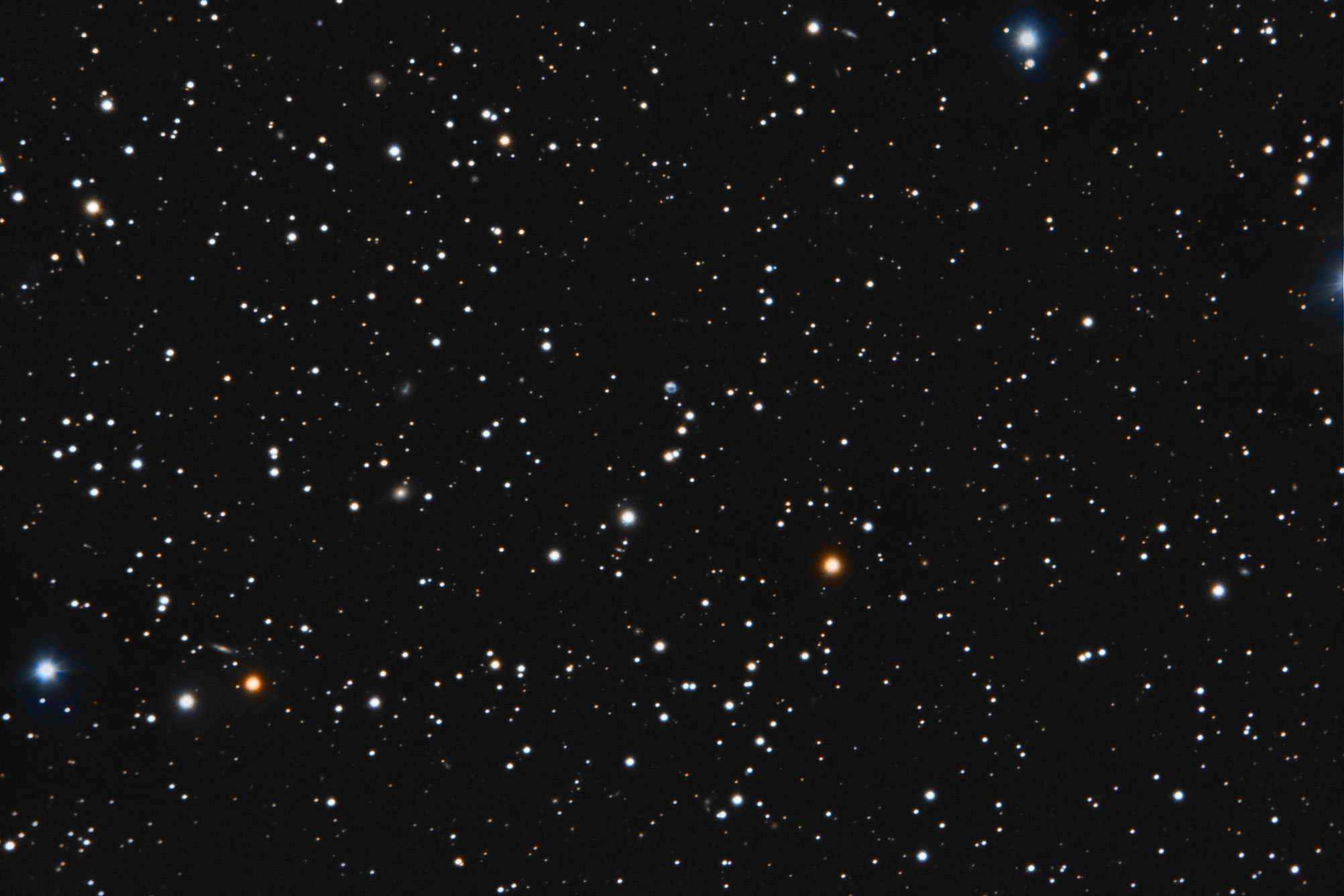
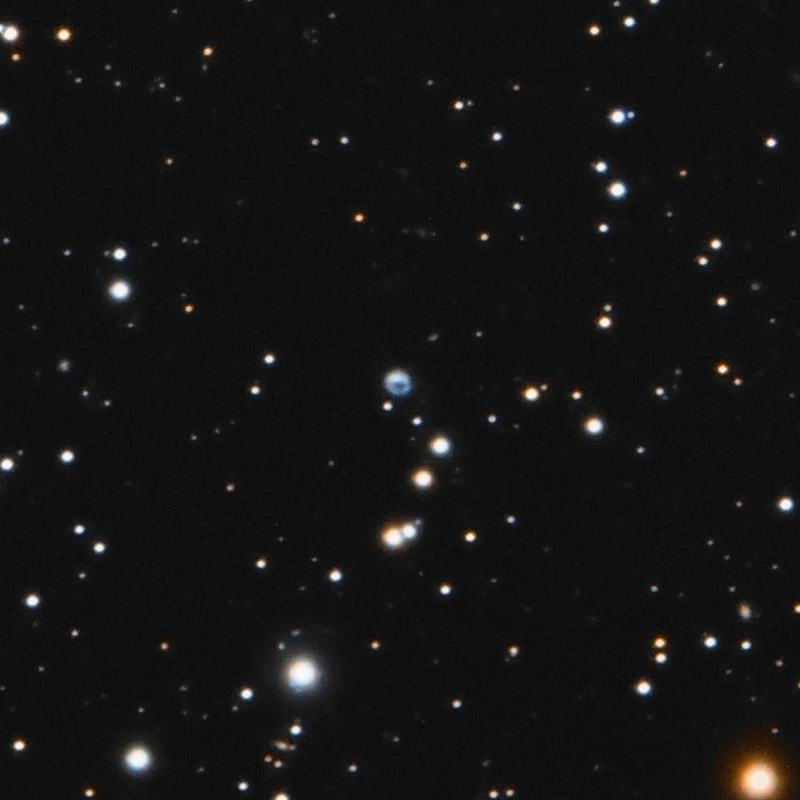
| IIZw28 is a small empty ring galaxy in Orion just east of the bottom of his shield. Rings of its type are thought to be caused by a small dense galaxy colliding with a disk galaxy almost perfectly face on like a bullet hitting a target. This blows the core to the edge of the ring. Usually, the "bullet" galaxy is quite obvious. Here there's no apparent "bullet" galaxy. Since the ring is thought to be a rather short-lived condition it should be nearby. One possibility is that the dense northern part of the ring is due to the superposition of the "bullet" galaxy and the displaced core. A note at NED says the galaxy has three distinct stellar populations; "...young stars in the ring, A-stars which are distributed inside the ring (this is strong evidence for the passage of the wave) and an old stellar population in the edge of the ring. It is thus very likely that the companion (is) seen in projection like in NGC 985." The mentioned NGC 985 is at -8 degrees and so far has been in too poor of seeing each time I tried for it. Maybe next year. It is more distant yet about twice the angular size of IIZw28. I measure the size of IIZw28 at 33,000 light-years so it is a small galaxy and target for the bullet galaxy to hit (maybe it has a lot of dark matter to draw in the bullet galaxy).
The field has quite a few distant galaxies in it but only 4 others have redshift data. Interestingly they appear in pairs. One pair close then IIZw28 at 220 million light-years and a more distant pair at 720 million light-years. NED identifies only a handful of other galaxies in the field. I've annotated all of them leaving the vast majority as unknown.
The northern galaxy at 220 million light-years carries the odd designation in NED as MS 0459.5+0327 Clump. I have no idea what is meant by "Clump". Its position had a rather large error bar so I can't tell if it is indicating the entire blue object or just the northern or southern part. To me, it appears to be two superimposed objects but may be one. Its size is smaller than the error bar of its position. The MS catalog is of objects discovered by the Einstein orbiting X-Ray observatory. The first true X-ray telescope put in space so it is no wonder the position is somewhat crude. In fact, it is darned accurate for the technology of 1978 when it was put into space. Apparently, there's been no followup on this object. At least I didn't find any.
This image is the result of several attempts from November 2013 through late January 2014. Seeing varied greatly. Since each color was taken a different night there's more color error in the star disks with various color fringes showing. This also made color correction difficult. I think it is correct in general but not up to my usual standards.
14" LX200R @ f/10, L=4x10' (best 4 of several dozen) RGB=2x10' (again best of many), STL-11000XM, Paramount ME | 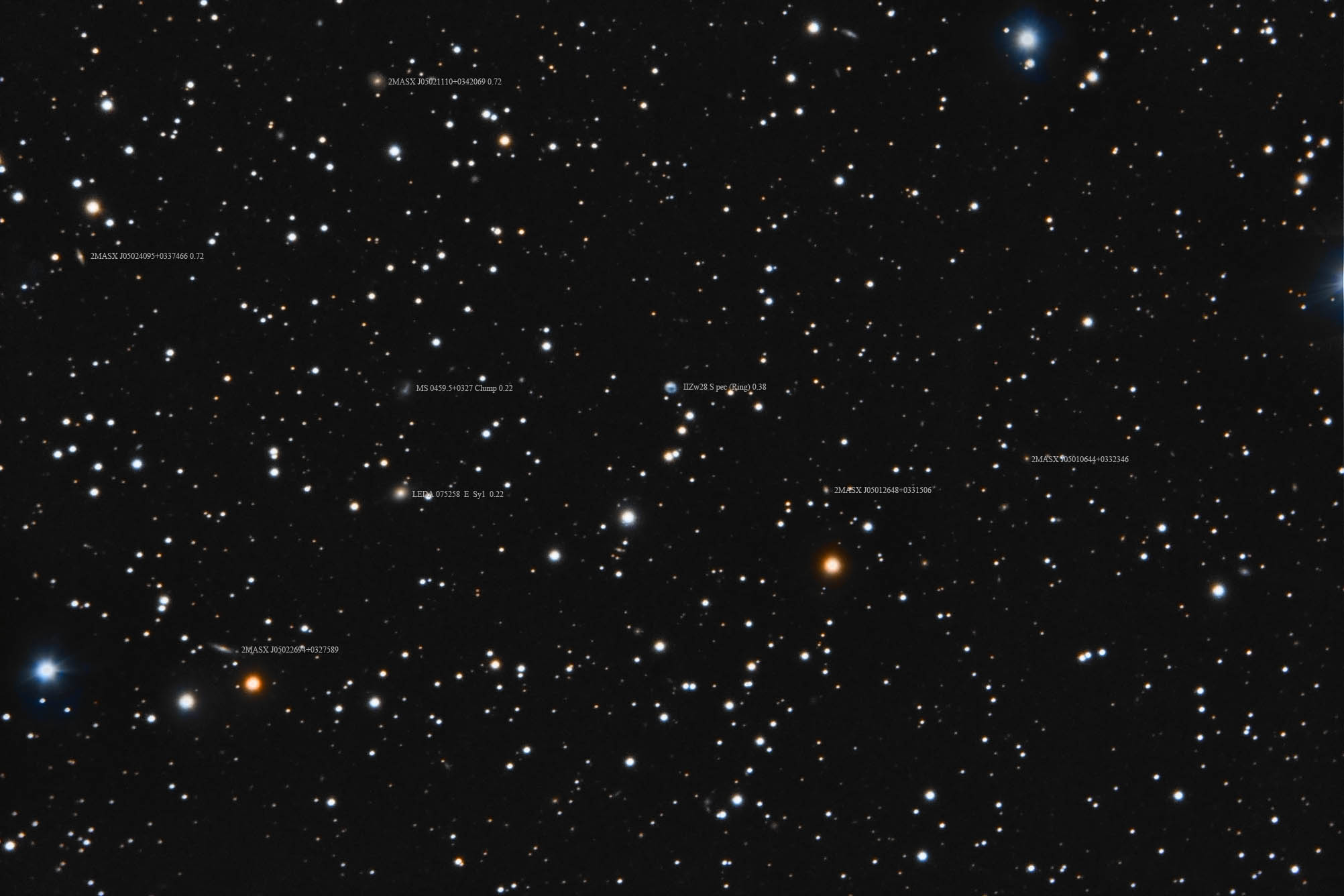
IIZW28L4X10RGB2X10-ID.JPG
IIZW28L4X10RGB2X10.JPG
IIZW28L4X10RGB2X10CROP150.JPG
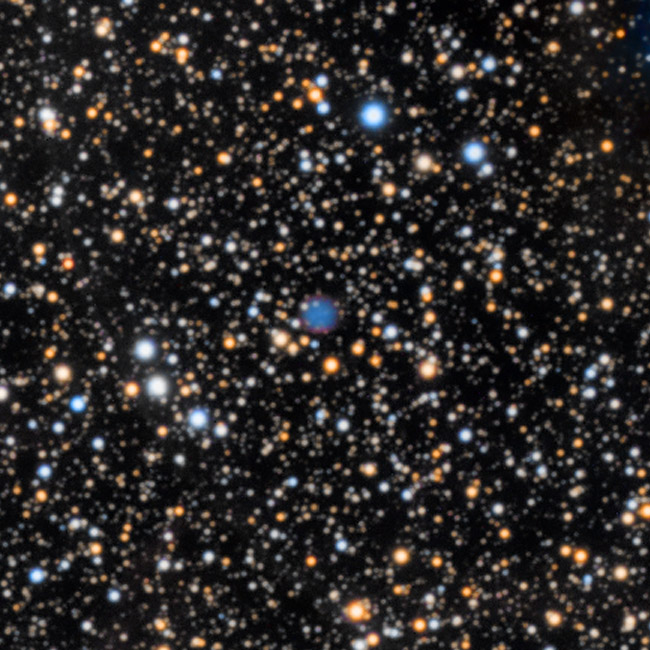
| IPHASX J200018+365934 also known as NeVe 2, is a planetary nebula candidate in the heart of Cygnus. The brilliant star that made processing this a nightmare is 25 Cygni, a B3IV 5th magnitude star. The image is so star-filled I couldn't get it below 1 meg in size. Finding the planetary candidate is almost a "Where's Waldo" challenge. Fortunately, it is 30" in size and not star-like. I see no central star but the blue disk with a red outer ring is sometimes seen in planetaries. It's hard to see it as anything else to my eye.
This one was brought up last July by a forum post asking what it was? Once I figured it out I added it to my short list of objects. Like most nights last summer neither seeing or transparency was very good but it was registering so I just gave it double my standard exposure time to make up for the horrid transparency. The first reference to it as a possible planetary nebula was in the Strasbourg-ESO Catalogue of Galactic Planetary Nebulae Strasbourg-ESO Catalogue of Galactic Planetary Nebulae in 1992. Then again in 2009 in this paper: http://adsabs.harvard.edu/abs/2009A%26A...504..291V . Apparently no definite answer to its nature is known as yet. It's one of several hundred such nebulae. An imaging task I doubt I'll undertake, I have too many on the to-do list as it is.
14" LX200R @ f/10, L=8x10' RGB=2x10', STL-11000XM, Paramount ME | 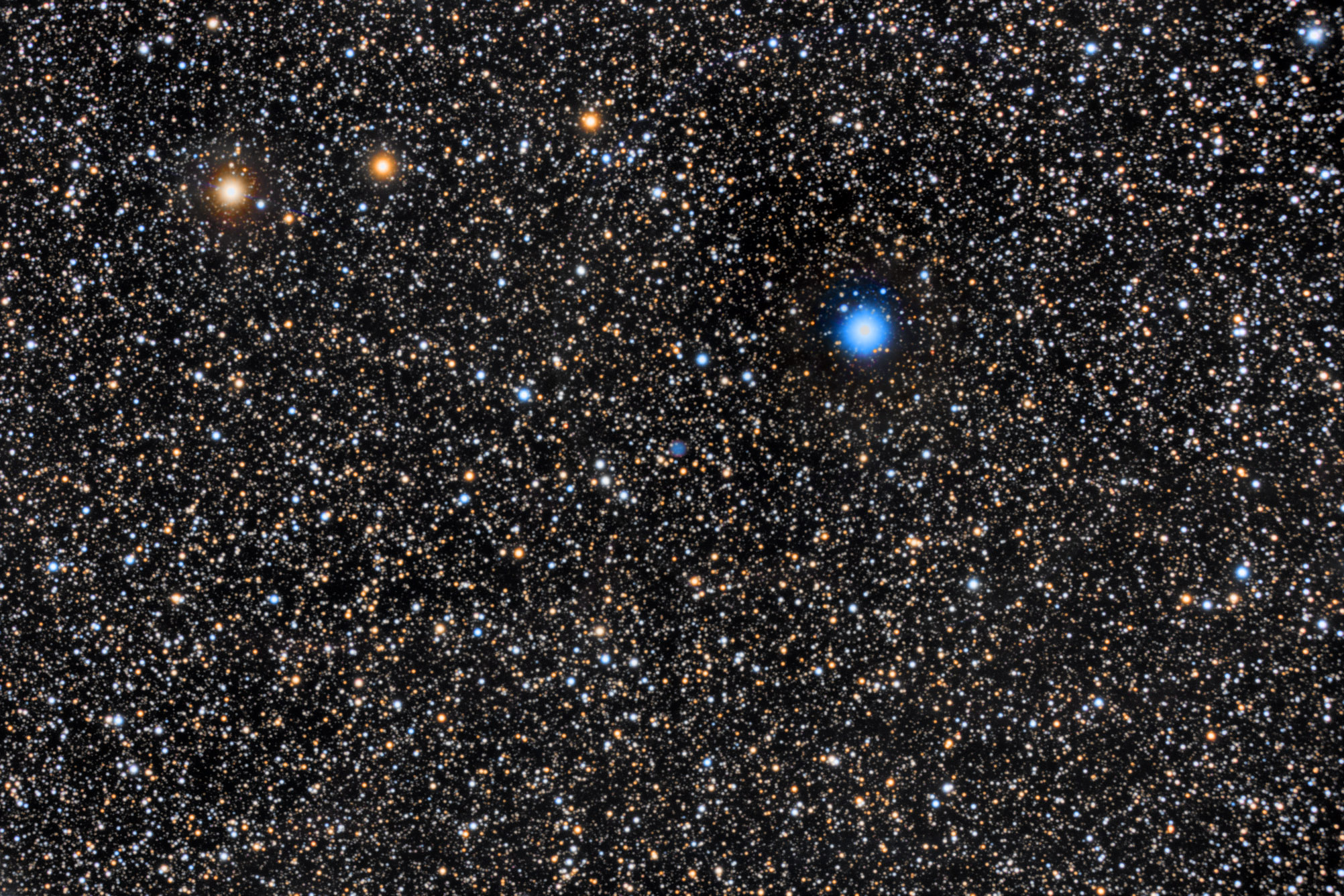
IPHASX J200018.7+365934L8X10-RGB2X10X3.JPG
IPHASX J200018.7+365934L8X10-RGB2X10X3CROP150.JPG
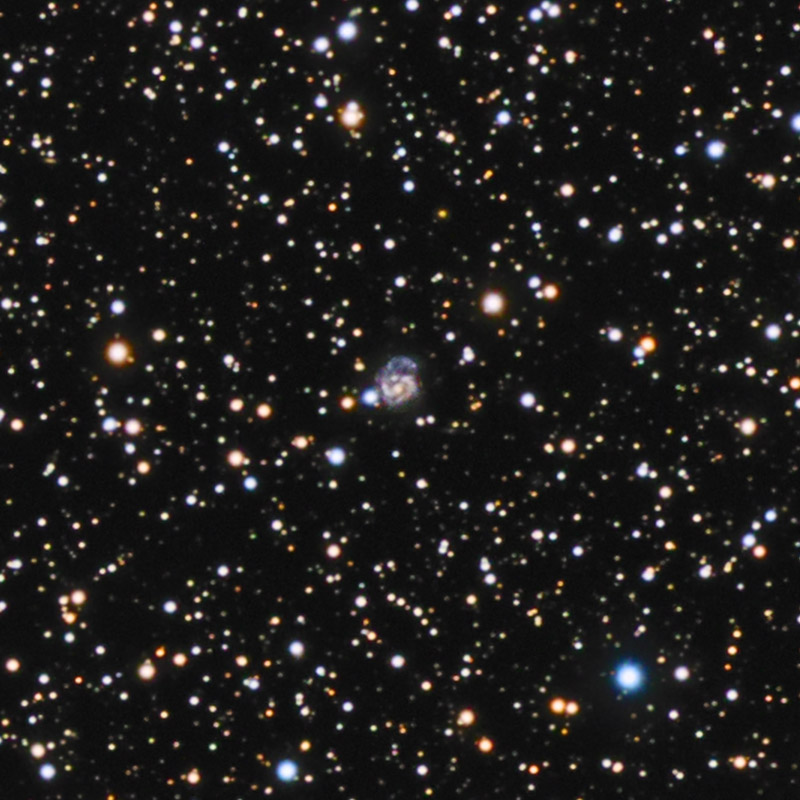
| IRAS 20351+2521 is a nearly merged pair of galaxies in Vulpecula about 440 million light-years distant per redshift and 450 million light-years distant according to the HST write-up on this object. Including the large plume of new stars to the north, it is still only about 87,000 light-years across. NED classifies it simply as a spiral galaxy and notes it is a Luminous Infra Red Galaxy (LIRG). The strong IR in such galaxies is usually due to strong light from massive new stars buried in dust so their light is absorbed by the dust then re-emitted in the infrared region of the spectrum. While not always an indicator of galaxy interaction that is often what causes such star birth activity. The HST page on this one has little more to add but for a bit better resolved image of the galaxy at: http://www.spacetelescope.org/images/heic0810cb/
Residing on the edge of the Milky Way deep in the "Zone of Darkness" it resides in a very rich field of stars. The dust of our galaxy is obscuring distant galaxies as only a very few are seen in my image. NED lists a dozen visible at microwave frequencies (super deep IR) or very short radio frequencies, take your pick. None have any useful information for an annotated image so none was prepared.
Like much of this year conditions were poor as to transparency the night I took this image but fairly good as to seeing. Dawn limited me to one frame per color. I lucked out and space junk only hit the luminance frames so one frame was sufficient.
14" LX200R @ f/10, L=4x10' RGB=1x10', STL-11000XM, Paramount ME | 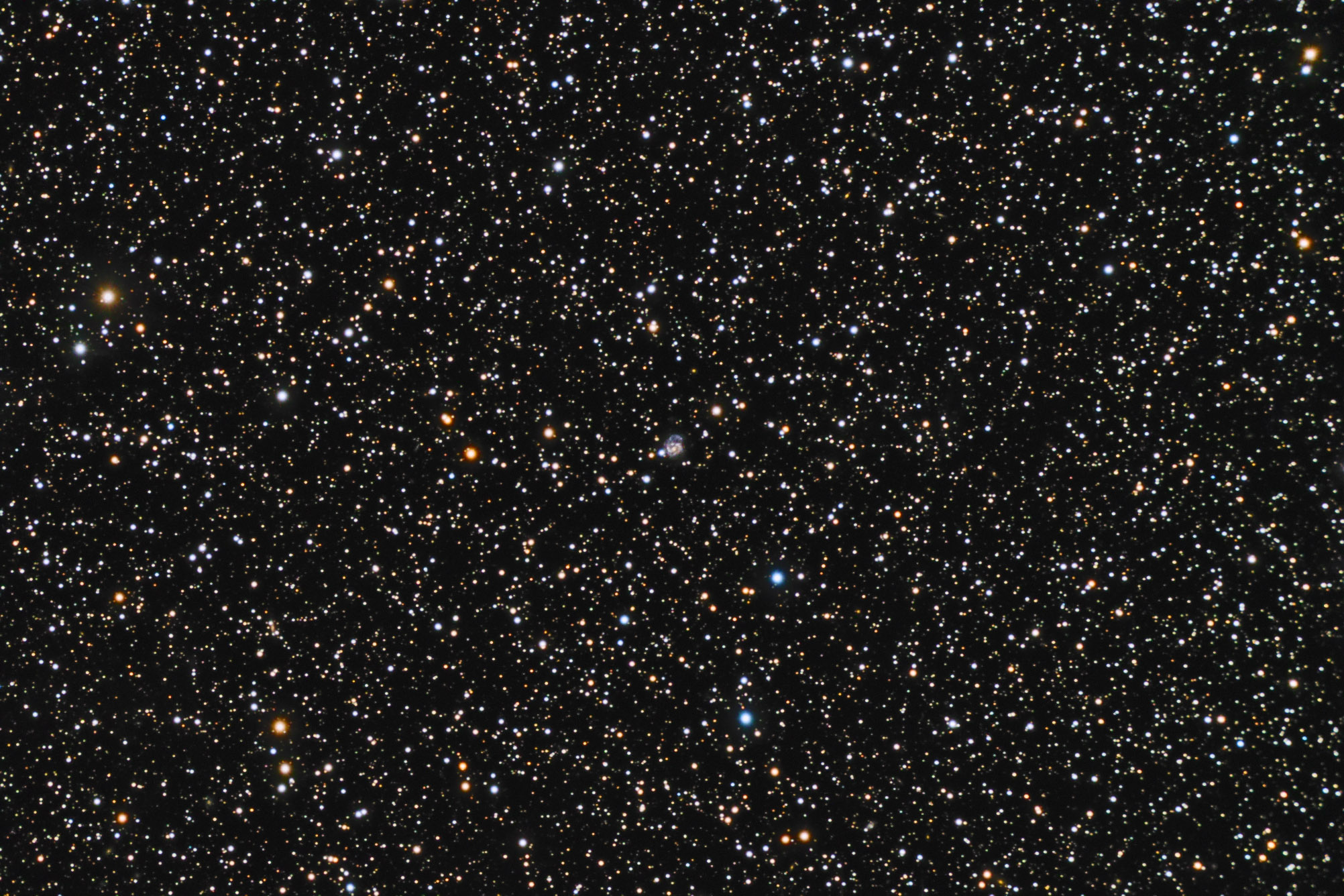
IRAS20351+252L4X10RGB1X10.JPG
IRAS20351+252L4X10RGB1X10CROP150.JPG
|