KKH 88 is a blue dwarf galaxy in Draco under the bowl of the Little Dipper. It could pass for a planetary blue egg but is a galaxy. It is about 44 million light-years distant by redshift measurement. The first K stands for Valentina Karachentseva, a Ukrainian astronomer. The second is Igor Karachenstev (no "a" on the end). Though that's not why I took this image. In fact, it has been on my to-do list for years. The H is for Walter Huchtmeier, a German astronomer.
NED classifies KKH 88 as Sm. I don't see the spiral structure. Others call it irregular which I can agree to. Assuming the redshift distance it is about 12,500 light-years across so is certainly a dwarf.
While NED lists over 2000 galaxies in the frame of my image conditions were so poor this night most don't show. And not one other than KKH 88 has any redshift information. Not unusual this far north. So no annotated image was made. I took this one as dawn was approaching and had time for only one green frame. I never went back for the second.
14" LX200R @ f/10, L=4x10' RB=2x10' G=1x10', STL-11000XM, Paramount ME | 
KKH88L4X10RB2X10G1X10.JPG

KKH88L4X10RB2X10G1X10CROP125.JPG
| KPG 118 is a pair of galaxies, NGC 2274 and NGC 2275. A note at NED says of this pair "The ASC and NED agree assigning type E to this galaxy (NGC 2274). According to Karachentseva (1973) this object, together with NGC 2275, is a member of an isolated pair of galaxies (KPG 118)." Problem is there's a third galaxy at the same redshift a bit to the west, UGC 3537, making it a triple system cataloged as WBL 121 and to really complicate things NED lists the galaxy group LDCE 0468 at virtually the same redshift and shows it as containing 12 galaxies. I have no idea which those 12 are. Only 4 with similar redshift is shown in my image, one of these has a higher redshift but may be related. In fact, none of the other galaxies in the image have a redshift listed at NED. Most aren't listed at all. Those that are without redshift are all from the 2MASS catalog of IR sources. I've labeled them in the annotated image. In any case, I don't understand calling KPG 118 an "isolated pair."
NGC 2275 is listed as S? at NED and Sab at the NGC project. It seems highly distorted but NGC 2274 appears pretty normal. So I am uncertain if they are interacting or not. There does appear to be a hint of a bridge between the two embedded in the outer halo of NGC 2275 but it is very indistinct to me. The barred spiral UGC 3537 is listed as SBcd:. The bar is rather indistinct. Its arms form a ring-like structure about its small core. Both NGC 2274 and 2275 were discovered by William Herschel on October 26, 1786. NGC 2274 is in the second H400 program.
The only other galaxy of note in the image is from the 2MASS flat galaxy catalog, 2MFGC 05420. It wasn't flat enough for the true flat galaxy catalog, however. At least it isn't listed there. Still, it is quite a nice edge-on thin galaxy. It may be a member of the group though its redshift is somewhat higher.
There's one other NGC object in the image, NGC 2277. This catalog was prepared during the era of visual astronomy. Human vision is prone to errors. NGC 2277 is one such error. It is just an asterism of 5 stars. Here is what the NGC Project has to say about it: "NGC 2277 is an asterism of five faint stars. It was found by d'A as he reobserved the interesting area containing NGC 2274, 2275, and the NGC 2290 group. Apparently observing on a poor night, or anxious to increase the number of nebulae in the area, he also found three other asterisms here (NGC 2278, 2284, and 2285, which see). - Dr. Harold G. Corwin, Jr." NGC 2290 and its companions, 2288 and 2299 lie about 46 minutes of arc east of my field of view. d'A is short for Heinrich Louis d'Arrest (1822-1875). The NGC 2290 group is still on my to-do list thanks to this year's lousy weather. Edit: It has since been taken.
14" LX200R @ f/10, L=4x10' RGB=2x10', STL-11000XM, Paramount ME Related Designations for KPG118KPG 118, NGC 2274, UGC 03541, CGCG 175-015, CGCG 0644.0+3338, MCG +06-15-008, 2MASX J06471737+3334021, 2MASXi J0647173+333401, 2MASS J06471736+3334015, KPG 118A, WBL 121-003, LDCE 0468 NED006, HDCE 0416 NED001, PGC 019603, UZC J064717.5+333401, UZC-CG 048 NED02, LGG 139:[G93] 001, NGC 2275, UGC 03542, CGCG 175-016, CGCG 0644.0+3340, MCG +06-15-007, 2MASX J06471794+3335571, 2MASXi J0647179+333557, 2MASS J06471792+3335574, KPG 118B, WBL 121-002, LDCE 0468 NED007, HDCE 0416 NED002, PGC 019605, UZC J064717.9+333556, UZC-CG 048 NED03, LGG 139:[G93] 002, NGC 2277, KPG118, NGC2274, NGC2275, NGC2277, | 
NGC2274L8X10RGB2X10.JPG

NGC2274L8X10RGB2X10CROP125.JPG

NGC2274L8X10RGB2X10ID.JPG
| I bet this is one few if any of you have heard of. I hadn't either until Sakib Rasool suggested it. KTG stands for "Karachentsev Isolated Triplets of Galaxies Catalogue" Though it appears there are 4 maybe 5 in this group. It is in Hercules about 140 million light-years from us according to its redshift.
KTG67 officially consists of three galaxies, NGC 6484 on the west, UGC 11027 to the northeast and UGC 11029 furthest east. Nearly directly east from NGC 6484 is a pair of similar small disk galaxies situated almost at right angles to each other. They are UGC 11010. The lower is MCG +04-42-011 and the upper, nearly vertical one is MCG +04-42-010. Only the latter has a redshift distance which is also about 140 million light-years. I can't tell if the southerly one is a fifth member or not as NED had no distance data on it.
The main reason for imaging this group is UGC 11027 a rather "sloshed" galaxy. The stereotypical sloshed galaxy is NGC 5474 near M101. This term applies to the off-center core. Often it really isn't off center by much, it's just that the disk stars on one side are very faint compared to those on the other side. That's the case with NGC 5474. My image isn't deep enough to say if that's the case here. Though I see no hint of a faint disk to the south and southwest to match the rest of the disk.
A note at NED is rather confusing. It says: "Bright red condensation 0.45 x 0.25 in south-following part, superimposed companion?" Confusing in that I see no hint of this object in my image nor the recently released expanded Sloan Survey image. The note is from the original release of the UGC catalog. NED classes it as Im meaning an irregular galaxy. Looks to me like a barred spiral with one part missing. It could very well be a merger situation, however. There are some bright knots on the eastern side that could be the remains of a merging galaxy.
UGC 11029 is classed as an SBd spiral. It does look quite typical of a many-armed spiral and thus likely not recently disturbed by its neighbors.
NGC 6484 may at first appear a rather normal barred spiral with two wide arms. But to me, it is very odd. First off, while the core is elongated as you'd expect in a typical barred spiral there is no obvious bar. In fact, it is classed as Sb? at NED. While one arm comes from an end of the core's elongation the other starts out of nowhere well away from the core. Also, the arms have an odd symmetry. Each has a pair of bright blue star clouds directly across the core from each other. Then further down the spiral arms are a line of fainter blue star clouds also opposite each other across the core. Coincidence or is there something behind the scenes causing this? I have no idea. There is also a short plume going to the southwest. This left over from some long-ago interaction? It was discovered by Truman Safford on July 11, 1866.
14" LX200R @ f/10, L=4x10' RGB=2x10'x3, STL-11000XM, Paramount ME Related Designations for KTG67KTG 67, NGC 6484, UGC 11010, MRK 1118, CGCG 141-019, CGCG 1749.7+2430, MCG +04-42-007, 2MASX J17514697+2429001, 2MASS J17514698+2429008, IRAS 17497+2429, IRAS F17497+2429, AKARI J1751453+242911, KTG 67A, HIPASS J1751+24, NSA 148275, PGC 061008, UZC J175147.1+242902, UZC-CG 258 NED01, NVSS J175147+242904, LGG 413:[G93] 001, UGC 11027, CGCG 141-026, CGCG 1751.2+2435, MCG +04-42-013, 2MASX J17531598+2434198, 2MASS J17531594+2434206, 2MASS J17531603+2434206, KTG 67B, HIPASS J1753+24, NSA 148285, PGC 061052, UZC J175316.1+243421, UZC-CG 258 NED03, LGG 413:[G93] 002, UGC 11029, CGCG 141-028, CGCG 1751.8+2428, MCG +04-42-014, 2MASX J17535174+2428013, 2MASX J17535203+2428133, 2MASS J17535207+2428138, IRAS F17517+2428, KTG 67C, NSA 148289, PGC 061063, UZC J175351.8+242801, UZC-CG 258 NED04, LGG 413:[G93] 003, KTG67, NGC6484, UGC11027, UGC11029, | 
KTG67L4X10RGB2X10X3.jpg
| LBN 532 is a nebula in central Cepheus. Simbad lists it as an HII emission nebula. I wanted to see what references had to say about it but Simbad says there's no mention of it in any paper since 1850! My attempt to research it came to a sudden halt at that point!
Other than its inclusion in the Lynds Bright Nebula catalog there's nothing on it. Looks more like an ERE (Extended Red Emission) nebula to me. This type of emission was unknown at the time of the Lynds catalogs. While it probably contains H II emission (I haven't found any images of it at that frequency nor did I take any) it appears much of its emission is due to the fluorescence of carbon compounds due to ultraviolet light of our galaxies O and B stars. The density of the cloud is obvious from the apparent total blockage of light from stars beyond the cloud. Of course, there's no estimate of its distance that I could find.
The nebula is so red I got no blue signal from it at all and virtually no green but it is so dark even the red was weak in the densest areas. HII usually, but not always, includes H beta emission seen in blue-green light. I didn't see any hint of such emission. Thus, I think most of the red I did pick up is from ERE rather than HII. I'd need to take an image in H alpha to prove this. For a nebula that is nearly pure bright ERE see images of the Red Rectangle. The red dust lanes in some of my galaxy images are also due to ERE.
For those interested in ERE there are many papers on it if you search the term. For those with hip waders, I found this one interesting.
http://arxiv.org/PS_cache/astro-ph/pdf/0309/0309674v1.pdf
For a more layman's approach see:
http://www.space.com/3658-mystery-red-space-glow-solved.html
14" LX200R @ f/10, L=4x10' RGB=2x10'x3, STL-11000XM, Paramount ME Related Designations for LBN0532LBN0532, | 
LBN532L4X10RGB2X10X3.JPG
| LBN 777 is one of those very faint dust nebulas that shine by ultraviolet light of the entire galaxy rather than a few super hot, nearby, newly formed stars in the case of an emission nebula. While M16 has long since been called the Eagle Nebula, I've been hard-pressed to see a flying eagle when looking at it. this one sure looks like the head of an eagle to me. But it is too faint to see visually. But it makes for a very big eagle. Still, most see it as a vulture rather than an eagle, maybe because of M16 already having the Eagle name. Since that was taken most call it the Vulture Nebula. I still prefer Eagle Nebula.
I've oriented the image with south up rather than my normal north up as it makes the eagle/vulture head more obvious. The red region behind the eye is Barnard 207 (some websites incorrectly call it Barnard 107. The "eye" is a real hole in the cloud. Between the eye and Barnard 207 is a red star with a shock wave coming from it. This is a typical M class dwarf star that just happened to run into the nebula. The shock wave is it plowing through the dust as its solar wind acts as a shield deflecting the dust around it. I couldn't find any distance estimate. The galaxy below its beak is CGCG 487-015 and is about 320 million light years distant. Far closer is asteroid 2001 MQ8, left of the beak. 2008UR205 is harder to find. Note the bright blue star below the "eye". Directly above it is a small slightly red star. Look just below this little red star for a short diagonal line going from upper left to lower right. The orbit of this one was pinned down only days before this image was taken. It is at magnitude 20.3 so nearly lost in the nebula. In fact what you see is only part of the trail, the rest got lost in my processing.
14" LX200R @ f/10, L=7x10' RGB=2x10, STL-11000XM, Paramount ME | 
LBN777L7X10RGB2x10R1.jpg
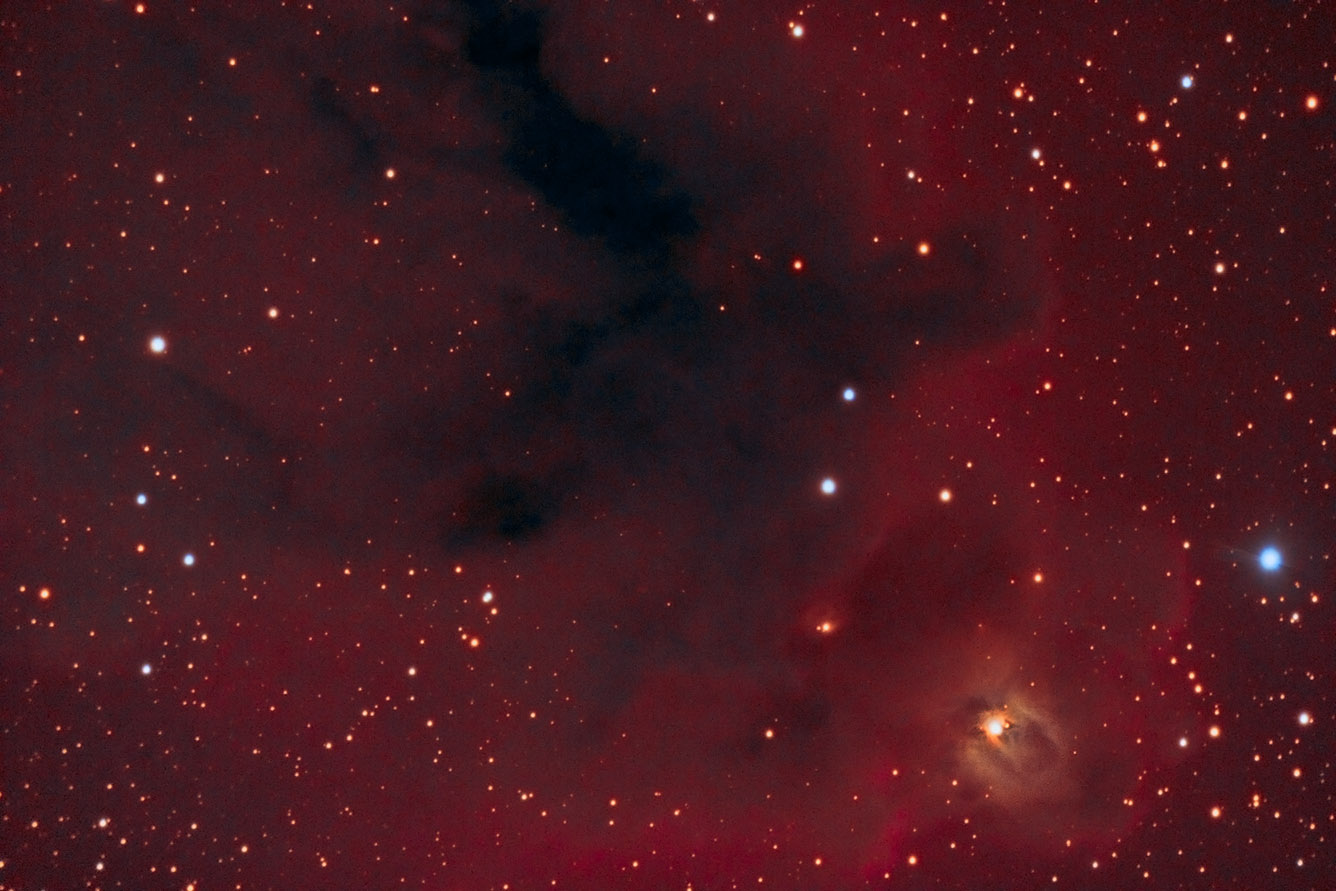
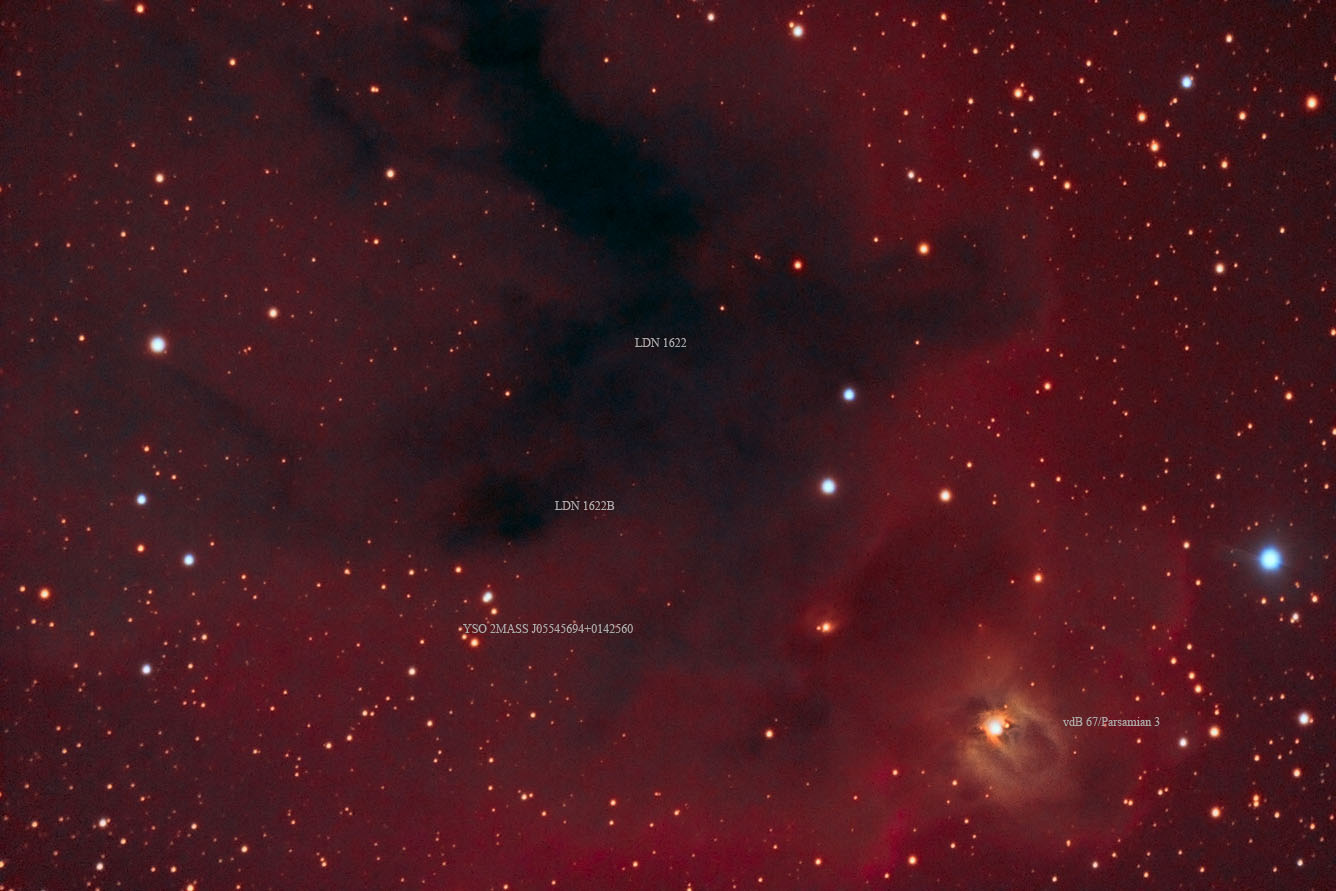
| The reflection nebula vdB69 is illuminated by the Herbig-Bell star HD 288313. These are young A or hotter stars with emission lines. They are also called Herbig Ae/Be stars for this reason. These are surrounded by nebulosity. If no nebulosity is present then they are simply Ae/Be stars. The nebulosity is also known as Parsamian 3 and GN 05.51.0.02. I was unable to find a distance estimate for this nebula but I assume it is likely related to LDN 1622 that fills much of the field and is thought to be about 500 light-years distant. I couldn't begin to fit all of LDN 1622 into my field but the portion sometimes called the "Boogy Man Nebula" did mostly fit in. It continues to the northeast another field or so. I was going to capture that as well and mosaic the two but clouds had other ideas. In fact, they cut short the session so I only got one green frame.
Weather never cooperated sufficiently to try again. Clouds hurt the color data I did get so it is somewhat suspect. In fact, I originally pitched the data as unprocessable but pulled it back from the bit bin and tried one cloudy night to salvage something. It seems severely blue starved for the nebula which came out far redder than others show it yet the star colors were right. I find this happens a lot when hit by clouds as this one was. I probably should have left it mono. This is one I need to try again. The field is located in eastern Orion just east the main parts of Barnard's loop.
14" LX200R @ f/10, L=4x10' RB=2x10' G=1x10', STL-11000XM, Paramount ME
| 
LDN1622L4X10RB2X10G1X10R-67.JPG
LDN1622L4X10RB2X10G1X10R-67ID.JPG
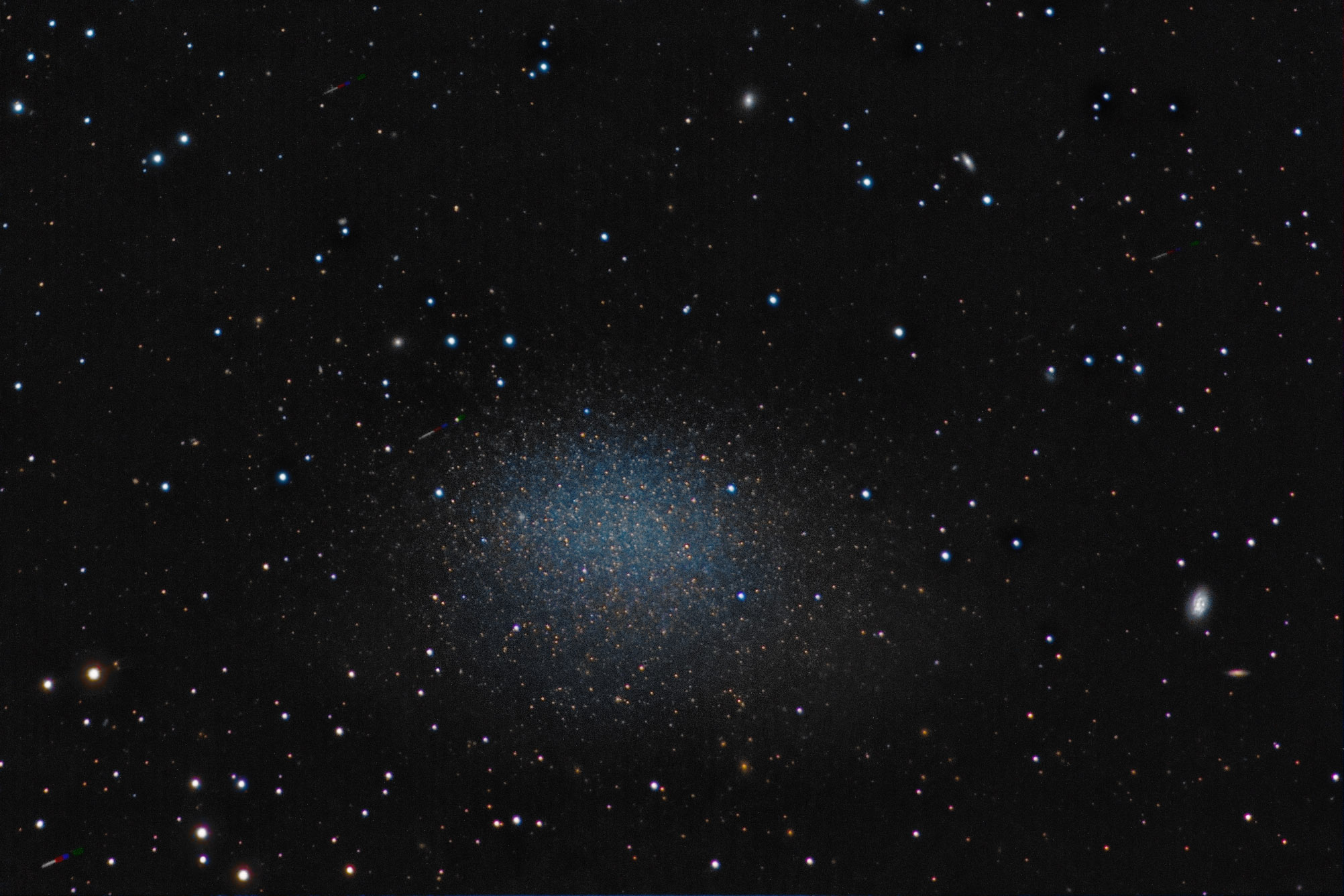
| Leo I is a dwarf galaxy in our local group of galaxies. Our local group has two large spiral galaxies, M31 and our Milky Way Galaxy, a third much smaller spiral galaxy M33 and 50 more, mostly small dwarf galaxies. Leo I is one of the larger dwarf galaxies. As its name implies it is in Leo -- just north of Regulus. Its glare makes viewing or imaging it a problem. I expected lots of reflection issues but once it was out of the frame at the bottom but not too far out of frame (hence Leo I being low in the frame) I had no reflection issues. But I did have a problem with color gradients as a light leak developed that let light from the red LED on my focuser and the green one on the mount into the camera. At the time I had no way of dealing with those but crude ones. I was very crude with my technique in removing them. I need to dig the old raw data out and reprocess it with today's tools but so far that hasn't happened.
Leo I is thought to be about 800 million light-years distant, about one third the distance to M31 and M33. Being close many of its stars are visible. The galaxy has more carbon stars than most. Being close I was able to pick up a few of them. Not adept at annotating images I only pointed out 5 in the crude annotated image. They aren't all that red as I expected. This might be due to my crude removal of red gradients. Another reason to reprocess this one.
At the time, February 2007, this image set a record for how many asteroids were in the image. Only 5 but it was a lot at the time. Not surprising as the galaxy is very near the ecliptic. Since then I've had 13 and more in a frame but it sure excited me at the time. The brightest is Kasuga. It's naming citation read; "Named in honor of Ryo Kasuga (b. 1950), Japanese Buddhist priest, opera singer, professional magician, television and radio personality. He is also an amateur astronomer, who operates a planetarium at his temple and is very active in the movement against light pollution. Name proposed by the discoverers following a suggestion by T. Sato and A. Fujii."
The asteroid trails show some breaks and uneven intensity levels. Clouds kept interrupting things. With only 35 minutes of data taken in subs too short for my read noise, it came out surprisingly well. Clouds also killed one blue frame totally and hurt all other color frames.
14" LX200R @ f/10, L=7x5' RG=3x5' B=2x5', STL-11000XM, Paramount ME
Related Designations for LEOILeo I, Leo I Dwarf, UGC 05470, DDO 074, CGCG 064-073, CGCG 1005.8+1233, MCG +02-26-027, Regulus Dwarf, KDG 067, [RC2] A1005+12, [RC1] A1006, PGC 029488, UZC J100826.8+121905, Harrington-Wilson #1, [SPB93] 136, [M98j] 104 NED04, LEOI, | 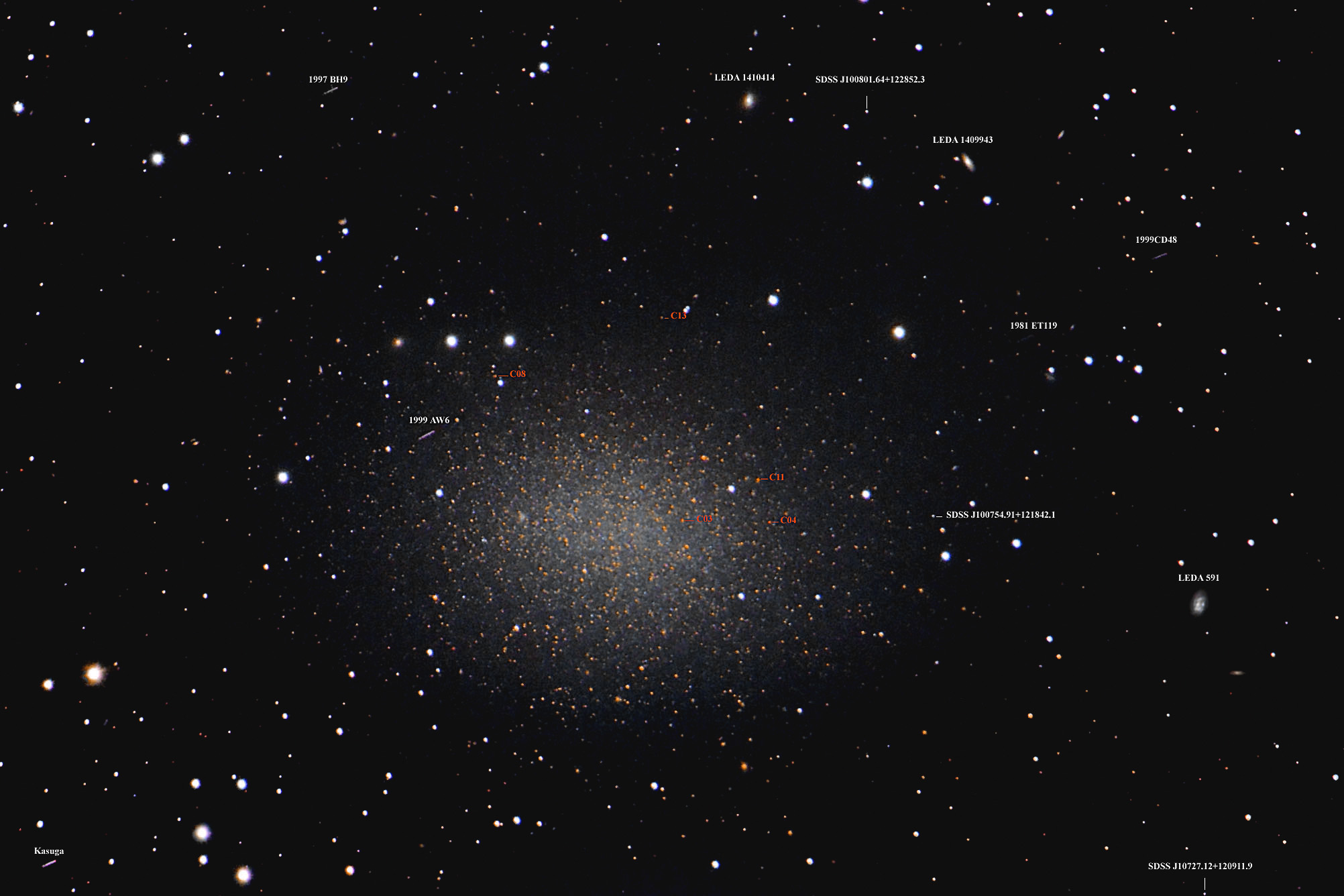
LEO_I_LUM7X5RG3X5B2X5R6a-ID.JPG
LEO_I_LUM7X5RGB2X7R7.JPG
| Leo II is another dwarf member of the Local Group. It is a bit closer than Leo 1 at 700,000 light-years. The star in the center is just a star in our galaxy that happens to line up with the center of the galaxy.
This is another early image. It had a nice asteroid seen against the edge of the galaxy. Often the color data from bright asteroids had nothing behind it so only the luminance trail shows easily. The color data is faint by comparison. I experimented with a way of brightening this portion of the trail. I did this by combining color and luminance data for a pseudo luminance frame. This does help the asteroid but hurts faint stars which get lost in weak color data. That happened to me in this image. I need to reprocess this one.
The asteroid is 16th magnitude Pauldavis. Its naming citation reads; "Named for Paul C. W. Davies (b. 1946), a British mathematical physicist resident in Australia, with research interests in cosmology, quantum gravity, astrophysics and the origin of life, who also has an international reputation as an author and broadcaster. His books range from the scholarly Quantum Fields in Curved Space (with N. D. Birrell) to the popular About Time. He has a long-standing interest in the relationship between science and theology, summarized in his well-known book The Mind of God. His contributions to this field were recognized in 1995 with the award of the Templeton Prize for Progress in Religion. Davies has been a vociferous supporter of the need for search programs for near-earth objects. Name proposed and citation prepared by D. I. Steel and the discoverer."
The break in the trail is due to my Meridian Tree. I knew it would block a part of the image so stopped imaging for the time it was behind the very top of the tree. The blue trail is fainter because the asteroid is quite red in color.
14" LX2004 @ f/10, Pseudo L=3L+2R+2G+2Gx10' RGB=2x10', STL-11000XM, Paramount ME Related Designations for LEOIILeo B, Leo II, Leo II Dwarf Spheroidal, UGC 06253, DDO 093, CGCG 126-111, CGCG 1110.8+2226, MCG +04-27-005, KDG 077, [RC2] A1110+22, [RC1] A1111, PGC 034176, UZC J111327.3+220934, Harrington-Wilson #2, [SPB93] 153, [M98j] 104 NED05, LEOII, | 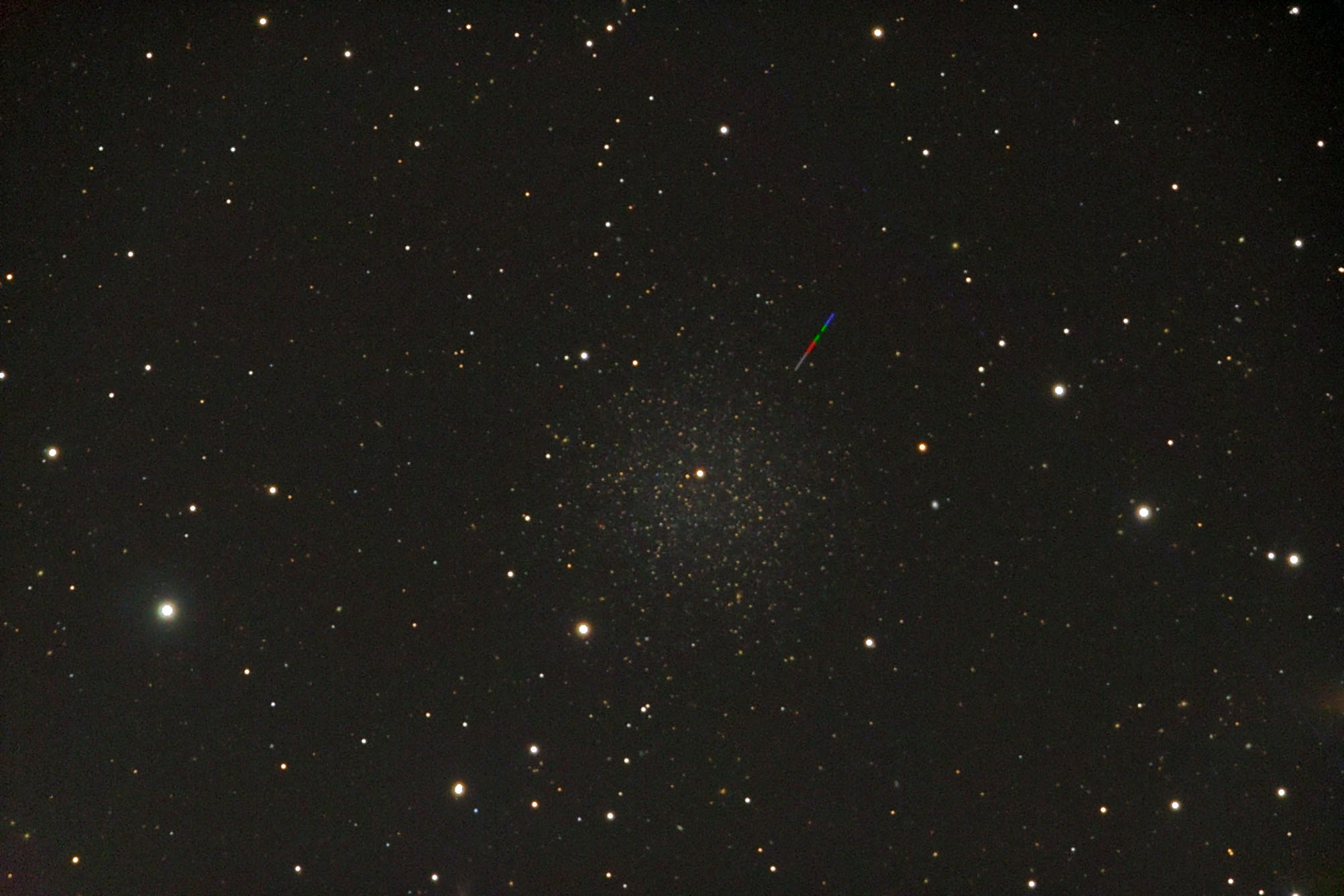
LEO11ADDRL9X10RGB2X10.jpg
| Leo III, also known as Leo A is quite different from Leo I and II. They are rather close at 800 and 700 million light-years. Leo III is over 3 times further away at 2.5 million light-years. This puts it at the distance of M31 and M33 but on the opposite side of the sky. Being so much further resolving its stars is much harder. Fortunately, I'd learned from the first two that I had to overcome read noise and stack properly if I wanted to bring out the stars. In this case, the three brightest stars, one at each end of the galaxy and the third toward the middle and high, are just stars in our galaxy. The brighter real objects in the galaxy are actually star clusters rather than individual stars. These are seen against a background of fine dust of giant stars in the galaxy.
14" LX200R @ f/10, L=4x10' RGB=2x10', STL-11000XM, Paramount ME Related Designations for LEOIIILeo III, UGC 05364, DDO 069, CGCG 153-010, CGCG 0956.4+3059, MCG +05-24-008, Leo A, [RC2] A0956+30, [RC1] A0956, BTS 014, PGC 028868, UZC J095923.7+304457, 11HUGS 173, [SPB93] 120, LEOIII, | 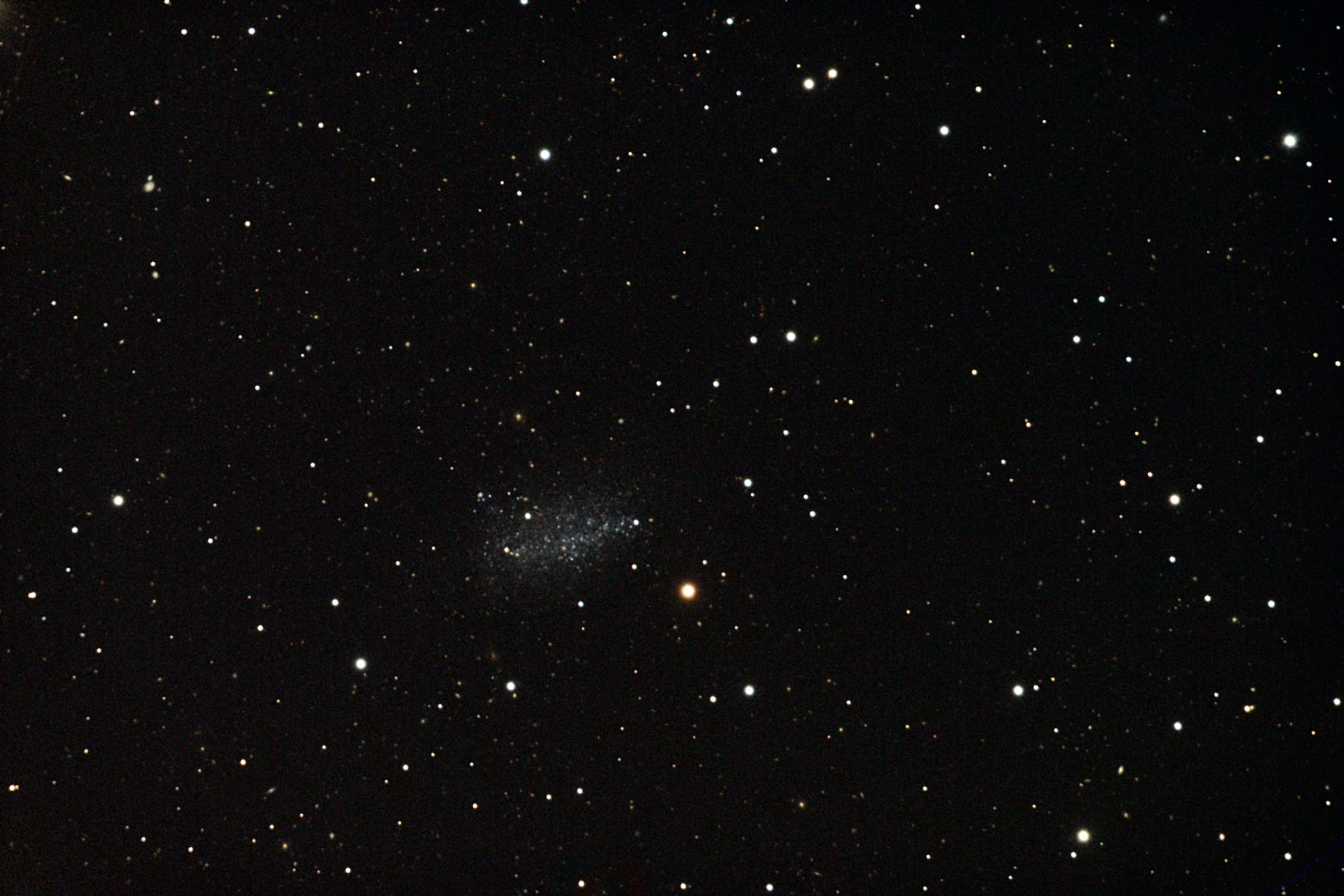
LEOIIIL4X10RGB2X10.jpg
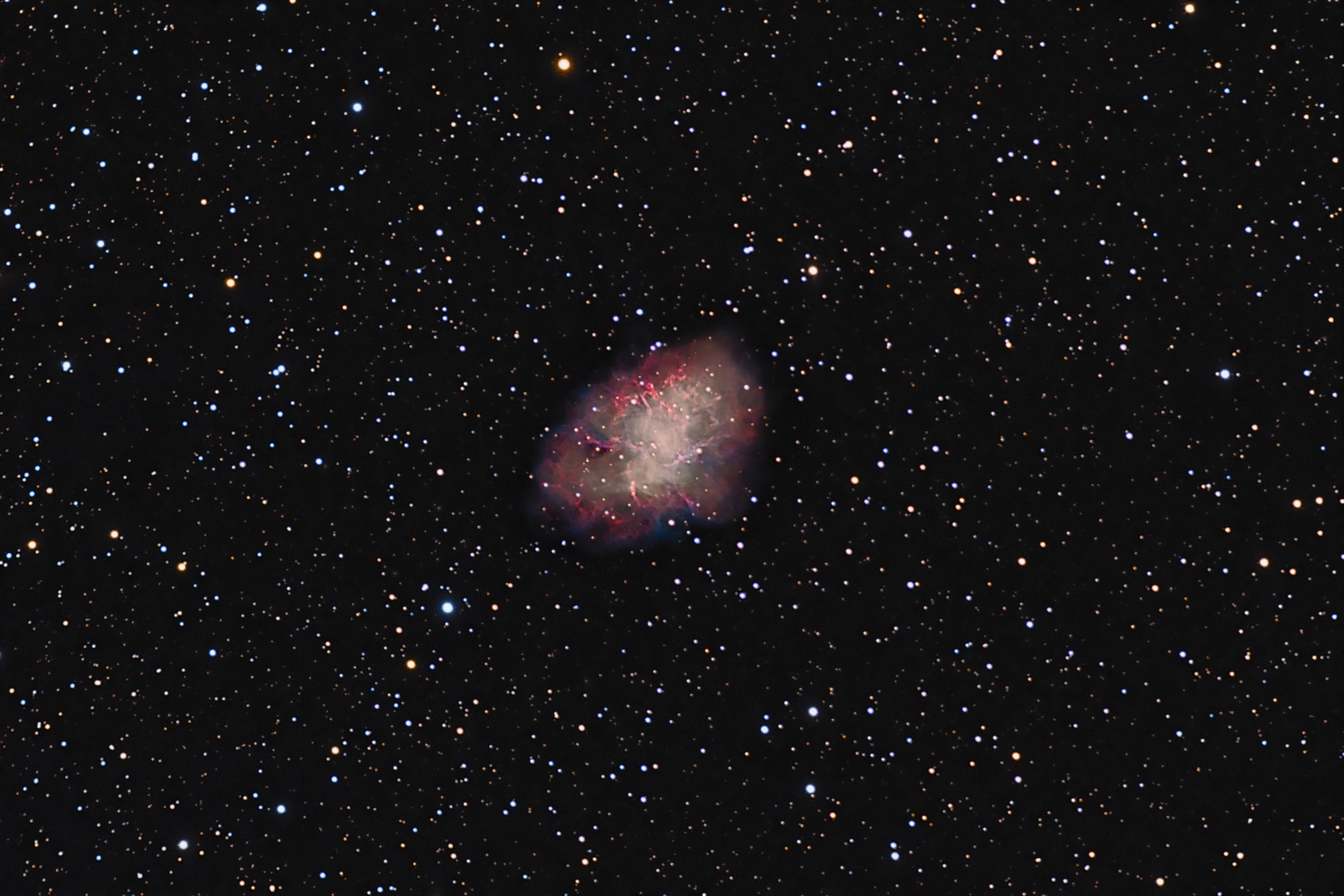
| M1 is a supernova remnant. It's a bit over 6,000 light-years distant and located by the southern horn of Taurus the bull. The supernova was seen in the year 1054, nearly a thousand years ago though the explosion happened over 7000 years ago, its light has taken over 6000 years just to reach us on earth. The star was crushed into a neutron star by the explosion. It is visible in my image as the dimmer of the two stars near the center of the nebula. It is a pulsar that pulses about 33 times a second. This was first detected at radio frequencies but later Don Taylor's students were able to detect it at visible light frequencies. It was the first and still one of a very few seen to pulsate in visible light as well as at radio frequencies.
It is often called the Crab Nebula because early observers seeing the nebula only in visible light through small telescopes thought it resembled a crab's claw. So why it isn't called the Crab's Claw Nebula I don't know. Too many words?
It was first seen by John Bevis sometime in 1731. Messier stumbled across it on August 28, 1758 while looking for Comet Halley which was making its first predicted return at the time. This then was his first discovery of a comet-like object. He knew it wasn't a comet since it didn't move but recorded it to avoid being fooled by it again. He had to watch it over time to see it didn't move like a comet would wasting valuable comet hunting time. Though like with M2 he wasn't its initial discoverer he did discover it independently not knowing of its prior discovery. M3 is the first he found before anyone else and that was in 1764 some 6 years later. Until then he wasn't actively looking for such objects.
The blue light of the nebula is synchrotron radiation. Light emitted charged particles forced into a curved path by a magnetic field or accelerated in a straight line. It is the former that creates the blue glow here. The pulsars light ionizes the gas expelled by the supernova and the strong magnetic field of the pulsar force these into curved paths creating the blue light. The red is due to ionized hydrogen atoms caused to glow by the extensive ultraviolet light emitted by the pulsar. The light of the nebula is also highly polarized due to the magnetic field but I don't have the filters needed to show this.
This, like many M objects, was a very early image when I moved to digital and I did some things quite wrong in taking the data. Also seeing this night was not very good. Put the two together and it isn't a great image. I reprocessed it a year later which improved things somewhat. Then third reprocessing improved things further. I've attached a crop showing all three. The full image is from the third processing of it. Another for the reshoot list that likely won't happen.
For more on M1 see: http://messier.seds.org/m/m001.html
14" LX200R @ f/10, L=6x5' RGB=3x5', STL-11000XM, Paramount ME Related Designations for M001MESSIER 001, Taurus A, NGC 1952, Crab Nebula, Crab SNR, 3C 144, 4C +21.19, PKS 0531+21, 2MASS J05343194+2200521, IRAS 05315+2158, SSTSL2 J053431.94+220052.1, PKS B0531+219, PKS J0534+2200, 87GB[BWE91] 0531+2159, NVSS J053432+220031, VLSS J0534.5+2202, PSR B0531+21, PSR J0534+2200, DA 179, NRAO 0214, TXS 0531+219, VRO 21.05.01, Cul 0531+219, NEWPS_5yr_5s 142, 2PBC J0534.5+2201, PBC J0534.5+2201, SAXWFC J0534.5+2201.2, 4U 0531+21, 3FGL J0534.5+2201, SWIFT J0534.6+2204, 2FGL J0534.5+2201, 1FGL J0534.5+2200, 0FGL J0534.6+2201, 1AGL J0535+2205, 2EG J0534+2158, 3EG J0534+2200, GEV J0534+2159, [VE75] CL 0531+22, [KRL2007] 047, [TES2010] 017, [BTM2013] 0287, M001, TeV J0534+220, | 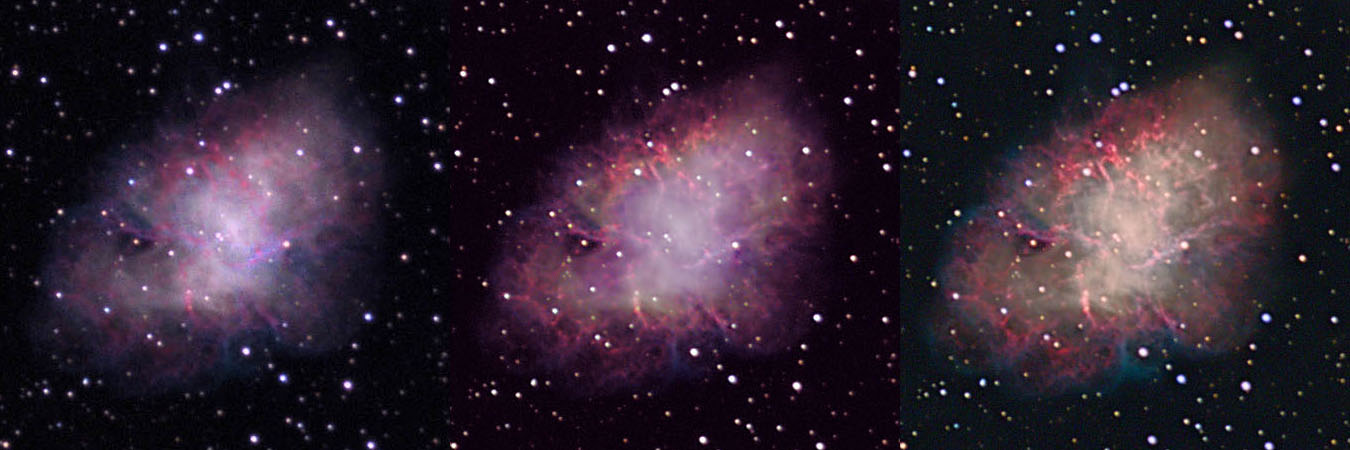
M1-3YEAR.jpg
M1L6X5RGB3X5R.JPG
|