Back on November 28, 1967 a grad student, Jocelyn Bell, discovered something very odd in the data of a radio object. No one could explain the emissions that pulsed with a regularity of an atomic clock and thus far beyond anything ever seen in the skies. No one could understand what it was and some fell back to the old, even then, pseudoscience argument from ignorance, since it isn't anything we can explain it may be due to aliens idea and some even started calling it LGM for Little Green Men. It turned out it was the first known pulsar of which we know of thousands. In a case of "Déjà vu all over again," we now have a star seen in the Kepler data hunting for planets, KIC 8462852 to use the Kepler Input Catalog number (it's Yale number is TYC 3162-665-1), with brightness variations that no one can explain. So far there are major problems with all astronomical explanations. So again falling back to the pulsar era the alien possibility is again being toted out. Yes the pulsar could have been an alien signal but wasn't. This too could be due to alien activity but I suspect it will again herald the discovery of something new in astronomical knowledge maybe opening up a whole new field of study as the pulsar has (will it get a watch named for it?).
Last night was the first night I had a hope of imaging it since it was announced. All I had were sucker holes but after 4 hours of trying, I finally got enough data to put a quick image together. I found no spectroscopic classification for it but with a B-V value that ranged around .5 to 1 (sources varied greatly) I expected a slightly red star but instead got a slightly blue one. I found no color image of the field but for one put together from the POSS data's red and blue plates by Aladin. That too showed it slightly blue. Now I'm confused. I doubt this has anything to do with the odd deep dips in the light curve of this star as these various measurements were random and highly unlikely to hit one of the dips in the curve. But I found nothing on how its color did change during a dip. So, for now, this is yet another mystery. I suppose somehow the clouds going by altered my color data but after calibration using NOMAD data the other stars all appear correct, this one is the exception. Also, I grabbed three short exposures (10 seconds) during an apparently clear sucker hole and it showed the same slightly blue color. So I'm quite confident the color is correct, at least for last night. I took many color frames, all but one of each color hit by clouds, so only used the cloudless color frames. If it stays clear tonight I'll try again for better color.
For more on this star including the strange light curves that started all this, see Phil Plait's article on it http://www.slate.com/blogs/bad_astronomy/2015/10/14/weird_star_strange_dips_in_brightness_are_a_bit_baffling.html Another good article on it is in the Washington Post http://www.washingtonpost.com/news/morning-mix/wp/2015/10/15/the-strange-star-that-has-serious-scientists-talking-about-an-alien-megastructure/?wpmm=1&wpisrc=nl_p1wemost
At 12th magnitude, a large Dob might show color. If so I'd like to know what color you see it as. I saw no color in my 14" but then my eyes aren't what they used to be either. I used far less stretch than normal to suppress the great number of faint stars that made the field a mass of stars. It's position is 20h 06m 15.45" +44d 27' 24.8".
The field is full of stars, many of which Kepler has studied. The star is the slightly blue one in the center of the image. I've marked it in the cropped image.
Edit: Since this was written studies in both IR and UV light indicate the small dips are caused by a dust ring about the star. This also could account for the long-term fading that is seen. It may even account for the short-term brightenings seen. But it can't easily account for the very deep (up to 20%) fast dips Kepler saw. None have been seen since Kepler had to stop watching this field so haven't been studied.
I've reproduced this one at 1.5" per pixel as my usual 1" per pixel adds nothing useful.
14" LX200R @ f/10, L=4x10' RGB=1x10', STL-11000XM, Paramount ME | 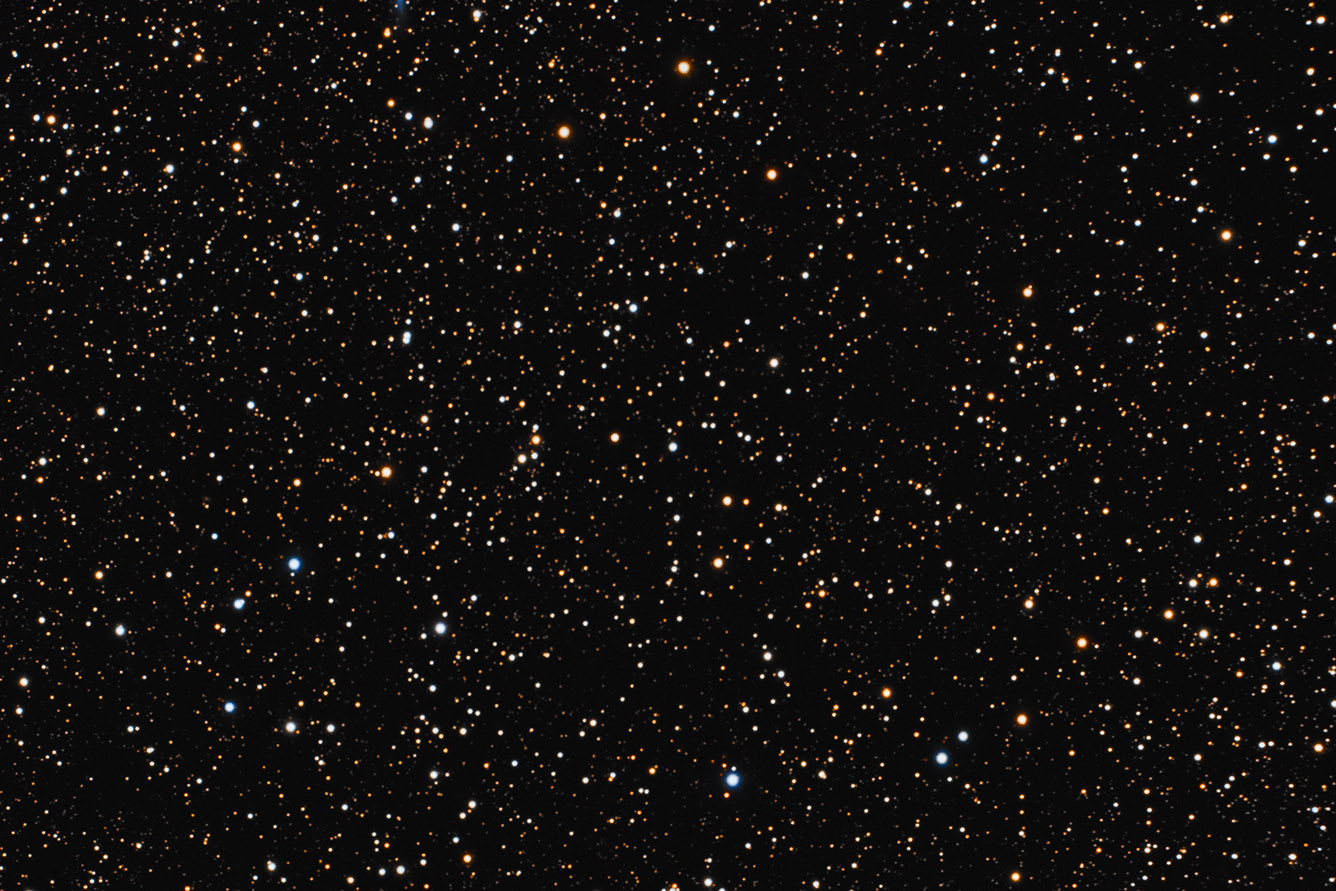
KIC8462852L4X10RGB1X10-67.JPG
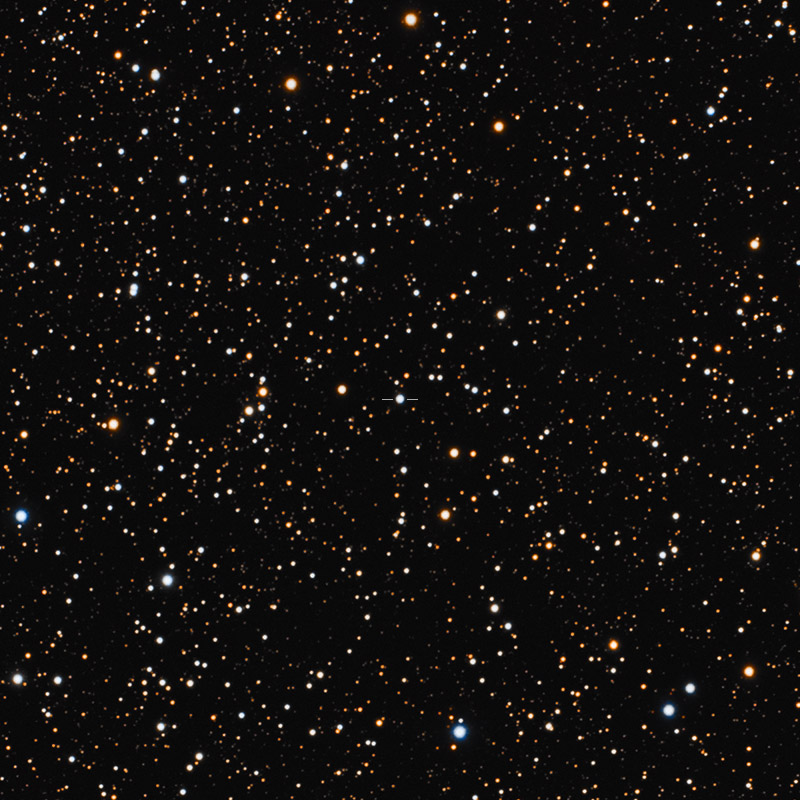
KIC8462852L4X10RGB1X10-67CROP.JPG
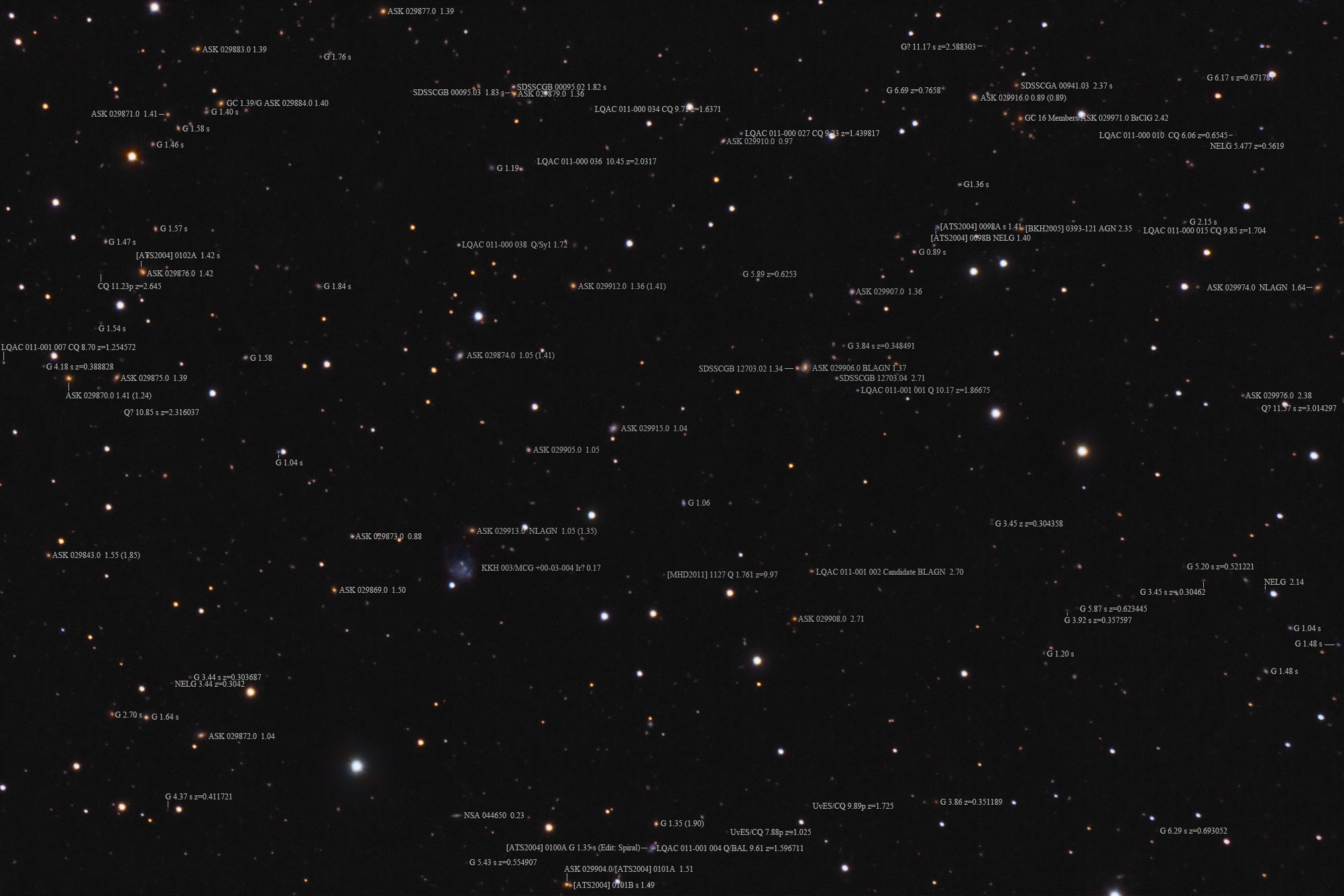
| The messy blue galaxy is kkh 003. NED classifies it as an irregular galaxy but adds a question mark indicating this is, well, questionable. It is located in northwestern Cetus about 170 million light-years distant It contains three blue star clouds almost in a line on its west side. NED refers to these as separate galaxies. Redshift for the upper two is virtually the same as for kkh 003 indicating they are really part of the galaxy. The lowest one has no redshift but I see no reason to assume it too is just a star cloud in the galaxy. It seems to have two faint horns going northeast from either side of the galaxy. I didn't see these in the POSS image I used when deciding to add it to my to-do list. If I had I'd have used more time to help bring them out. I already used twice my normal luminance data but it needs even more. Unfortunately, this one has no research on it other than basic parameters. To me, it looks possible it is the result of a merger. Note that's just possible. It may just be a rather ordinary blue irregular galaxy. One source called it a dwarf irregular. But if you include the faint "horns" it is about 50 thousand light-years in size which is rather large for a typical irregular galaxy, one reason I'm considering it being due to a merger. Another is due to the horns which could be plumes ripped from galaxies it has consumed. Pure conjecture on my part as I found nothing on this anyplace.
The kkh catalog is what the authors, Karachentseva, Karachentsev and Huchtmeier found from the Palomar plates that they interpreted to be rather nearby dwarf galaxies. That would be true of kkh 003 if it were that close but it is nearly 6 times that distance and thus not a dwarf though it sure looks like one. Redshift data for most of these were not available at the time of the catalog so errors like this aren't surprising. While the catalog is named for the authors, NED lists it in lower case so I followed their example.
The annotated image includes all galaxies, quasars and candidate quasars NED had on its site.
14" LX200R @ f/10, L=8x10, RGB=2x10, STL-11000XM, Paramount ME | 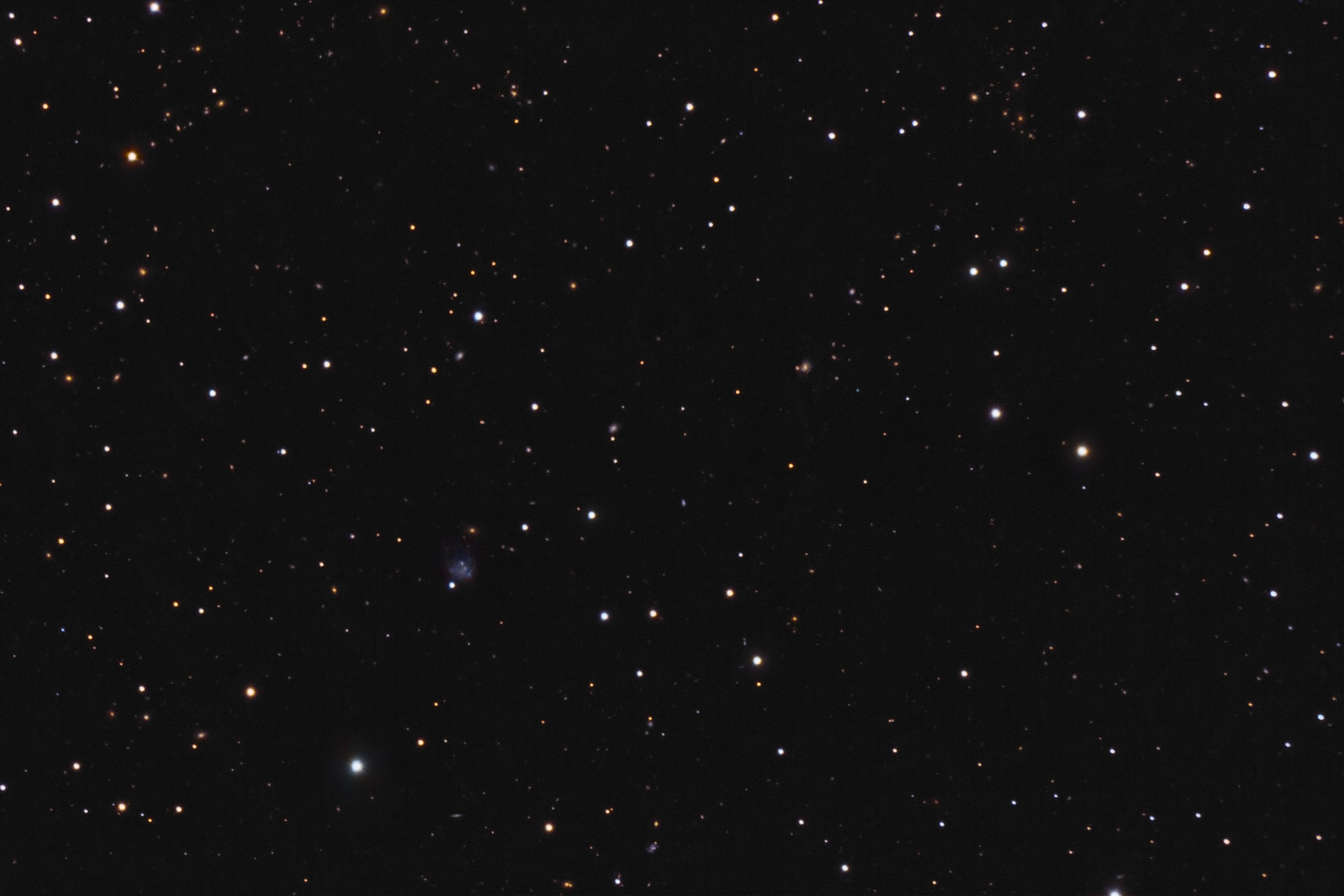
KKH3L8X10RGB2X10.JPG
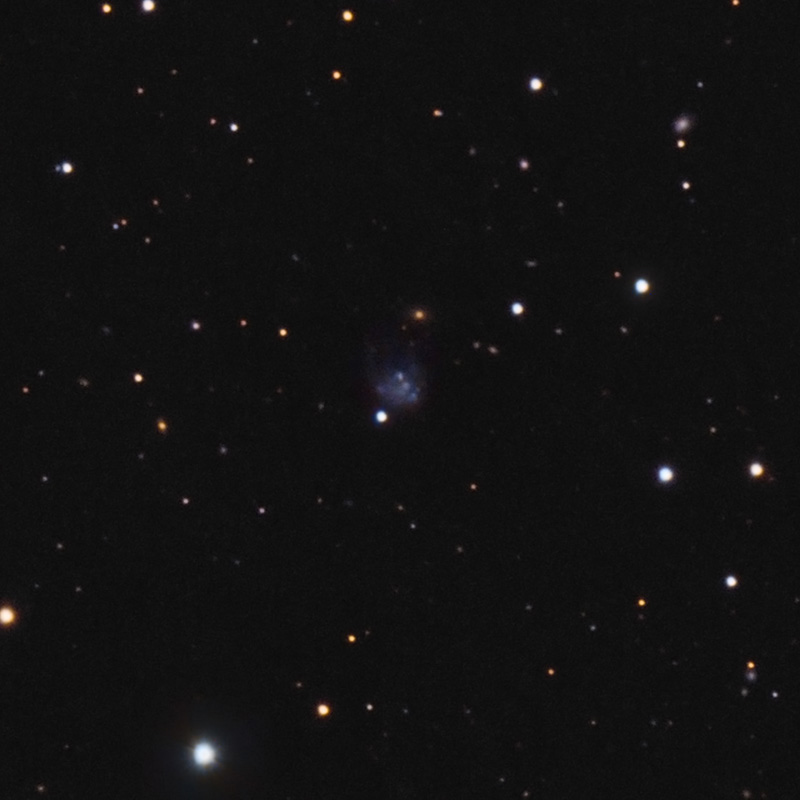
KKH3L8X10RGB2X10CROP125.JPG
KKH3L8X10RGB2X10ID.JPG
| KKH 005 is a low surface brightness, dwarf, irregular galaxy not even recognized as a galaxy until 2001. Most consider it a member of the Maffei/IC342 group though it is located at its very edge. The one paper I found on it ( https://www.aanda.org/articles/aa/pdf/2003/05/aa3077.pdf ) says it "appears to be well resolved into stars." I found a couple HST frames of the galaxy that are quite noisy. Not able to tell the difference between noise and stars I've not tried to process it. The Planetary camera appears to resolve a lot of widely spaced stars and noise specks. The galaxy is nearby and has a blue shift so that is unavailable for a distance estimate. The one paper I found on it calculates a distance of about 14 million light-years based on the tip of the red giant branch. Since the brightness of these stars is thought to be known, by comparing this to the apparent magnitude and accounting for dimming for gas and dust between us and the galaxy, its distance can then be calculated. Usually, I can see stars in galaxies this close but Maffei galaxies are so obscured it isn't surprising I don't see any stars.
Since the galaxy is about 40 arc seconds long it is very small. Assuming the 14 million light-year distance it is only about 2,700 light-years across. A small dwarf indeed.
14" LX200R @ f/10, L=4x10' RGB=2x10', STL-11000XM, Paramount ME | 
KKH005L4X10RGB2X10R.JPG

KKH005L4X10RGB2X10RCROP125.JPG
| KKH 24 is a rather obscured galaxy in northern Cepheus only 4 degrees from the pole and 3.5 degrees from Polaris. It resides in a molecular cloud that looks somewhat like a comet. The "head" is GAL 126.6+24.5 AKA MCLD 126.6+24.5. The smaller and fainter comet-like feature to the upper left of kkh 24 marks the center of LBN 628.
NED says of kkh24 that it is an irregular galaxy about 76 million light-years distant. I found one Ph.D. thesis that covered this galaxy which states the stated redshift of 1706 km/s is very wrong and it really has a redshift of about 5000 kp/s. That puts it some 225 million light-years distant. The thesis says that rather than being an irregular galaxy it is a large spiral. If NED is right it is some 18,000 light-years across, if the thesis is right then it is 53,000 light-years across. I'd not call that a large spiral, just a normal one. In the POSS red and blue plates it does look like an irregular galaxy but in the POSS II IR plate, it shows a classic spiral shape. In my image from the core west (right) it looks very much like a normal spiral at over 200 million light-years. The eastern half is odd looking, likely because it is being hidden by the dust of the molecular cloud we have to look through to see it. The galaxy is quite red in my image. The thesis says its B-V is 0.91 and thus it is very reddened by the molecular cloud. But then it goes on to say: "Attempts to remove the emission of the nebula by fitting the background were unsuccessful, as the nebular emission varies too drastically across the region of the galaxy to interpolate what emission would be superimposed on the galaxy. Therefore, the galaxy colors are contaminated by the presence of the nebula's light." So I'm not sure how that B-V was determined.
The only other galaxy in the image with redshift data at NED is 2MASX J04081574+8540400 in the lower right corner. NED has it at 350 million light-years from us. That's about all it has to say about it. With a field this far north it isn't surprising data is so lacking. Galaxies this far north just aren't common so surveys avoid this area to concentrate on where the pickings are better.
The thesis I'm referring to is "The Stellar Content and Star Formation Rates of Dwarf Irregular Galaxies" by Jacqueline Michelle Dunn who got her Ph.D. from TCU in 2007. https://books.google.com/books?id=J9Dimgwwa-UC&pg=PA8&lpg=PA8&dq=The+Stellar+Content+and+Star+Formation+Rates+of+Dwarf+Irregular+Galaxies&source=bl&ots=aMbSiAk27R&sig=xPZkdgpiPcBDp0K2LW5xFRToatI&hl=en&sa=X&ei=SWMrVffTBc_9gwS0nYPoCQ&ved=0CCkQ6AEwAg#v=onepage&q=The%20Stellar%20Content%20and%20Star%20Formation%20Rates%20of%20Dwarf%20Irregular%20Galaxies&f=false
14" LX200R @ f/10, L=4x10' RGB=2x10', STL-11000XM, Paramount ME | 
KKH24L4X10RGB2X10.JPG
| KKH 037 (MAILYAN 016/LEDA 095597) is the northernmost member of the Maffei group of nearby galaxies. It is located a bit less than 10 degrees from the pole in Camelopardalis. Being so far north it is relatively unobscured compared to most of the group that is further south and very reddened by our galaxy's dust and gas. In this case, it really is a tiny dwarf galaxy. It is part of the group that is about 10 to 11 million light-years from us. I'm going with the greater distance here as that is what two of three Tully Fisher measurements say with the third not significantly closer. NED classifies it as simply an irregular spiral. It seems to have a fairly orderly spiral structure in my image but for the fact it is totally blue. Even the core is blue indicating its light is dominated by young massive and hot stars right into the core. This is likely why it has both a spiral and irregular classification. At the 11 million light-year distance it is only 2,700 light-years across. Really small for a disk galaxy like a spiral but rather common for dwarf irregular galaxies.
I found very little on it. There is an elongated somewhat red object on its northeastern edge (upper left) that a note at NED says is a distant background galaxy. It isn't listed in NED. In fact, only 4 other galaxies are in listed in NED, none with even a magnitude let alone a distance estimate. All are from the 2MASS listing. Therefore no annotated image was prepared. There is a fainter, blue elongated object due east (left) of the core. I assume it is a star cloud in the galaxy. I found no mention of it.
14" LX200R @ f/10, L=4x10' RGB=2x10' STL-11000XM, Paramount ME | 
PGC95597L4X10RGB2X10.JPG

PGC95597L4X10RGB2X10CROP150.JPG
| kkh040 is a small, nearby, blue, irregular, dwarf galaxy. This is exactly what the authors of the catalog intended for their entries, unlike kkh003 which turned out to be neither small or nearby. It is located in central Lynx about 26 to 30 million light-years distant depending on whether you rely on the redshift or tip of the red branch method for determining this. Since redshift can be unreliable at close distances I'll go with the 30 million light-year distance though that is determined from a single measurement which itself can be unreliable. It is only about 6 or 7 thousand light-years across, again depending on which distance estimate you use and what you consider its edges. They are very vague just fading away with no obvious edge.
I had good transparency the night this was taken allowing me to pick up galaxies down to magnitude 22.9 and likely fainter though 22.9 was the faintest NED had magnitude data for. Thus galaxies to over 5 billion light-years out were picked up. See the annotated image for these.
When working near the Zone of Avoidance as I was here galaxy data can be limited. In this case, I listed all NED had distance data for. While kkh040 is a dwarf ASK 477566.0 in the lower left corner is huge. To see spiral structure at over 2.5 billion light-years at my resolution it had to be huge. I measure it as being just under 200,000 light-years in size, 28 times the diameter of kkh040 and likely over 20,000 times its volume.
14" LX200R @ f/10, L=4x10' RGB=2x10', STL-11000XM, Paramount ME | 
KKH040L4X10RGB2X10.JPG

KKH040L4X10RGB2X10CROP125.JPG

KKH040L4X10RGB2X10ID.JPG
| kkh 42 also known as UGC 4129 is a double galaxy in northern Cepheus less than 4 degrees from the pole only 84 million light-years away by redshift. It's two components are MCG +14-04-044 and MCG +14-04-045. I find very little on this system. It appears the two are interacting but whether they will merge or not I don't know. The system, including the plumes, is only some 26,000 light-years across so they are dwarf systems. Is the blue color due to massive star formation due to their interaction or were they blue before that happened? Lots of questions but no answers that I could find. I don't even know how it came to my attention. I never noted that in my notes. It certainly would have fit any of several of Arp's categories yet it isn't on my Arp-like list. I can't understand why it wasn't there.
Being so close to the pole there's little information on the field. Only this galaxy has redshift data at NED. NED only lists a handful of galaxies for the field, all of which are on the annotated image as without listing them there'd be no need for the listing. NED does list over 500 Ultraviolet Sources in the field, some of which are galaxies but the vast majority are just stars. The couple NED did also list as galaxies are in the annotated image with a Galex label. What few other galaxies I checked specifically aren't listed at NED under any category.
Like many of my images, this spring clouds moved in necessitating three different nights of images. to get the 10 usable ones I used. One night cleared suddenly not giving me time to properly cool the scope but it was the night of best seeing so three of those frames were used for the Luminance channel even with the tube currents. They add a little blob to the west side of bright stars, especially on the eastern half of the image. Why the problem faded on the western side I don't understand.
14" LX200R @ f/10, L=4x10' RGB=2x10', STL-11000XM, Paramount ME | 
KKH42L410RGB2X10.JPG

KKH42L410RGB2X10CROP125.JPG

KKH42L410RGB2X10ID.JPG
| The nearby irregular galaxy kkh 58 is located in north central Leo Minor. Its redshift puts it 39 million light-years distant but a paper listing LVGs (Local Volume Galaxies) gives a Tully Fisher measurement of 48 million light-years while NED cites a single Tully Fisher measurement of 60 million light-years. Agreement seems hard to come by here. The kkh galaxy catalog stands for Karachentseva+Karachentsev+Huchtmeier. Since those are names I'd expect it to be KKH, not kkh. But NED always uses lower case for this particular catalog though I find papers on galaxies from this catalog are divided about half and half whether to capitalize the kkh or not. Again agreement seems hard to come by.
The galaxy has several faint star clouds and one very bright one. At first, it might appear to be an off-center galaxy core but that's not the case. It is just a huge star cloud in an otherwise common irregular galaxy. Its size based on its redshift would be about 16,000 light-years. The two Tully Fisher measurements give 20 and 25 thousand light-years for its major axis as seen from our perspective.
I found no images of it but for Sloan and POSS survey images. I left no note as to what drew my attention to it. After searching I still can't find what it was that drew my interest to it. I usually note that in my to-do listing but failed to do so for this one.
The annotated image is rather sparse as few galaxies had redshift data at NED. Many weren't listed there at all. I was especially interested in a pair of possible interacting galaxies to the northwest of kkh 58. Only the eastern galaxy was listed at NED and that without any redshift data. I did annotate it with its Sloan Survey designation (only coordinates) and a question mark for its possible companion. Many of the galaxies and all quasars with redshift data were listed only by their coordinates so I used just a G, Q or UvES for a label for those as the coordinate designations are quite long and tell little. UvES stands for Ultraviolet Excess Source and in this case designates a quasar candidate. Since a star can sometimes fool a photographic redshift determination these remain, candidates, until better data is available including a spectroscopic redshift.
For an object I can't recall why I imaged it in the first place, I spent an inordinate amount of time trying to capture it. Clouds kept ruining the attempts. I wasted many hours over a 4 month period trying to get usable data. Nearly all of it was thrown out as of very low signal to noise ratio and often of extremely poor seeing as well. I finally used 6 luminance frames taken over 3 of the nights but the color frames all came from my final attempt on March 24, a night of poor seeing so no luminance frames came from that night. Oddly, not one of the many frames picked up an asteroid though with so little data from any one night the trail would be hard to see if there had been one.
14" LX200R @ f/10, L=6x10' RGB=2x10', STL-11000XM, Paramount ME Related Designations for KKH058KUG 1004+392, CGCG 211-011, CGCG 1004.3+3913, MCG +07-21-010, SDSS J100722.72+385810.6, SDSS J100722.72+385810.7, ASK 339908.0, kkh 058, PGC 029431, UZC J100722.9+385809, 11HUGS 188, KKH058, | 
KKH58L6X10RGB2X10.JPG

KKH58L6X10RGB2X10CROP150.JPG

KKH58L6X10RGB2X10ID.JPG
| This field is located in northeastern Virgo very near the border with Bootes. It contains two objects I had on my to-do list. FGC 179A a flat galaxy, about 73,000 light-years across. For some reason, NED shows it as an irregular Magellanic galaxy rather than an edge on spiral. It does seem not to have a dust lane. It's companion in distance anyway, kkh 84 a very blue irregular galaxy that looks like a dwarf but is a bit large for one at 30,000 light-years. It is just classified as an irregular galaxy. Both are 70 million light-years distant by their redshift so likely part of the same group. Unfortunately, I found very little on either of these galaxies. Both have a rather low surface brightness.
To make the Flat Galaxy Catalog the galaxy must be at least 40" of arc long and have a length to width ratio of at least 7:1. In most galaxy catalogs when a letter is appended to the number it means the galaxy is very nearby its namesake in angular distance. They may actually lie millions of light years apart in three dimensions. But with the FGC this isn't the case. In fact, FGC 189 lies almost exactly 180 degrees opposite FGC 189A in Right Ascension. So how they determine this number/letter system is a mystery to me. If someone out there knows let me know and I'll pass it on. I have to admit I've not had time to delve into this very deeply. Flat galaxies have little to no central bulge. Studies are showing that the size of a galaxies massive central black hole is proportional to the size of the bulge. Big bulge -- big black hole. That would indicate the galaxies in the FGC are all harboring unusually small black holes for the size of the disk.
The field happened to contain 3 asteroids and an assortment of very distant galaxies along with even more distant quasars and one candidate quasar (CQ) that is very faint. Its redshift has been determined only photographically. These can be wrong so until it has been verified with a spectroscope it will remain a candidate quasar. Too many times I've seen these turn out to be very nearby blue stars in our neighborhood of our galaxy.
14" LX200R @ f/10, L=4x10' RGB=2x10', STL-11000XM, Paramount ME
Related Designations for KKH084CGCG 073-036, CGCG 1332.0+0904, MCG +02-35-003, SDSS J133437.78+084736.9, SDSS J133437.79+084737.0, WBL 455-003, USGC U552 NED05, SDSSCGB 12018.01, AGC 230436, ASK 452633.0, kkh 084, MAPS-NGP O_499_0332590, NSA 170911, PGC 047826, UZC J133438.0+084741, WVFSCC J133449+084436, ALFALFA 3-536, KKH084, | 
KKH84L4X10RGB2X10.JPG

KKH84L4X10RGB2X10ID.JPG
| The tiny galaxy kkh 87 is a probable dwarf member of the M101 galaxy group located about 19 to 23 million light-years distant. Some sources don't list it as a member but many do. I'm going to side with those that do include it as a member. I'll split the difference and say 21 million which is a good match for M81. Their angular separation of 3.2 degrees would then be a separation of 1.2 million light-years. It's size is about 5400 light years making it a rather small dwarf galaxy. A note at NED however says it might be two saying "North and south portions are possibly separated forming a pair." It does show an odd kink in the middle though it has a blue star cloud right at its core assuming it is one galaxy or at the north end of one of two galaxies if considered two galaxies or is that at the south end if it is a member of the northern galaxy. I prefer only one galaxy. The apparent blue cloud at the top right is actually a background galaxy. The orange object at the very top on the left is a star in our galaxy seen against the dwarf. I've included a crude HST image of this galaxy that easily resolves its stars. I see nothing in it to indicate this is two galaxies.
The annotated image shows all galaxies and quasars listed at NED with a redshift. Galaxies and quasars whose only designations are its position are listed only as G or Q. NED lists many galaxy clusters in this field but with such a large error bar and no central galaxy I had no way of pointing them out. There were some very faint possible galaxies at the center of one of the cluster's position so I did mark it though the error circle is so large I could be wrong.
This was taken partly the same night as my previous post of NGC 4939 and mostly the next night. Fortunately this one was near the zenith rather than low to the horizon so I was looking through far less gunk. Still seeing was poor for it, just that the background was only 4 times normal for the worst frames rather than 10 so it does go considerably deeper. Still it is a good magnitude shy of what I normally can achieve under average conditions. I'm much more confident in the color accuracy of this one as well. It uses 8 luminance frames which helped some to get back to my normal depth but still fell somewhat short. Some of the color data was obtained in dawn's glow thanks to my short nights in June. I'm learning to compensate for that however.
14" LX200R @ f/10, L=8x10' RGB=2x10', STL-11000XM, Paramount ME | 
KKH87L8X10RGB2X10.JPG

KKH87L8X10RGB2X10CROP125.JPG

KKH87L8X10RGB2X10ID.JPG

KKH87R_HST.JPG
|